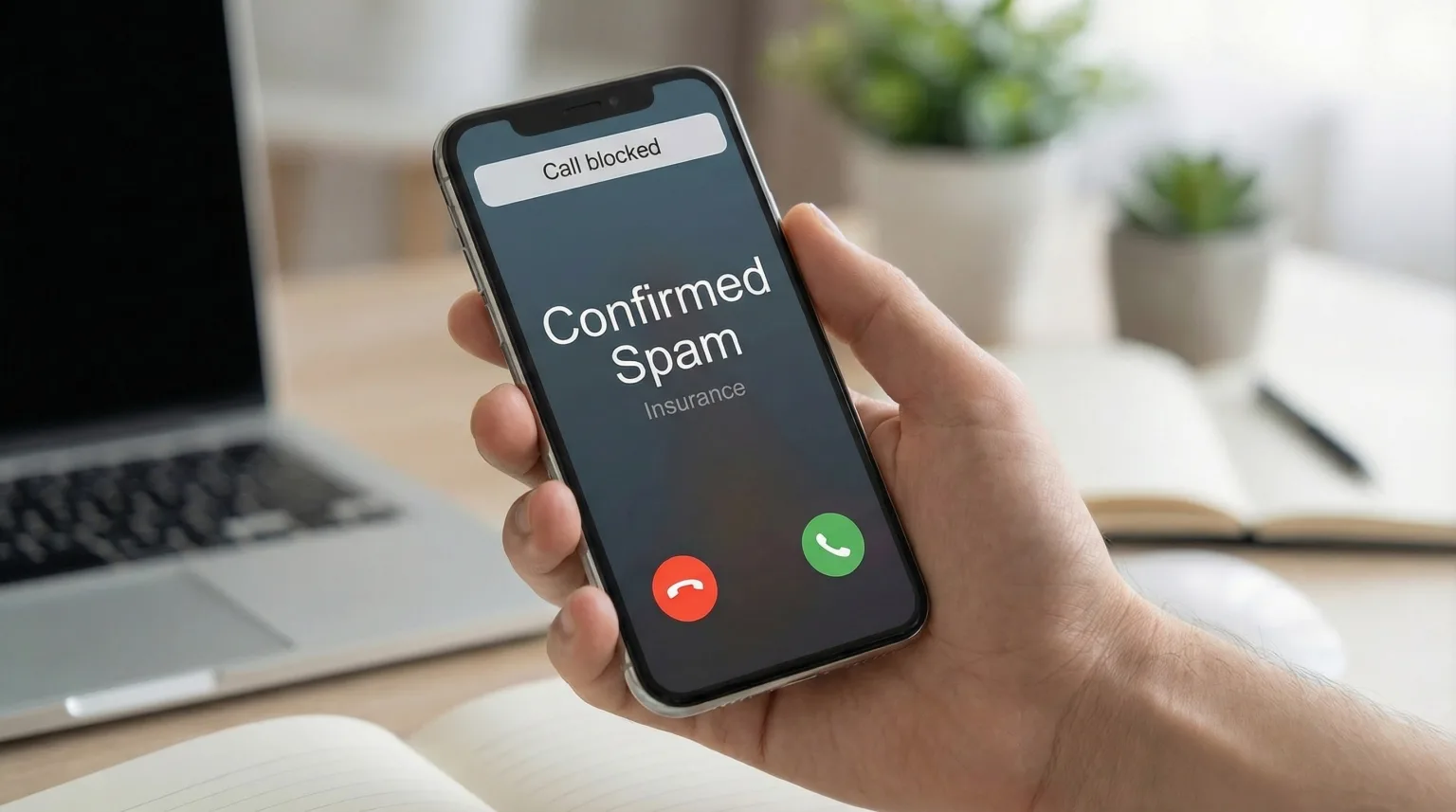
“This is about your health insurance, your rates are going to increase…”
You pick up. By reflex. By fatigue. By conditioning.
And you feel the trap instantly: these calls don’t just steal time. They steal your ability to decide.
Every unknown number triggers a survival scan:
- “Is this important?”
- “What if it’s urgent?”
- “What if I’m missing something?”
In my book (chapter 6), I show how a simple framing bias can trap the brain in seconds. Spammers do the same thing at industrial scale: they frame your attention, then they capture it.
Good news: you can take control back. Not only over calls—over the mental load they inject into your day.
1) The golden rule: stop playing the unknown-number game
The strongest lever isn’t technology. It’s behavioral:
- Never call back an unknown missed call without a credible voicemail.
- Let voicemail do the sorting: legitimate calls leave usable evidence.
- Kill the reflex: an unexpected call has no default priority.
Goal: reduce the cognitive cost to zero. Your phone rings, your brain doesn’t go into alert mode.
2) Turn on built-in filters (they’re better than they used to be)
iPhone: reduce noise
Apple provides options to manage unknown callers (screening/silencing and dedicated lists; sometimes carrier-based spam filters). (Apple Support)
Android: caller ID + spam protection
Google provides “Caller ID & spam protection” and simple flows to report/block numbers, improving detection over time. (Google Support)
These features matter because they remove daily micro-decisions. Fewer micro-decisions = more clarity.
3) Add a “firewall”: Truecaller, Saracroche, and the database approach
Your “counter-spell” framing is accurate.
Truecaller (global approach)
Truecaller focuses on caller identification and spam blocking/auto-blocking features. (Truecaller)
Saracroche (France-focused: ARCEP ranges + reports)
Saracroche highlights large-scale blocking using regulated numbering ranges plus user reports, and adds SMS filtering in newer versions. (App Store / Google Play, CommentÇaMarche, ARCEP)
Key point: these apps don’t just save time. They make you unreachable to noise, therefore unreachable to manipulation.
4) Cut it at the source: opt-out lists, reporting, rules
Technology alone isn’t enough: you also want to dry up the system.
- France: opposition to phone canvassing (e.g., Bloctel) and practical steps. (CNIL, Bloctel)
- Understand dedicated numbering ranges for canvassing and how they’re structured. (ARCEP)
- Outside France: similar “Do Not Call” mechanisms and regulators’ practical guidance exist. (FCC, FTC)
Even if enforcement is imperfect, these tools change your position: from isolated target to system-level signal.
5) The real target: your attention (therefore your strategy)
Blocking calls isn’t the finish line.
The real issue is regaining control over your nervous system—your focus—your day.
Because attention has become a strategic asset.
And innovation often starts with a radical move: subtraction. Cutting the noise.
👉 Mirror question: what is the newest form of pollution you should block to regain clarity? Yes—meeting overload is one.
References
(Apple Support) = https://support.apple.com/en-us/111106
(Google Support) = https://support.google.com/phoneapp/answer/3459196
(Truecaller) = https://www.truecaller.com/spam-blocking
(App Store) = https://apps.apple.com/be/app/saracroche-bloqueur-dappels/id6743679292
(Google Play) = https://play.google.com/store/apps/details?id=com.cbouvat.android.saracroche
(CommentÇaMarche) = https://www.commentcamarche.net/applis-sites/applications/37077-nouvelle-version-saracroche-avec-filtrage-de-sms/
(ARCEP) = https://www.arcep.fr/la-regulation/grands-dossiers-thematiques-transverses/la-numerotation.html
(CNIL) = https://www.cnil.fr/fr/plainte/telephonie/ne-plus-etre-demarche-par-telephone
(Bloctel) = https://www.bloctel.gouv.fr
(FCC) = https://www.fcc.gov/consumers/guides/stop-unwanted-robocalls-and-texts
(FTC) = https://consumer.ftc.gov/features/how-stop-unwanted-calls