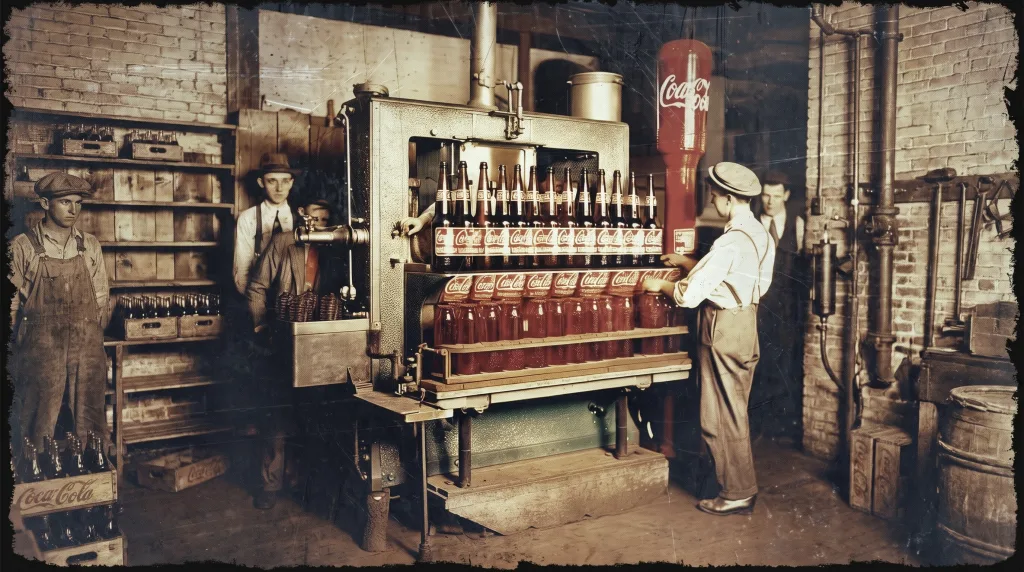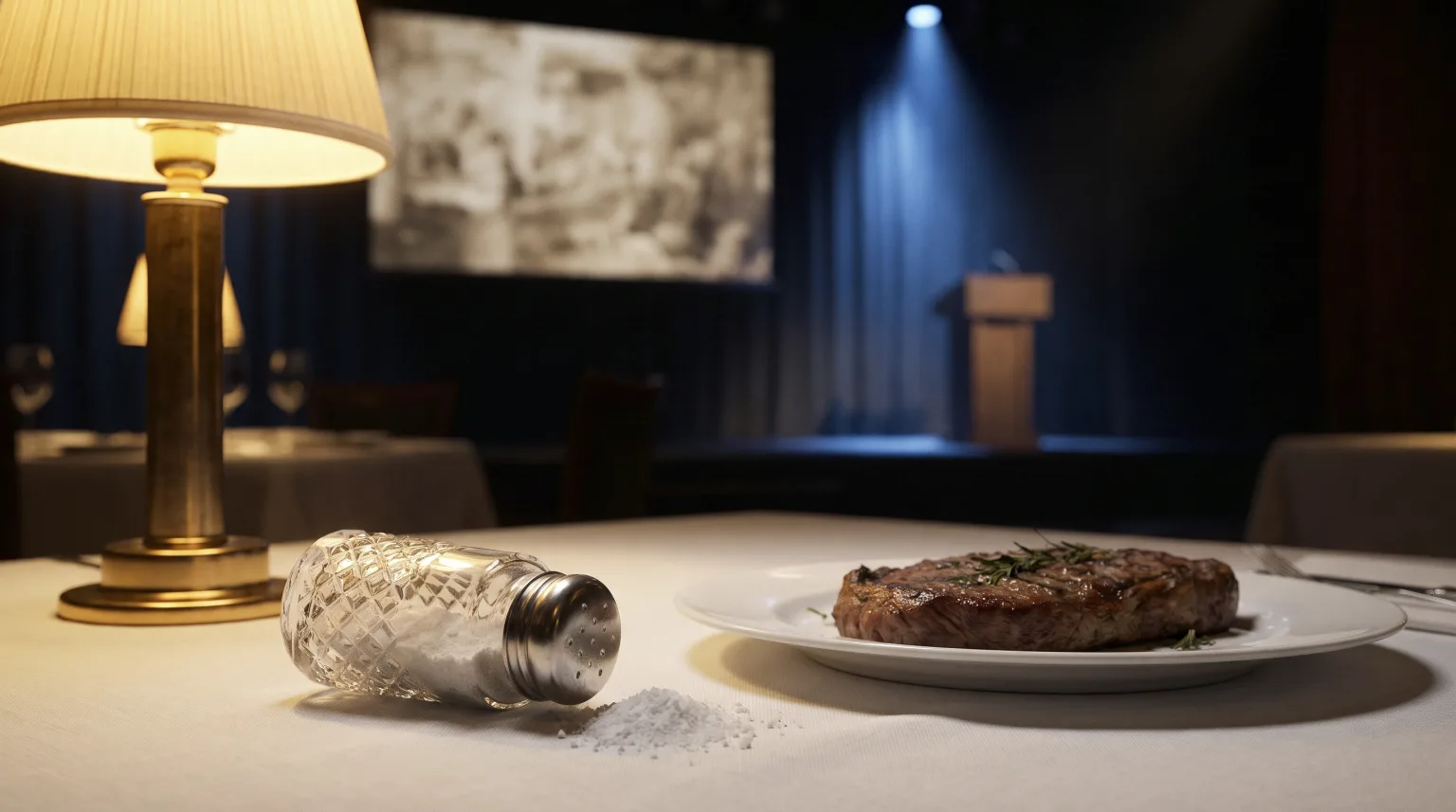
A restaurant. White tablecloths, polished silverware. Henry Ford has invited two young engineers to dinner. Same degree, same grades, same references. The steaks arrive.
The first candidate tastes, then salts. The second salts first and tastes afterwards. The first thanks the waiter who fills his glass. The second does not even look at him.
At dessert, Ford decides. The first one gets the job.
“Mr. Ford, we never talked about engineering. Why him?”
You know the rest. It circulates on LinkedIn, in business schools and in a remarkable number of leadership keynotes, told with emotion and applauded by entire rooms.
Notice one detail: this story has no date and no address. There is a simple reason for that. The dinner never happened.
One dinner, four heroes
The fact-checking site Snopes looked into the story. It found the same scene attributed to Thomas Edison, Henry Ford, J.C. Penney, founder of the department store chain bearing his name, and Admiral Hyman Rickover, father of the US nuclear navy (Snopes). Four men, four eras, one meal.
In the Edison version, the steak becomes a bowl of soup. The candidate who salts before tasting is accused of deciding on assumptions instead of collecting data. The Thomas Edison Birthplace Museum in Ohio itself files this story under legend (Thomas Edison Birthplace Museum). Menlo Innovations traced it back: the only written trace points to an anecdote attributed to the actor Paul Muni, born in 1895, who was very unlikely to have met Edison in a hiring context (Menlo Innovations).
When the hero changes with the audience, the story tells you about the teller and very little about history. The speaker who wants a symbol of innovation picks Edison. For industry, Ford. For military discipline, Rickover. The character adapts to the moral, and that is the signature of a fable.
The salt test, applied to the speaker
Here is the irony I enjoy most. The moral of this legend fits in one sentence: taste before you salt, check before you judge. The speaker who tells it without checking does exactly what the fable condemns. He salts before tasting.
And he is not alone at the table. In January 2025, Fortune reported that the “salt and pepper test” was resurfacing on social media, to the point where people now advise candidates invited to an interview dinner to taste their food before seasoning it (Fortune). The legend has left the stage and become career advice. People change their real behavior based on an invented story.
This shift has a well-documented mechanism. In 2015, Lisa Fazio and her colleagues showed in the Journal of Experimental Psychology that repeated statements seem more true, even when participants know the correct answer. The researchers called this knowledge neglect: faced with a sentence that is easy to process, we forget to consult what we already know (PubMed). A later study by the same team found the effect in 5- and 10-year-old children as well as in adults, with prior knowledge offering no protection (Vanderbilt University).
Translated for the stage: every speaker who repeats the Ford legend makes it a little more believable for the next audience. The audience does not check. It paid someone to check on its behalf.
The real Henry Ford, less photogenic
The most frustrating part is that reality offers far richer material than the fable.
By late 1913, Ford’s workers disliked the new assembly line so much that labor turnover reached 380% (The Henry Ford). On January 5, 1914, Ford announced the Five-Dollar Day: five dollars for eight hours of work, compared with $2.34 for nine hours before (The Henry Ford). Part of that amount was a profit-sharing bonus, paid only to employees who met the conditions set by the company.
To enforce those conditions, Ford created a Sociological Department. Its investigators visited workers’ homes and checked their bank deposits, their children’s school attendance and even divorce filings (The Henry Ford). Employees came to resent this intrusion into their private lives, and by 1921 the department was largely dissolved (The Henry Ford).
That is how the real Henry Ford assessed his employees’ character: with inspectors in workers’ kitchens. No salt shaker in the archives. That story raises uncomfortable, and useful, questions for any leader today. How far can a company go to make sure its people “deserve” their pay? What do our productivity-tracking tools and hiring algorithms say about this century-old temptation?
Edison also left a real trace of his methods. In 1921, he gave candidates a general-knowledge questionnaire of about 140 questions. Of 718 applicants, only 32 reached the 90% score he wanted (Mental Floss). The New York Times published the questions, and the controversy spread across the country. A questionable test in many ways, but documented and verifiable, and revealing of Edison’s obsession with general knowledge.
The legend gives you a comfortable moral. Reality gives you a debate.
The waiter: a real rule with a twisted history
The second half of the anecdote, respect for staff, rests on firmer ground. The “Waiter Rule” exists. It was popularized by a USA Today article published on April 14, 2006, in which several CEOs explained that they judge candidates by how they treat service staff (Wikipedia). It was one of the 33 management rules published by Bill Swanson, then CEO of Raytheon, and echoed a line by the humorist Dave Barry (Wikipedia).
Swanson’s booklet later became the center of a plagiarism story, and Raytheon stopped distributing it (Silicon Canals). As for the rule’s predictive value, no study has validated it as a hiring tool: it remains an executive heuristic supported by anecdotes (Silicon Canals). A candidate who knows the rule can perform kindness for the length of a lunch.
Let me reassure you: watching how someone treats a waiter strikes me as an excellent idea, as one clue among others. I simply refuse to turn it into a historical fact attributed to Ford, or into a scientific method it has never been. A speaker has the right to defend an intuition. He has the duty to present it as an intuition.
What the stage taught me
I am not speaking from a pedestal. One of my first talks in front of a large audience was a fiasco. In 1992, at Apple’s WWDC, I tried to imitate the American speakers and open with a self-deprecating joke about the French. Total silence. Leaving the stage, I promised myself I would never speak in public again (My book, chapter 15).

A few years later, between 1996 and 1997, I attended Apple keynote rehearsals in Cupertino. The speakers, Steve Jobs included, tested content and delivery in front of an internal audience, with communication consultants, until every sentence held. There I measured the gap between that discipline and the improvisation I practiced.
Since then, I apply to my keynotes what I apply to innovation: experimentation and measurement. I test something new at almost every talk, I drop what does not work, and my opening experiment took three years to mature. A segment stays in my library once it has proven itself in front of real audiences.
There is a deeper reason to tell your own lived experience. When the person presenting is not a professional actor, the story must be their own and fully authentic: their emotions will show, and they will reach the room (My book, chapter 10). Bert Decker put it this way: people buy on emotion and justify with facts. The myth teller gets the emotion. He cannot supply the facts.
And the day an attendee pulls out a phone and types “Henry Ford salt test myth”, trust collapses. First the trust placed in the anecdote, then the trust placed in everything else in the talk.
Three questions to unmask a myth teller
Whether you are an event organizer, a communications director or a speaker yourself, ask these questions before approving a story.
Where does it come from? A serious historical anecdote has a source: a biography, an archive, a dated testimony. If the only source is “everyone tells it”, you are probably holding a legend.
Does the hero change between versions? If the same scene circulates with Edison, Ford or an anonymous CEO, the story is a parable. You can use it, as long as you announce it as one: “The story goes”, “This fable has been around for decades”.
Did the speaker live it? A personal experience, however modest, has a value no legend can reach: the person speaking can answer for it and take questions. Ask a speaker what they have personally tested, measured, failed at. The answer will tell you whether they share lived experience or recite a collection of quotes found online.
A small exercise to finish. Rate your own rigor from 0 to 5: how many times have you repeated an inspiring story in a meeting without checking where it came from? I am not always at 5 myself. Nobody is. A speaker paid to enlighten a room still has no right to settle for that.
The essentials
Remember three things:
- Henry Ford’s dinner and Edison’s bowl of soup are legends: the same scene circulates with at least four different heroes, with no source from the period.
- Repetition makes a story believable, even to people who know it is false. Every speaker who repeats it without checking feeds the illusion.
- Documented reality, from the Five-Dollar Day to the Sociological Department, offers richer and more uncomfortable insights than the fable.
A speaker who relies on lived experience and verified facts can be wrong, and will tell you so. A myth teller has already salted your steak before you tasted it. It is up to you to choose who goes on stage. Innovate or agonize, the choice is up to you!



References
- (My book) https://philippeboulanger.com/book/
- (Snopes) https://www.snopes.com/fact-check/movers-and-salt-shakers/
- (Thomas Edison Birthplace Museum) https://www.tomedison.org/blog/unveiling-edisons-favorite-fuels
- (Menlo Innovations) https://menloinnovations.com/stories/menlo-bits/march-2022-menlo-bits
- (Fortune) https://www.fortune.com/2025/01/22/have-a-job-interview-over-lunch-beware-of-the-secret-salt-pepper-and-hot-sauce-test-that-could-cost-you-the-role
- (PubMed) https://pubmed.ncbi.nlm.nih.gov/26301795/
- (Vanderbilt University) https://news.vanderbilt.edu/2020/10/06/study-shows-that-repeated-statements-are-more-often-judged-to-be-true-regardless-of-a-persons-age-or-prior-knowledge/
- (The Henry Ford) https://www.thehenryford.org/collections/explore/articles/fords-five-dollar-day
- (The Henry Ford) https://www.thehenryford.org/collections/explore/sets/detail/henry-ford-sociological-department
- (Mental Floss) https://www.mentalfloss.com/history/thomas-edisons-impossible-employment-test
- (Wikipedia) https://en.wikipedia.org/wiki/Waiter_Rule
- (Silicon Canals) https://siliconcanals.com/t-waiter-rule-hiring-character-power-status/