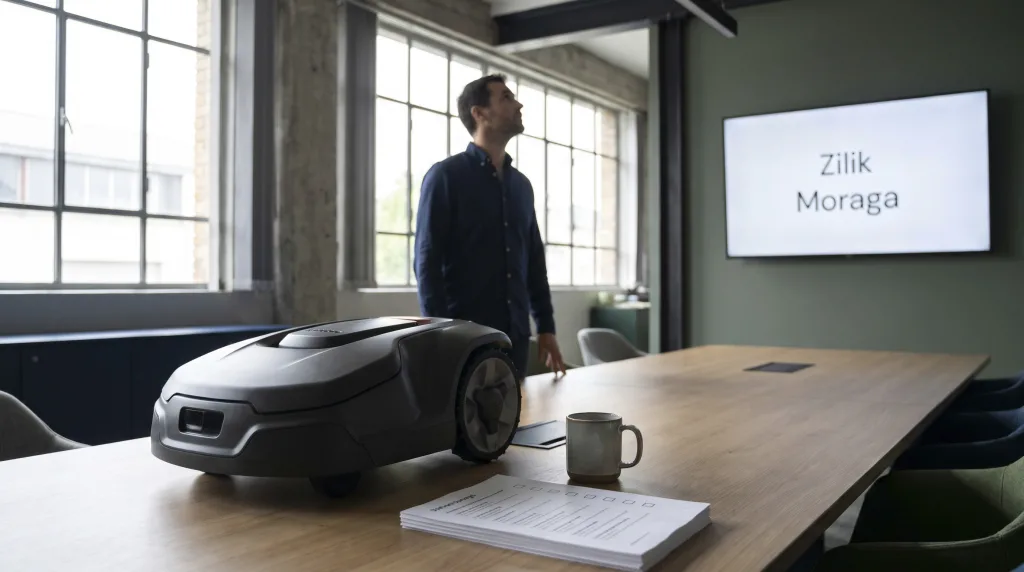
Tuesday, 8:40 a.m., in the communications office of a town hall in France’s Rhône valley. Nathan has set his coffee down next to the half-marathon route map. In three weeks, two thousand runners will cross the town center, and he has promised the mayor a video “like on TV.”
On the phone, the drone pilot he contacted stays polite, but he gives no ground.
“Over the runners, I can’t. Over the crowd, I can’t either. I can film the start from the parking lot, from a distance.”
“From a distance? I want to see the sweat.”
“Then you need a specific authorization, a risk assessment and lead time. And a drone over the market square at 8 a.m. on a Sunday, I’ll let you picture the neighbors.”
“Then find me a drone that’s allowed.”
Nathan hangs up, opens his browser and types “drone allowed over crowds.” He will spend the morning looking for a better drone.
He will not once ask himself whether he needs to fly.
The trap is called framing
Nathan has a need: a moving shot, close to the effort, that travels with a runner. Without noticing, he translated it into a solution: a drone. From then on, every obstacle becomes a drone problem. Too noisy, too regulated, too far away. He is optimizing the wrong variable.
This is the framing bias. The way a problem is presented to you, or the way you present it to yourself, decides the answer before you have thought about it. Your System 1 links “filming on the move” to “drone” in a split second, and your System 2, slower and hungrier for energy, never wakes up to object. I run this experiment live during my keynotes, and the room is often stunned by the result (My book, chapter 6).

A drone is an answer. Your need is a question. As long as you confuse the two, you innovate inside a box you built yourself, and then you wonder why you keep hitting the walls.
A robot that rolls where drones can’t fly
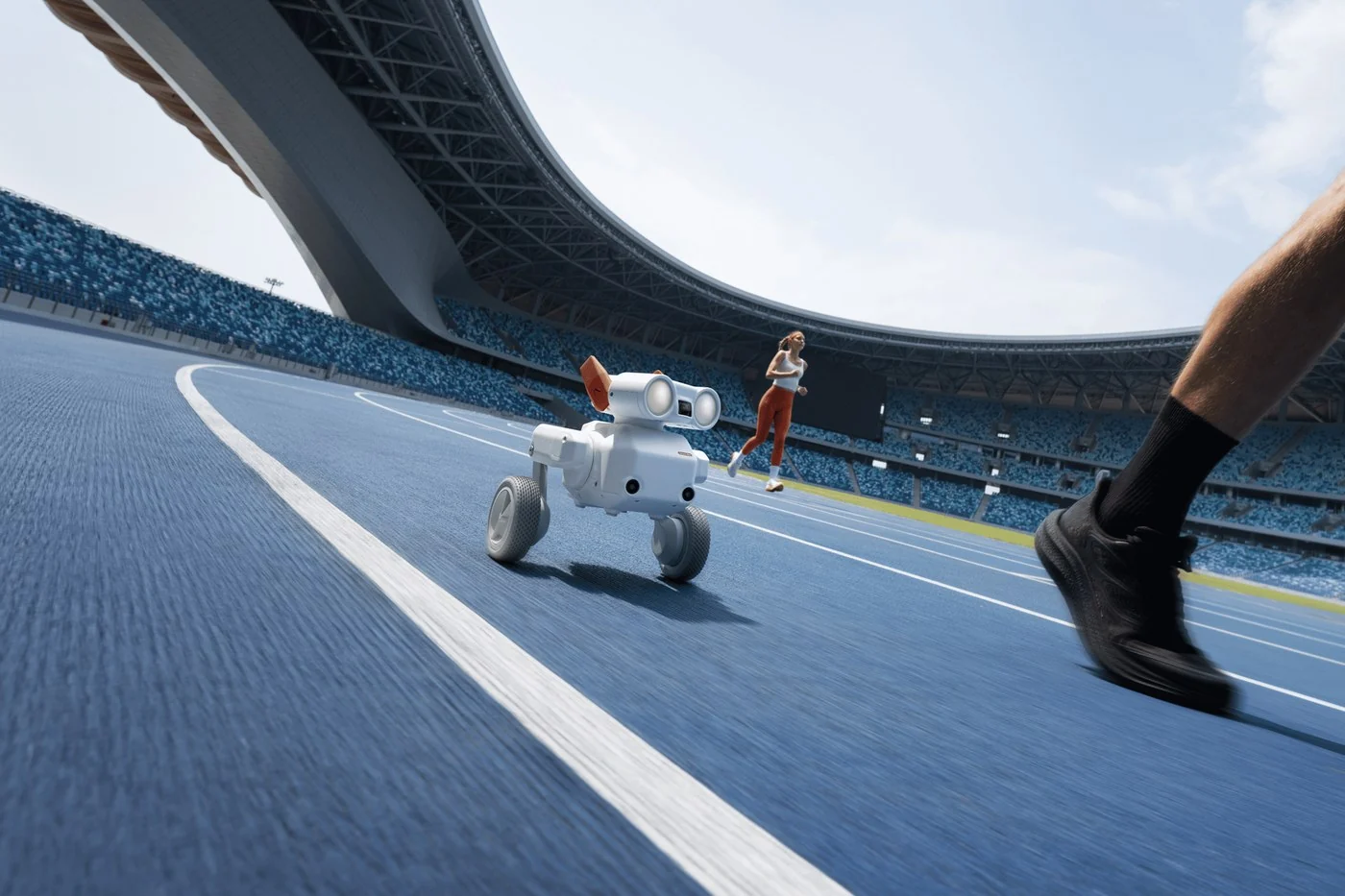
Mondo Robotics has just put Beni on sale, a wheeled camera robot that follows its user and films in 4K. It does not fly. It rolls beside you on two legs ending in wheels, clears steps and curbs up to 25.4 cm (10 inches), reaches 28.8 km/h (17.9 mph) and rights itself when it falls (Phototrend).
On the imaging side, the sensor is 1/1.3-inch and video goes up to 4K 60p with 10-bit recording. The removable battery lasts about 90 minutes, and the whole unit weighs 1.8 kg. The robot recognizes humans and dogs, and can follow you from behind, from the front, from the side or by circling around you (Phototrend).
After a Kickstarter campaign launched in July, Mondo Robotics shipped more than 5,000 robots to backers in October, then opened direct sales on November 10 at $799 (PetaPixel).
The most interesting detail is elsewhere. The company, founded in 2025 and based in Hong Kong, claims about 150 engineers and designers between Shenzhen and Palo Alto, with a team partly drawn from DJI. And DJI filed a patent for a ground drone in 2020 that never went anywhere. Phototrend suggests Mondo Robotics may have picked up that concept (Phototrend).
Read that paragraph again. Engineers who came through the company that dominates consumer drones built a product that doesn’t fly. I have no proof of a direct link to that patent, and I won’t invent one. But the pattern is familiar: an idea sleeping in a market leader’s drawer often wakes up somewhere else, with someone who has no air fleet to protect.
What European rules actually say
Let’s be precise: no European rule bans drones outright. In the “open” category, the one for leisure and low-risk commercial use, you are generally not allowed to fly over people who are not involved in your activity, such as pedestrians or drivers (EASA). To go further, you have to move into more demanding categories, with authorization and risk analysis.
EU Regulation 2019/947 also addresses noise, in black and white. It calls for drone noise and emissions to be minimized as far as possible, and points to maximum noise levels for drones operated close to people in the open category, with a stated goal: making them socially acceptable (EASA).
In other words, the lawmakers themselves identified the two weak spots of drones in town. They fly over people, and you can hear them. Nathan’s pilot was right on every count.
Silent? An assumption to kill
It is tempting to present Beni as the silent solution. I won’t. Phototrend’s review does not mention its noise level, and I found no published measurement. You can assume that a wheeled robot disturbs people less than a propeller-driven quadcopter. An assumption is still an assumption.
And assumptions are highly dangerous. You have to kill them with experimentation, as early as possible. In France, people talk about “trial and error”; in English-speaking countries, they say “test and learn.” The difference in mindset is fundamental, because one puts the stress on the error and the other on the learning (My book, chapter 12).
If Nathan wanted to test the idea, all he would need is a sound-meter app, a Saturday morning on the market square and ten minutes of filming. Cost of the experiment: next to nothing. Cost of a false belief: a residents’ petition on race day.
Changing dimension moves the constraints
The ground has its own rules. Phototrend calls Beni’s legal status on public roads unclear: a 1.8 kg machine moving at nearly 29 km/h on a sidewalk raises a real safety question, and the author recommends parks, skateparks and private land instead (Phototrend).
Then there is the viewing angle. About 20 cm off the ground, the robot films from below. With a child, a dog or a skater, the effect is spectacular. With an adult portrait, it is unflattering (Phototrend). PetaPixel puts it simply: Beni will mostly be pointing up at its subjects (PetaPixel).
It is not waterproof, and its maker advises against using it in heavy rain (The Gadgeteer).
For Nathan’s half-marathon, the list of unknowns grows: two thousand runners, a crowd on the sidewalks, autumn weather. The robot may not be the right answer. It still did something valuable: it broke the frame. Once you have seen a camera that rolls, you can no longer believe that “filming on the move” means “flying.” Options appear on their own: an e-bike with a gimbal, a camera worn by a volunteer runner, a robot on the pedestrian stretch of the course.
An innovation that gets around a constraint trades one set of obstacles for another. Your job is to pick the set your organization can handle.
What Aibo taught me
Yanko Design presents Beni as what Sony’s Aibo grew up to be (Yanko Design). You can imagine my smile when I read that comparison.
The same article makes a point I agree with: emotional attachment decides how often a device leaves the house. A robot you like, you take outside. A robot that reads like a spec sheet stays in a drawer (Yanko Design).
Beni nods, changes the color of its eyes and shows expressions (Phototrend). Hardcore engineers will roll their eyes. They would be wrong to do so too quickly, because the product that wins is the one people use, and people use what they love.
My career also taught me to distrust my own enthusiasm. Our past success can be our greatest enemy, and a product that makes people smile in a demo proves nothing in the field. Mondo Robotics will have to demonstrate reliable tracking, obstacle avoidance and framing, areas where DJI spent years improving its drones (Phototrend).
Three questions before you look for a better drone
Before your next call with a supplier, take five minutes with your team.
- What is your need, stated without naming any technology? “A close, moving shot of the effort, without bothering anyone” opens more doors than “a drone.”
- In which dimension does the constraint blocking you exist? In the air, on the ground, in time, in budget, in law? A hard constraint in one dimension sometimes disappears in another.
- Which low-cost experiment could kill your assumption this week?
Then rate yourself. On a scale from 0 to 5, how much are you subject to the framing bias when a supplier presents a solution before you have stated your problem? I am not always at 5 myself. Admitting it is the first step.
The essentials
Remember three things:
- A drone is an answer, your need is a question. State the need without naming a tool.
- A constraint that blocks you in the air may vanish on the ground, where you will find others. Pick the ones you know how to handle.
- Beni’s silence is an assumption. Measure it before you promise it to anyone.
Nathan lost a morning looking for a better drone. Ten minutes spent restating his need would have opened several paths, some of which don’t fly. The next time a regulatory “no” lands on your project, first ask in which dimension it applies. Innovate or agonize, the choice is up to you!



References
- (My book) https://philippeboulanger.com/book/
- (Phototrend) https://phototrend.fr/2026/11/mondo-robotics-beni-robot-camera/
- (PetaPixel) https://petapixel.com/2026/11/10/you-can-now-buy-beni-the-jumping-robot-cameraman-for-799/
- (EASA) https://www.easa.europa.eu/en/node/137263
- (EASA) https://www.easa.europa.eu/en/document-library/easy-access-rules/online-publications/easy-access-rules-unmanned-aircraft-systems
- (Yanko Design) https://www.yankodesign.com/2026/08/13/beni-is-what-sony-aibo-grew-up-to-be-a-549-camera-robot-that-captures-life-while-you-live-it/
- (The Gadgeteer) https://the-gadgeteer.com/2026/07/10/mondo-robotics-beni-all-terrain-camera-robot-kickstarter/