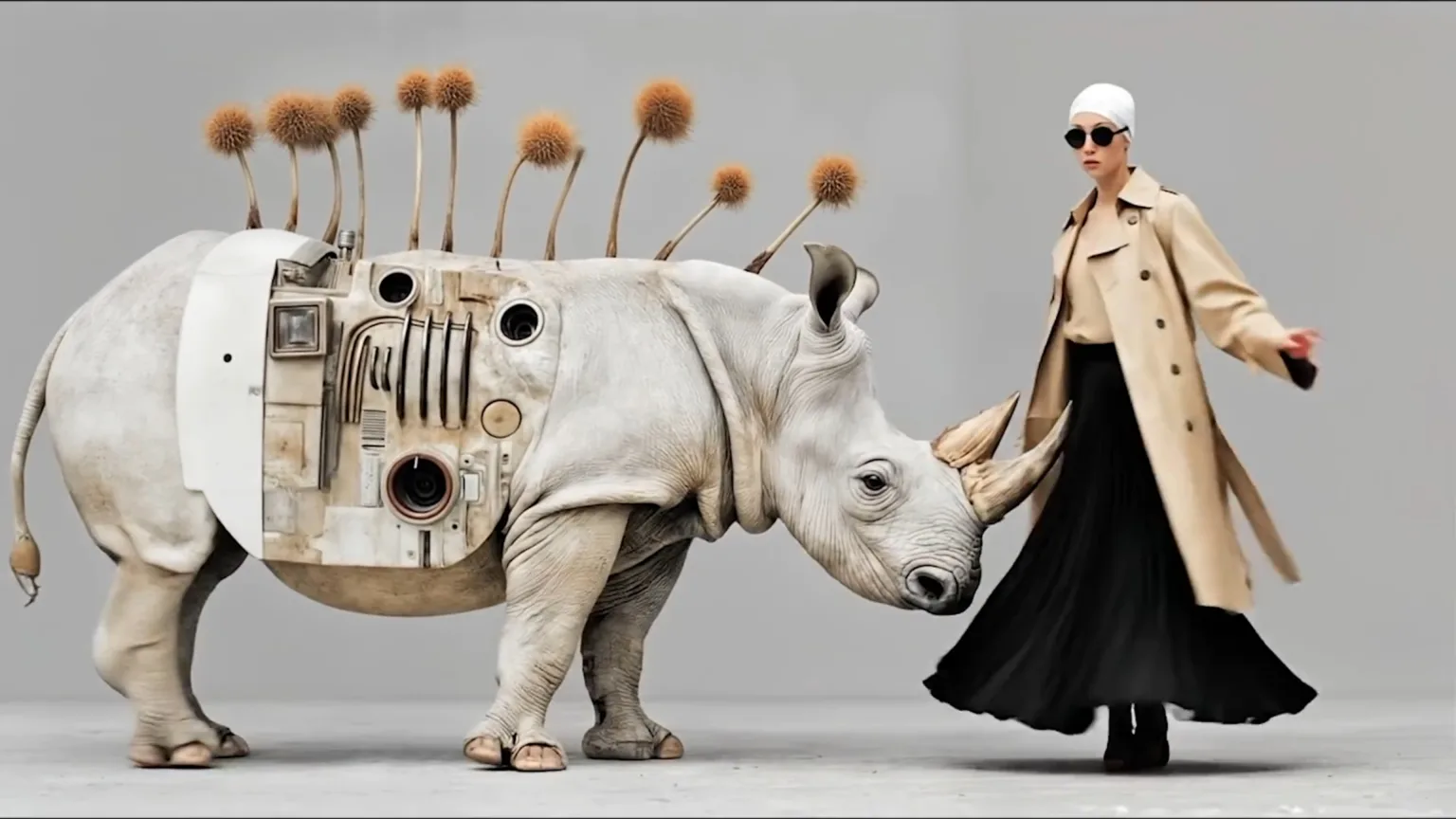
When an “infernal machine” enters a studio, the industry typically reacts in two predictable ways: panic… or dismissal.
Panic: “Artists will be replaced.”
Dismissal: “It’s just a tool, anyone can do it.”
Kelly Boesch’s trajectory is useful because it breaks both assumptions.
She didn’t adopt AI as a trend. She transferred a rare pre-AI skill — cinematic grammar — into a new medium.
In an interview, she says she spent 17 years at IMAX in film production and marketing, and that this experience taught her to think cinematically and to treat composition and color as a language (ProVideo Coalition). On her website, she positions herself as a creator blending IMAX-driven design expertise with an artist’s practice (Kelly Boesch AI Art).
That’s the gap:
- Many people generate.
- She directs.
And that is exactly what AI does not automatically provide.
1) The misunderstanding: thinking the edge is the tool
Yes, Midjourney is powerful (Midjourney).
Yes, Runway has industrialized AI video workflows (Runway).
Yes, Pika makes animation more accessible (Pika).
But in every creative revolution, access gets cheaper… and value moves upstream.
When everyone has a camera, value doesn’t go to “the person who has a camera.”
It goes to the one who can:
- frame,
- light,
- direct,
- edit,
- pace,
- hold intention.
AI accelerates that exact shift.
So the competitive advantage is no longer “best tool.”
It becomes best grammar.
2) The real pivot: moving from “executing” to “storytelling”
Boesch’s process reads like cinema:
- Build a hero image (a shot that carries intention) in Midjourney (ProVideo Coalition).
- Prefer Image-to-Video workflows for control and stylistic consistency (ProVideo Coalition).
- Assemble meaning in the edit — she explicitly frames editing as the “human touch” that turns clips into a story (ProVideo Coalition).
That detail matters: without editorial thinking, you get a sequence of pretty fragments — not a narrative, not a sustained emotion, not a progression.
This is where the boundary moves: AI takes over part of execution, and the artist climbs up the value chain.
3) “Everyone prompts”: a category mistake
Many people treat prompting as if it were the job.
But a prompt is not intention.
A prompt is not direction.
A prompt is not editing.
Even Midjourney emphasizes guiding outcomes with image references — working with visual constraints, not only words (Midjourney).
On the video side, platforms are investing heavily in controllability (coherence, continuity, direction). Scene/character consistency has become a key topic in AI video generation (The Verge).
Operational translation: the market rewards people who can direct.
4) What you should replicate (without copying her style)
You don’t need to be an artist.
You need to identify your pre-AI advantage.
Because AI is an amplifier: it scales your strength… or your weakness.
A simple framework:
A. Your grammar
- Cinema: framing, editing, pacing, intention.
- Design: hierarchy, contrast, coherence.
- Strategy: segmentation, narrative, positioning.
- Teaching: progression, analogies, practice loops.
- Sales: objections, proof, sequencing, closing.
B. Your production unit
- Before: 1 unit per week.
- With AI: 10 units.
- The question: are those 10 units 10x more coherent — or simply 10x noisier?
C. Your bottleneck
- The constraint is no longer “making.”
- The constraint becomes: choosing, directing, editing.
This is also the point I develop in my book, chapter 5: tools matter only when they serve an objective, and the advantage comes from disciplined use (my book, chapter 5).
5) The weak signal: artists upgrade studio culture
The most interesting part isn’t “she makes dreamy videos.”
It’s what that implies:
Studios will hire less for “software mastery”
and more for “language mastery”:
- art direction,
- narrative sense,
- editing,
- pacing,
- intention.
Deep skill returns — inside a new pipeline.
👉 Which pre-AI skill will you turn into a decisive weapon with AI?
References
(ProVideo Coalition) = https://www.provideocoalition.com/ai-tools-artist-spotlight-kelly-boesch/
(Kelly Boesch AI Art) = https://www.kellyboesch.com/
(Midjourney) = https://www.midjourney.com/
(Midjourney Docs) = https://docs.midjourney.com/hc/en-us/articles/32040250122381-Image-Prompts
(Runway) = https://runwayml.com/research/introducing-gen-3-alpha
(Pika) = https://pika.art/
(The Verge) = https://www.theverge.com/news/640821/runway-gen-4-artificial-intelligence-video-generator-filmmaking