Until now, water was a network problem. Pipes, plants, pumping stations, standards—an infrastructure promise. And like every infrastructure promise, it’s solid… until the day it isn’t.
A storm, a hurricane, a conflict, sabotage, a long drought: the network fails. And with it goes the most comforting illusion of modern life: “Water will always come out of the tap.”
We’ve seen the chain reaction: when water infrastructure breaks, everything follows—logistics, health, school, the local economy, trust, dignity.
That’s why what follows is not “nice climate-tech.” It’s not a showroom gadget. It touches something sacred: local, autonomous, resilient access.
A Nobel Prize, molecular cages… and drinking water
In 2025, the Nobel Prize in Chemistry was awarded to Susumu Kitagawa, Richard Robson, and Omar M. Yaghi for the development of MOFs (metal–organic frameworks)—porous materials that can trap and channel molecules like microscopic architecture. (NobelPrize.org)
MOFs aren’t just elegant chemistry. The Nobel committee explicitly highlights their applications: capturing CO₂, storing gases… and harvesting water from desert air. (NobelPrize.org)
And then the story turns sharp.
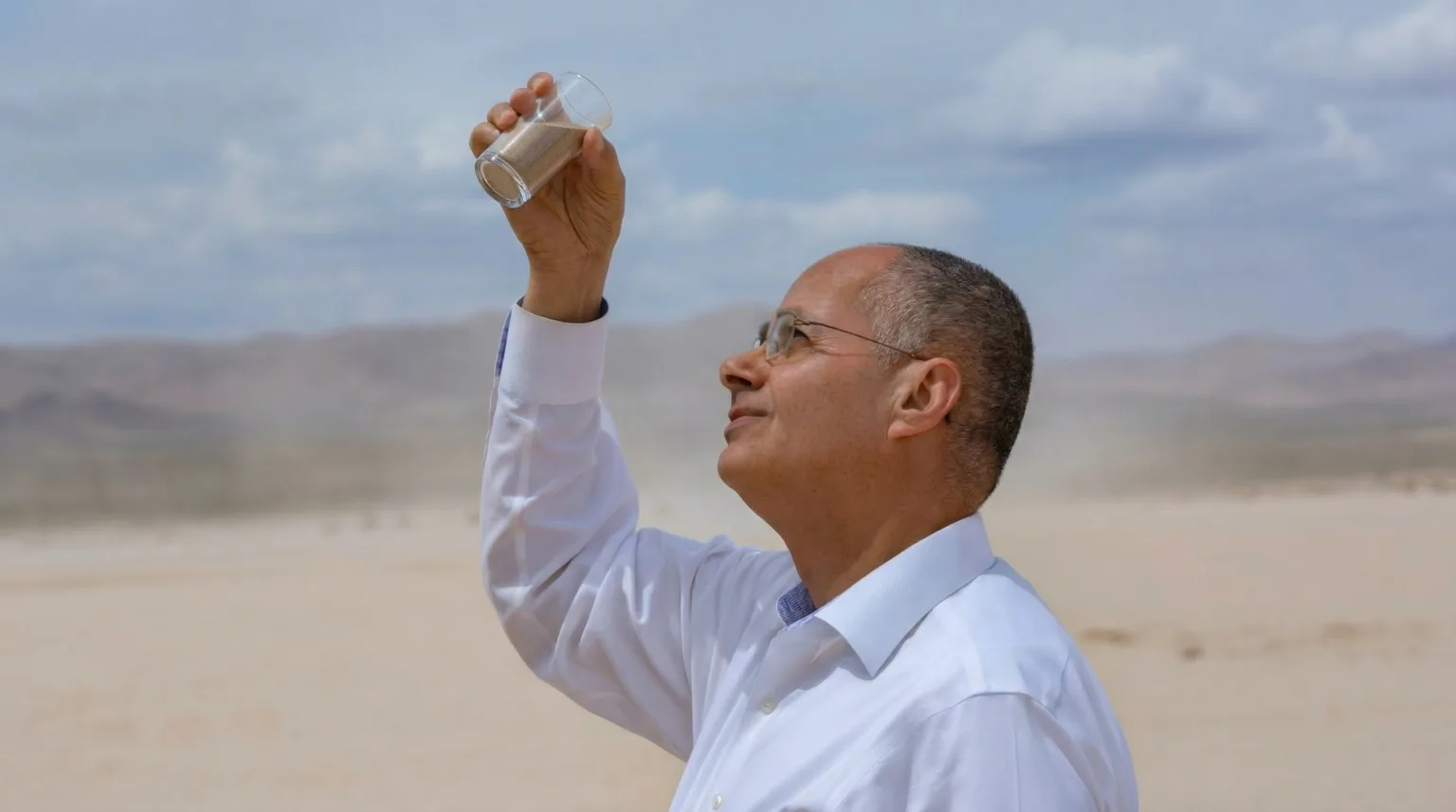
According to (The Guardian), Omar Yaghi designed an atmospheric water-harvesting machine capable of producing up to 1,000 liters of clean drinking water per day, even in arid conditions, in a unit comparable to a 20-foot shipping container, relying on ultra-low-grade thermal energy rather than heavy grid dependence. (The Guardian)
(WIRED Middle East) describes the same industrial direction: containerized units, including an off-grid version powered by low-grade heat, with production figures around 1,000 liters per day for that off-grid configuration. (WIRED Middle East)
No miracles here. Just a clear shift:
This is not “making water.”
It’s moving the infrastructure.
The real topic: decentralizing what used to be sacred
People often confuse innovation with shiny invention. In my book, I underline a structural distinction: without implementation, you can’t call it innovation (my book – chapter 3).
So the point isn’t the beauty of chemistry. It’s whether the system holds when everything collapses.
That’s what the container represents:
- It doesn’t “replace” the network—it bypasses it when absent.
- It doesn’t “fix” the world—it creates a local Plan B.
- It doesn’t “promise”—it produces, on site.
In my book, I also insist on a simple idea: innovation is a muscle—individual, collective, organizational—and if you don’t train it, it atrophies (my book – chapter 3).
Resilience works the same way: either you train it continuously, or you rediscover it in panic mode. And panic is always more expensive.
The scene you should carry in your head (and let guide you)
Picture an island hit by a hurricane. Water network down. Electricity unstable. Ports overwhelmed. Bottled water arrives last. Disease arrives first.
Now picture a community with a containerized, autonomous unit that restores a minimum vital: drinking water, locally.
That’s not science fiction. (The Guardian) explicitly frames the value for hurricane-prone territories facing infrastructure collapse. (The Guardian)
At that point, innovation stops being a feature race.
It becomes operational sovereignty.
“What if the next global infrastructure fits inside a container?”
This is not poetry. It’s organizational.
In my book, I describe the “intelligence innovationnelle®” system like a temple: foundations, pillars, and feedback loops. If pillars and foundations don’t evolve, the temple eventually collapses (my book – chapter 4).
Translated into business reality:
- If your energy depends on a single point, you’re fragile.
- If your data depends on a single chain, your decisions are fragile.
- If your decisions depend on two key people, execution is fragile.
Water in a container is just a mirror: it forces you to see your own dependencies.
The simple stress test: “What happens if the network goes down?”
Not “if things go well.”
Not “if we have a plan.”
But: if it truly goes down.
- If your main site is unreachable for 72h, do you still produce?
- If your ERP is unavailable, can you still invoice?
- If a critical supplier stops, can you still deliver?
- If your decision committee is blocked, can anyone decide?
Uncomfortable questions—because they reveal dependencies we prefer not to see.
That’s what useful innovation does: it makes blind spots visible.
What I would decentralize (in 80% of organizations)
Direct answer: in most organizations, the first candidate is neither energy nor data. It’s decision-making.
Because when decisions are centralized:
- the organization slows down,
- execution degrades,
- teams learn helplessness,
- and innovation becomes theater.
Decentralizing decisions doesn’t mean chaos. It means:
- clarifying what is non-negotiable (vision, constraints, risk),
- distributing the right to act within that frame,
- training the muscle through learning loops (feedback, experimentation, correction).
Which brings us back to the core: innovation that matters is innovation that runs.
Question
👉 What would you decentralize in your organization: energy, data, or decision-making?
References
(The Guardian) = https://www.theguardian.com/environment/2026/feb/21/nobel-laureate-omar-yaghi-invents-machine-that-harvests-water-from-dry-air
(NobelPrize.org) = https://www.nobelprize.org/prizes/chemistry/2025/summary/
(NobelPrize.org) = https://www.nobelprize.org/prizes/chemistry/2025/press-release/
(WIRED Middle East) = https://www.wired.me/story/this-startup-rearranges-atoms-to-make-clean-air-and-water
(Science) = https://www.science.org/doi/10.1126/science.aam8743
(UNU-INWEH) = https://unu.edu/inweh/news/world-enters-era-of-global-water-bankruptcy
(Reuters) = https://www.reuters.com/sustainability/climate-energy/looming-water-supply-bankruptcy-puts-billions-risk-un-report-warns-2026-01-20/