Two years of research and preparation on new activities for Sony… with a small, dynamic team. In 2005, I filed a patent for Sony and proposed a new activity: mass customization of videos.
The initial problem is simple: when a new movie comes out, a pirated version can be found almost instantly on the internet. Producers lose out on huge amounts of revenue.
The idea for recovering revenue was just as simple: just personalize the movie to restore its value. Imagine if you could have your own version of “Harry Potter” in which your child plays a role? By replacing one of the actors in the movie with your child. Suddenly, it’s interesting to you and your family, but not at all interesting to the neighbors! Piracy of a personalized movie becomes meaningless. And all the kids will want to have their own version… and will be proud to show it off, creating a viral loop.
Yes, personalized content has value. Everyone we surveyed was ready to pull out their credit cards. Right away.
By extension, any type of video content can be personalized and thus go viral: commercials, TV series… Imagine the series “Friends” or ‘House’ or “The Big Bang Theory” in which the actors are your friends and you… You don’t know what the writers and screenwriters are going to do to you. Interest and laughter guaranteed!
As Sony was planning to put the PlayStation processor in its televisions, we could even imagine personalizing programs such as the news or series in real time…
I received support from Kunitake Ando (the President of Sony Corp, who had previously hired me to launch Vaio PCs in Europe) and Nobuyuki Idei (the CEO of Sony Corp). Thanks to them, I was received by the heads of Hollywood studios (Sony Pictures, Columbia Pictures, etc.) and others (Pixar, Lucas Film, etc.) to present the project.
Off to Hollywood and the Bay Area (around San Francisco).
And there, disappointment… To my great surprise, the resistance was incredible. I was told outright that the actors’ guild, the writers’ guild, the directors’ guild, and the rights holders would immediately oppose it.
An actor wants to know who he’s going to be acting with and can refuse a role. And on top of that, being replaced? Are you kidding me? Okay, you just have to pay the actor a little more… actually, a lot more. Yes, it’s just a question of money.
George Lucas, a master at managing merchandise, was also opposed to it. It was beyond his control. For him, it wasn’t even a question of money, it was a matter of principle. His right-hand man was extremely clear with us.
The film industry’s recommendation finally came down: “Start with the Europeans, they’ll be less picky than the unions in the US.” Indeed, in 2007-2008, the Writers Guild of America strike, also known as the “American writers’ strike,” brought the industry to its knees.
One of my conclusions: an industry has a hard time reforming itself.
Unless…
Unless it’s an industry at the forefront of innovation. Guess what request I got during a project presentation meeting in Palo Alto? I could have received immediate funding if the project had started by personalizing porn videos… Funny. And against Sony’s ethics, which did not want to be associated with any project in this field. Personally, I would have felt that I was not doing justice to the potential of this project.
It was too early… The technology to do this customization was available, and we had made demonstration prototypes, examples of which can be found in low resolution at the end of this article. Artificial intelligence now makes it easier to carry out such a project.
Another internal resistance at Sony ultimately put an end to the project. In fact, Sony was not the right company for such a project. We should have stayed in startup mode.
Once again, and I have a few other stories on this theme, it is from another industry that change and disruption will ultimately come.
This story now illustrates some of my lectures.
A new app available on smartphones, Reface, is exploiting this initial idea, 15 years later, using artificial intelligence.
I was certainly a visionary, but innovation must come in the right context and at the right time to flourish.
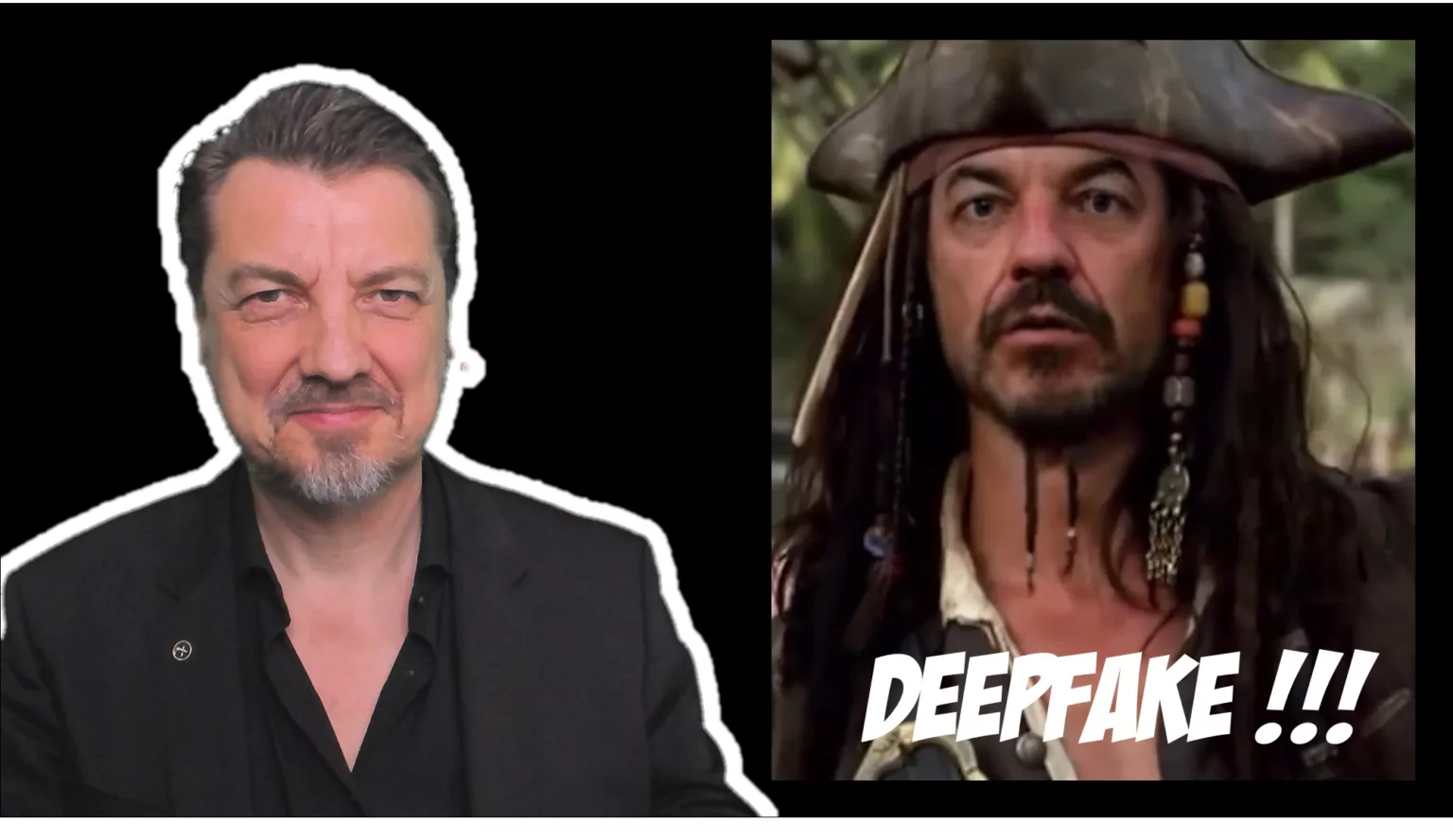
So here I am in Pirates of the Caribbean, replacing Johnny Depp, thanks to Replace’s #deepfake… I wish the creators of this app a bright future, and I hope they manage to overcome the resistance I faced 15 years ago.
And also, because I like to laugh at myself, you’ll find me below with Shakira’s body… don’t have any nightmares!
Nevertheless, I suspect that the industry (films, TV, actors, celebrities) will come down hard on Replace and demand their share of the profits… This is precisely why Netflix, Amazon Prime, and Apple have their own studios to create exclusive content, so they can turn a profit without any rights issues.
Below are two low-resolution prototypes based on real advertisements from the time. Don’t judge me too harshly—times were different back then, and this type of advertising would not be acceptable today… 15 years younger and without a beard…
And now, with AI in 2026, my wildest dreams are fulfilled. 21 years later.
Timing is key in innovation. Too early or too late, it’s too bad!