The Confusion That Gets Expensive
I was rarely this disappointed watching a business channel.
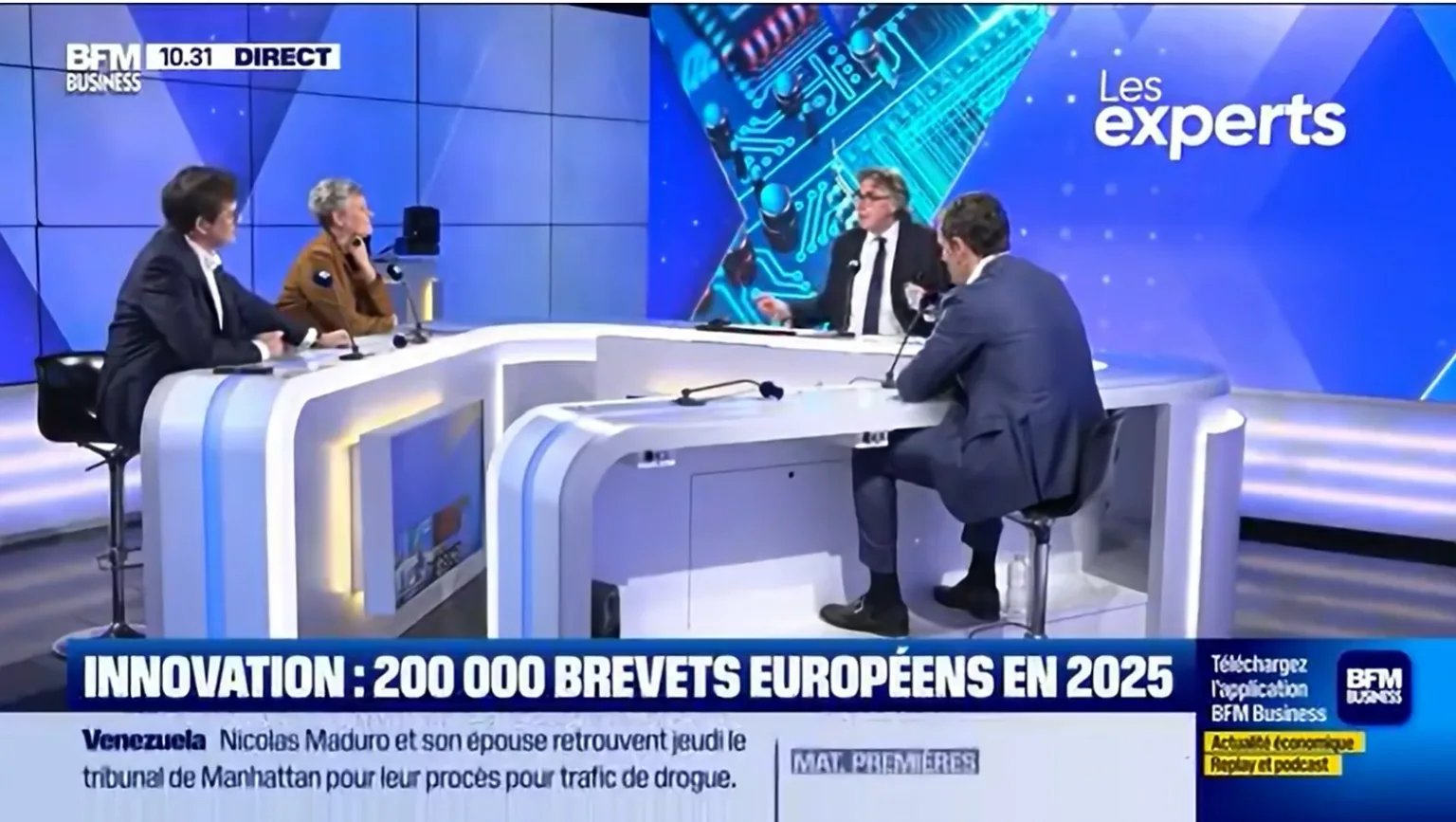
On BFM Business, in a segment about European innovation and the challenge of industrialisation, the framing blends research, patents, innovation and industrial scale-up into one narrative. The diagnosis that Europe struggles to industrialise is not absurd. What is far more troubling is the implicit suggestion that a high number of patents is enough to prove innovation. (BFM Business)
A patent protects an invention. That is all.
It does not prove market demand, customer adoption, execution quality, industrial capability, or value creation. The OECD defines innovation as a new or improved product or process that has been made available to potential users or brought into use. In other words, innovation begins with implementation. Not with filing an intellectual property title. (OECD)
Patent, invention, innovation: three words, three different realities
The problem in Europe is not only industrial. It is conceptual.
And when language gets blurred, strategy follows.
According to WIPO, a patent is an exclusive right granted for an invention. It is a legal protection tool for a technical solution. It matters. It can be valuable. It can even be decisive. But it remains a protection mechanism, not a certificate of economic success. (WIPO, WIPO FAQ)
France’s INPI also makes it clear that a patentable invention must meet specific criteria such as novelty, inventive step and industrial application. Once again, that is patentability. Not adoption. Not diffusion. Not a market won. (INPI, INPI)
That is exactly what I explain in my book, chapter 3: creativity, invention and innovation are different but connected concepts; innovation is first and foremost about implementation, production, adoption and use. Confusing those notions creates a mental fog that then contaminates budgets, priorities and decisions.
Patents comfort people. Innovation exposes them.
Patents comfort legal, administrative and institutional minds.
They provide something countable.
A spreadsheet.
A KPI.
A number that looks impressive in a report.
Innovation is far more demanding.
It forces organisations to go through the least glamorous part of the journey:
prototyping,
trade-offs,
field testing,
customer feedback,
iterations,
distribution,
training,
manufacturing,
scale-up financing.
That is why so many organisations prefer celebrating invention over confronting innovation.
Because invention flatters.
Innovation forces movement.
The OECD has stated this quite clearly in its work on innovation indicators: patents and R&D mostly say something about invention and inputs, not about the commercial success of innovation. Many patented inventions are never commercialised. (OECD)
Why this confusion is dangerous
When “experts” on a major business channel keep that confusion alive, the damage goes far beyond one TV segment.
Executives hear:
“We have patents, therefore we innovate.”
Leadership teams conclude:
“We are already strong at innovation, the problem must be somewhere else.”
Public decision-makers start believing:
“If we increase patent filings, competitiveness will follow.”
Meanwhile, other ecosystems work on the hardest part:
commercialisation,
scale-up,
industrial deployment,
access to capital,
execution speed.
The Draghi report on European competitiveness highlights barriers to commercialisation and scaling in Europe. The European Commission has also launched a startup and scaleup strategy to make Europe a better place to launch and grow innovative companies. Those initiatives exist precisely because research, patents and invention alone do not automatically create industrial winners. (European Commission, European Commission, EIC)
Europe does not only have an innovation problem. It has a transformation problem.
Europe produces science.
Europe produces research.
Europe produces patents.
Europe also produces frameworks, protections, regulations and systems.
But producing an IP title is not the same thing as turning a discovery into a widely adopted solution.
The European scoreboards show that a region can perform on intellectual assets while still facing difficulties on commercial impact, investment or scale-up. Innovation performance is never reducible to a single metric. (European Innovation Scoreboard 2025)
That is why I keep insisting on one simple point: this is not only a technology issue. It is also cultural, organisational, financial and managerial.
You can protect brilliantly what you will never deploy.
That may be one of the quiet tragedies of Europe.
BFM Business, bring in real innovation experts
When innovation is discussed on a major business platform, we need people who have already crossed the real valley between idea, invention, patent, product, market, adoption and industrialisation.
Not only commentators.
Not only panel strategists.
Not only people who understand innovation from a slide deck.
We need women and men who know that a patent is only a possible beginning.
Sometimes useful.
Sometimes defensive.
Sometimes irrelevant.
And sometimes completely disconnected from market success.
Innovation is not a file.
Innovation is not a flattering statistic.
Innovation is not a cabinet full of titles.
Innovation is motion.
It is measured in usage.
In diffusion.
In transformation.
In the ability to move an idea from the lab into reality.
What companies should take away from this
The lesson for companies is straightforward.
If you manage innovation through patent counts, you may reward protection rather than execution.
If you confuse invention with innovation, you may underfund the critical journey to market.
If you celebrate research without organising adoption, you may generate internal pride without creating external value.
And if that confusion settles inside the leadership team, you will inject fog exactly where precision is needed most.
That is why I keep working, in keynotes, workshops and advisory work, to clarify what too many people still mix up.
Because in business, poorly used words eventually become very expensive.
👉 How many absurd decisions have you seen born from a simple confusion between patent and innovation?


References
(BFM Business) = https://www.bfmtv.com/economie/replay-emissions/les-experts/video-innovation-europeenne-le-defi-de-l-industrialisation_VN-202603240440.html
(OECD) = https://www.oecd.org/en/publications/oslo-manual-2018_9789264304604-en.html
(OECD) = https://one.oecd.org/document/DSTI/EAS/IND/WPIA%282008%2910/en/pdf
(WIPO) = https://www.wipo.int/en/web/patents
(WIPO) = https://www.wipo.int/en/web/patents/faq_patents
(INPI) = https://www.inpi.fr/realiser-demarches/propriete-intellectuelle/criteres-de-brevetabilite
(INPI) = https://www.inpi.fr/realiser-demarches/propriete-intellectuelle/proteger-son-innovation-technique
(European Commission) = https://commission.europa.eu/document/download/97e481fd-2dc3-412d-be4c-f152a8232961_en
(European Commission) = https://research-and-innovation.ec.europa.eu/strategy/strategy-research-and-innovation/jobs-and-economy/eu-startup-and-scaleup-strategy_en
(European Innovation Council) = https://eic.ec.europa.eu/eic-funding-opportunities/step-scale_en
(European Commission) = https://research-and-innovation.ec.europa.eu/knowledge-publications-tools-and-data/publications/all-publications/european-innovation-scoreboard-2025_en