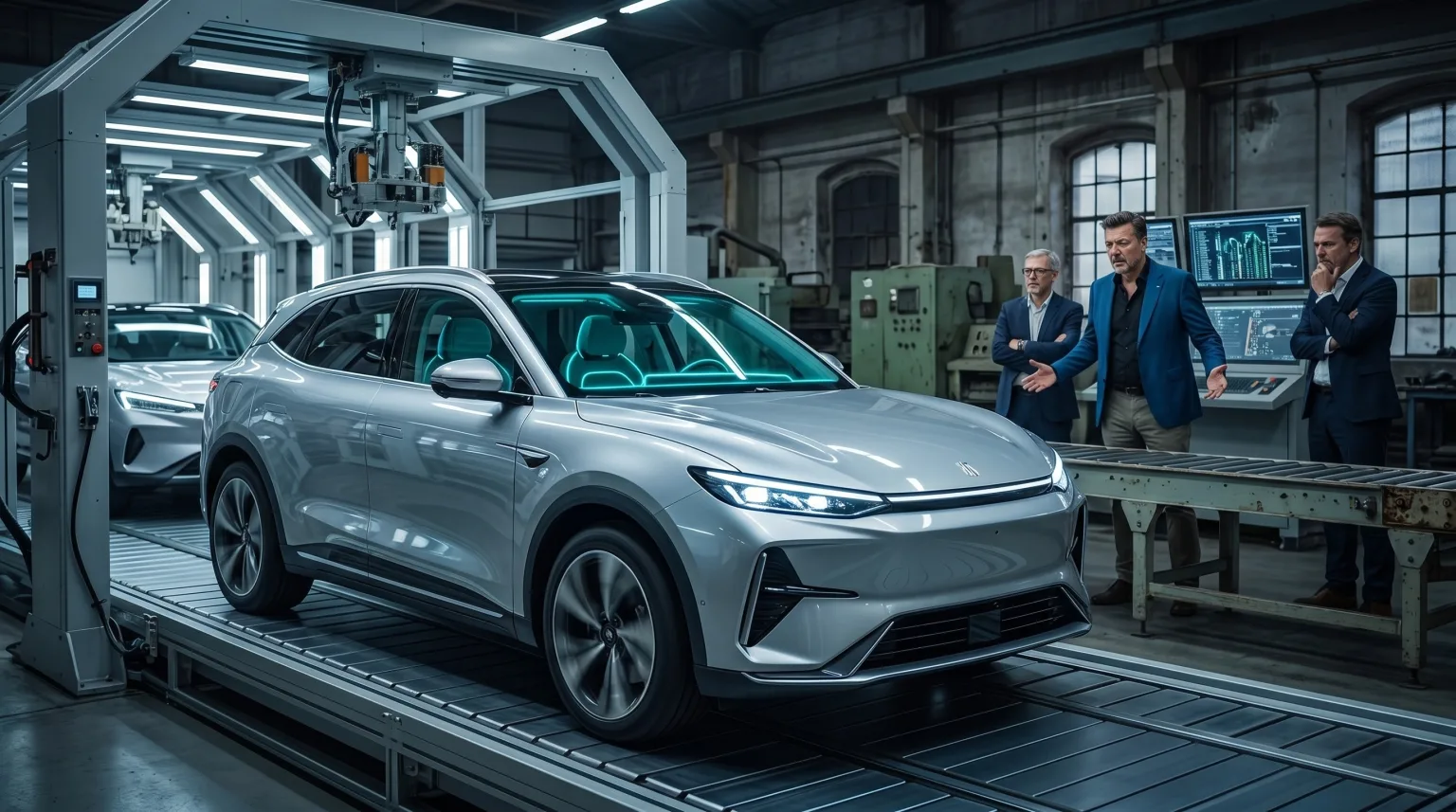
Europe’s breakdown is not primarily industrial. It is mental.
For years, many European players looked at Chinese automakers through an outdated strategic lens: low cost, imitation, catch-up.
That lens no longer works.
The real shift is somewhere else. Chinese carmakers are moving because they know how to compress time. They industrialize faster, test faster, launch faster, fix faster. The real competitive edge is no longer only unit cost. It is learning speed. That is exactly what the Boursorama article highlights when it notes that their strength is not only labor cost but innovation, while European manufacturers remain weakened by a softer domestic market and were caught off guard by electrification. (Boursorama)
In 2025, the European market did grow by 1.8% year over year, yet ACEA stresses that volumes remain well below pre-pandemic levels. In other words, Europe is dealing at the same time with technological transition, regulatory pressure, and a market base that is still fragile. (ACEA)
China executes while Europe debates
Europe’s problem is not a lack of engineers. It is the habit of confusing the quality of analysis with the quality of execution.
The market is now shifting at a speed that punishes delay. In Europe, battery electric vehicles represented 17.4% of registrations in 2025, up from 13.6% a year earlier, while hybrids captured 34.5% of the market. The transition is no longer theoretical. It is already reshaping value chains, onboard software, batteries, interfaces, development speed, and industrial trade-offs. (ACEA)
At the same time, Chinese brands are gaining ground systematically. JATO Dynamics reported that in May 2025 they reached 5.9% of sales across 28 European markets, more than double their share a year earlier. Their rise does not depend only on pure EVs. They are also moving with plug-in hybrids and other powertrains adapted to market reality. (JATO Dynamics)
When a company learns faster than its competitors, it eventually turns speed into perceived quality, then perceived quality into market share.
Innovation is not a speech. It is implementation.
In my book, I explain that innovation is first and foremost implementation, meaning the deployment or production of a new or significantly improved product, service, or process (my book, chapter 3).
That changes everything.
Europe often speaks about innovation as if it were a noble backdrop. China treats it more as an operating discipline. It is less romantic. It is far more dangerous for competitors.
In automotive, innovation speed is not measured by keynote speeches or motor shows. It is measured by the delay between idea, prototype, industrialization, software update, cost reduction, defect correction, and rollout across models.
That is where the strategic gap widens.
Volkswagen did not partner with XPENG for symbolism. The German group says explicitly that the partnership focuses on product development and technological innovation at scale. The first vehicle from that cooperation has already entered production, with a locally engineered electronic architecture for China. When a leading European manufacturer learns in this way from a Chinese partner, the signal is unmistakable: the direction of know-how transfer has changed. (Volkswagen Group)
Those who believed they would teach now have to relearn.
Barriers slow flows. They do not recreate agility.
The European Union has imposed additional duties on electric vehicles made in China since 2024. By 2026, negotiated exemptions already exist for some models. That proves one simple thing: trade barriers can alter routes, but they never replace industrial strategy. (Reuters)
Chinese automakers understand that perfectly. They localize. They adapt. They move closer to the European field of play. Chery is expected to start production in Barcelona in 2026 after delays, while also reinforcing its local presence in Europe. BYD has pushed ahead with its European industrial footprint through Hungary. (Reuters, IAA Mobility, Chery International)
When one door closes, they move through another. Plants, hubs, local R&D, partnerships, supply chains: they are not just exporting cars. They are building a system.
Europe’s real brake has an unflattering name: inertia
Many European companies are still managed as if their main competitive asset were legacy.
Legacy does not protect against disruption. It often delays the response.
McKinsey noted in 2025 that weak profitability across part of Europe’s automotive ecosystem was making transformation harder to finance, especially for smaller players. That creates a dangerous loop: lower margins, less investment capacity, slower transformation, weaker competitiveness. (McKinsey)
Yet reducing the issue to money alone would be too convenient.
One company can have capital and still remain slow. Another can face pressure and still move fast. What separates them is their relationship to time, experimentation, decision-making power, and the right to correct course quickly.
In my book, I also stress that the status quo acts as a powerful trap inside organizations, especially when habits, routines, and culture make challenge uncomfortable (my book, chapter 6).
That is exactly where Europe needs a lucid self-assessment.
The issue is not only that part of the electric turn was missed.
The issue is that management by delay was allowed to thrive.
Delay the decision.
Align everyone.
Consult more people.
Reassure the legacy base.
Protect the existing structure.
Then discover that the market has already moved on.
Innovation speed has become a survival capability
In an industry reshaped by electrification, software, embedded electronics, and artificial intelligence, speed is no longer optional. It is a survival skill.
That does not mean doing everything faster without discipline.
It means:
deciding faster without sacrificing rigor,
experimenting earlier,
industrializing without political drag,
accepting correction instead of defending the indefensible,
and letting learning circulate instead of burying it inside silos.
Chinese speed is not magic. It rests on a coherent chain linking ambition, execution, learning, and adaptation. When that chain works, it eventually creates an advantage that competitors experience as a shock. In reality, it is simply the logical result of better-organized discipline.
Europe can still respond. On one condition.
The right European response is not to recite the past glory of its automotive industry. It is to rebuild a credible transformation machine.
Not a communication machine.
Not a commentary machine.
An execution machine.
That requires reviewing several reflexes:
the place of software inside the product,
decision-cycle speed,
organizational simplification,
the weight of internal legacy,
and the connection between innovation, manufacturing, and go-to-market execution.
The issue is no longer to defend the old world with better arguments.
The issue is to learn how to build the next one faster than everyone else.
That is where many companies will discover an uncomfortable truth: in a market changing this fast, a slow org chart can cost more than weak technology.
What is happening goes beyond automotive
Automotive is only a magnifying mirror.
What we see here applies elsewhere: energy, industry, electronics, health, logistics, services.
Each time, the same question comes back: who learns faster under pressure?
The winner is no longer only the one who invents.
The winner is the one who turns an idea into robust reality faster.
That is why innovation speed is becoming more strategic than investment volume alone or the historical power of a brand.
A slow company can still impress.
A fast company eventually moves the market.



References
(Boursorama) = https://www.boursorama.com/actualite-economique/actualites/automobile-les-constructeurs-chinois-a-l-assaut-d-une-europe-affaiblie-et-en-panne-d-innovation-54c87453de927544fc0a0e48384f626c
(ACEA) = https://www.acea.auto/pc-registrations/new-car-registrations-1-8-in-2025-battery-electric-17-4-market-share/
(JATO Dynamics) = https://www.jato.com/resources/media-and-press-releases/chinese-automakers-double-european-market-share-in-may
(Volkswagen Group) = https://www.volkswagen-group.com/en/press-releases/milestone-of-in-china-for-china-strategy-first-car-developed-jointly-by-volkswagen-and-xpeng-rolls-off-the-production-line-20218
(Reuters) = https://www.reuters.com/world/china/eu-tariffs-imports-china-made-evs-2026-02-11/
(Reuters) = https://www.reuters.com/business/autos-transportation/chery-start-production-spain-this-year-after-delays-2026-02-06/
(IAA Mobility) = https://www.iaa-mobility.com/en/newsroom/news/future-technology/byd-launches-trial-production-hungary-milestone-european-ev-manufacturing
(Chery International) = https://www.cheryinternational.com/pc/news/news1/20260420/detail-2575.shtml
(McKinsey) = https://www.mckinsey.com/industries/automotive-and-assembly/our-insights/european-automotive-industry-what-it-takes-to-regain-competitiveness