The issue is not just Iran
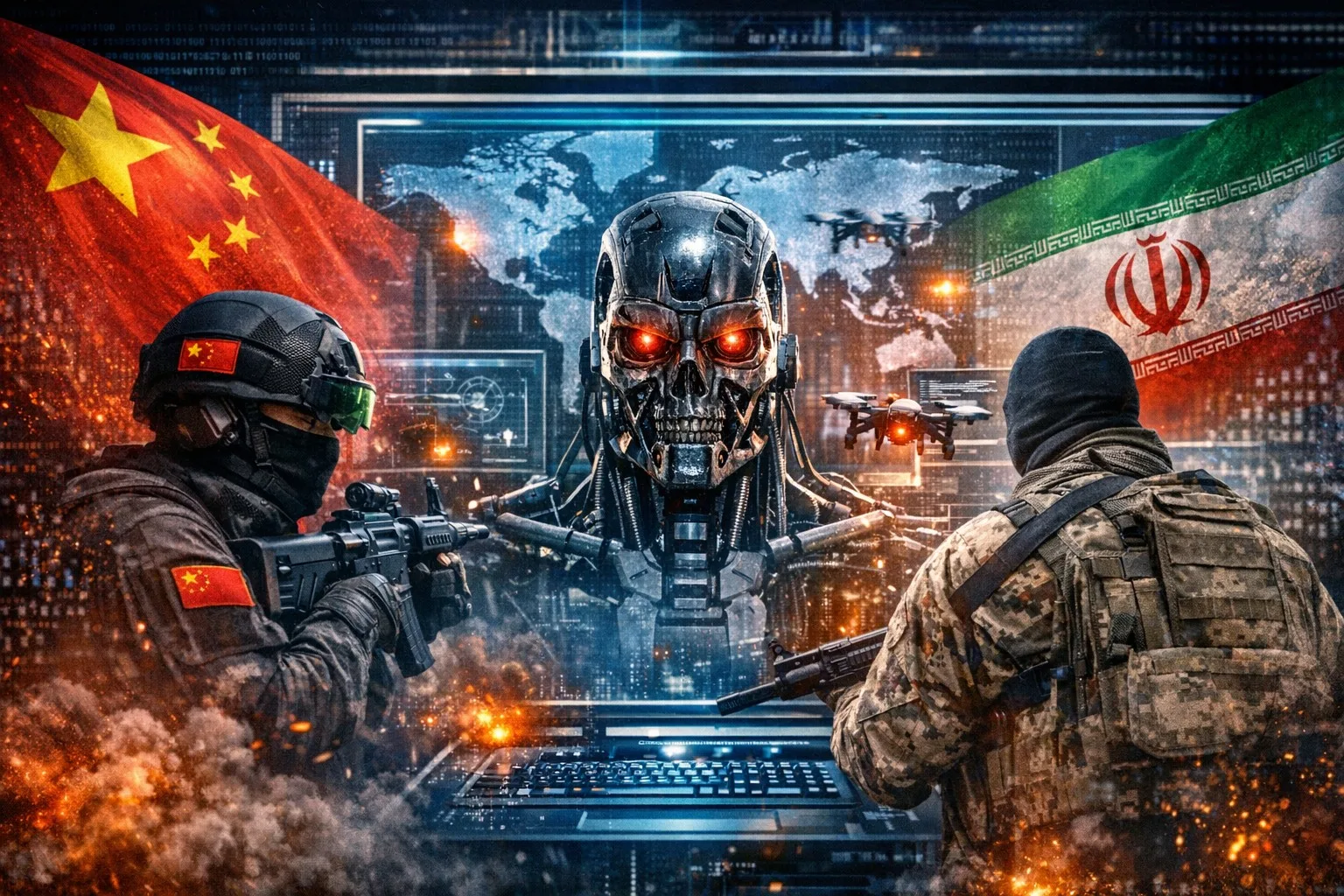
I have a simple conviction: when a power watches a conflict without fully exposing itself, it is not merely watching a war. It is watching a learning environment.
That is why the issue is not only Iran.
The issue is the lab.
A lab where data flows are tested, weak signals are surfaced, information fusion speeds are measured, and coordination between sensors, platforms, propaganda, cyber operations, and decisions is refined. A lab where AI stops being a demo tool and becomes a multiplier of perception and command.
The Asia Times article pushes that interpretation to its logical extreme. It does not publicly prove Chinese strategic intent on its own, but it raises a hypothesis leaders should treat seriously: major ruptures are rarely prepared in the spotlight. They are tested quietly, on secondary terrain, with limited political exposure. (Asia Times)
Modern war learns faster than most organizations
What serious analysis already shows is that drones are no longer battlefield accessories. They are becoming the backbone of sustained campaigns able to impose psychological, economic, and operational pressure at relatively low cost. CSIS notes that in Iran’s recent campaign, drones are no longer just strike systems; they are campaign-management systems. (CSIS)
Add another decisive shift: AI does not only sit inside the weapon. It sits inside environmental awareness. RAND argues that AI can reshape war through large-scale data analysis, multisource fusion, decision support, platform coordination, and accelerated generation of operational options. (RAND)
In other words, superiority will not be decided only by raw force. It will be decided by who sees earlier, understands earlier, decides earlier, and adapts earlier.
That is where many companies still read AI through a frame that is far too narrow.
They see a tool.
They should see a learning architecture.
China is not hiding the strategic direction
The U.S. Department of Defense states clearly that Beijing sees artificial intelligence and advanced analytics as foundational technologies for the next phase of military modernization. Its 2025 report also emphasizes China’s military-civil fusion strategy, designed to accelerate flows of technology, talent, research, and dual-use capability into the strategic apparatus. (Department of Defense)
The picture gets sharper when RAND shows that China is actively studying the Russia-Ukraine war to prepare for a possible future conflict involving the United States. The report describes major learning efforts, doctrinal adaptation, and a shift toward a more protracted, more costly, more hybrid form of conflict. (RAND)
When a power studies conflict in depth, builds “intelligentized warfare” capabilities, activates military-civil fusion, and sees concrete uses of drones, OSINT, AI, and information warfare emerging in another theater, one conclusion becomes hard to ignore: the terrain is not merely being observed. It is being exploited as learning material.
The weak signal many leaders miss
The Washington Post recently reported that Chinese technology firms tied to the military-commercial ecosystem were marketing AI and OSINT tools able to track and expose U.S. military movements. Even if their exact capabilities remain debated, the strategic signal is powerful: observe, correlate, publish, influence. (The Washington Post)
The problem for companies is that they almost always underestimate this kind of shift.
They wait for the official announcement.
They wait for the final product.
They wait for the spectacular demonstration.
Meanwhile, the competitor is already learning elsewhere.
Learning on a neglected segment.
Learning on a peripheral market.
Learning on a customer group nobody values yet.
Learning in use cases still considered marginal.
Learning inside data streams others do not even know how to connect.
Then one morning everyone discovers what had already become obvious.
AI changes strategy before it changes tools
That is exactly what I explain in my book, especially chapter 3 on what innovation really is, chapter 4 on the system, and chapter 7 on team dynamics: performance does not depend only on technology. It depends on the collective ability to read the terrain, align, decide, and act fast.
Many organizations still assume the main danger is not having the best model.
That reading is too weak.
The real danger is that a competitor turns unstable terrain into usable learning faster than you do.
The real danger is that they understand before you what must be measured, tested, automated, delegated to machines, and kept under human control.
The real danger is that they build a learning loop while you are still stacking committees.
What companies should copy from this lab
War is not a business. Yet one common principle is impossible to miss: advantage shifts toward those who shorten the perception-understanding-decision-action cycle.
In business terms, that means five things.
Treat weak signals as strategic raw material.
Connect data instead of piling it up.
Reduce the delay between observation and experimentation.
Let information move across functions instead of dying inside silos.
Train teams to learn under unstable conditions, not only in clean and controlled environments.
CSIS notes that both Ukraine and the Middle East are becoming accelerated adaptation theaters, where software, drones, integration, and doctrine evolve almost in real time. That is a brutal lesson for companies: the field rewards not the biggest players first, but the fastest learners. (CSIS)
The most dangerous competitor is not always the visible one
The most dangerous competitor is not always the loudest one.
It is often the one quietly turning every friction into data, every data point into a model, every model into a decision, and every decision into advantage.
Iran may therefore be more than a geopolitical subject.
For other actors, it may also be a full-scale learning environment.
That is where the topic becomes unsettling for leaders.
Because in every industry, a discreet lab already exists.
Sometimes far from headquarters.
Sometimes far from your radar.
Sometimes inside your own market.
That lab is already shaping tomorrow’s rules.
And those who fail to identify it will eventually mistake surprise for fate.


References
(Asia Times) = https://asiatimes.com/2026/04/china-using-iran-as-proxy-lab-for-future-ai-warfare-with-us/
(CSIS) = https://www.csis.org/analysis/unpacking-irans-drone-campaign-gulf-early-lessons-future-drone-warfare
(CSIS) = https://www.csis.org/analysis/adapting-under-fire-ukraines-race-reinvent-modern-defense
(RAND) = https://www.rand.org/pubs/research_reports/RRA3141-4.html
(RAND) = https://www.rand.org/pubs/research_reports/RRA4316-1.html
(Department of Defense) = https://media.defense.gov/2025/Dec/23/2003849070/-1/-1/1/ANNUAL-REPORT-TO-CONGRESS-MILITARY-AND-SECURITY-DEVELOPMENTS-INVOLVING-THE-PEOPLES-REPUBLIC-OF-CHINA-2025.PDF
(The Washington Post) = https://www.washingtonpost.com/national-security/2026/04/04/china-ai-military-intelligence-iran-war/