Most companies are looking in the wrong place
Everyone is watching the same race.
Who has the best model.
Who ships the most impressive demo.
Who buys the most GPUs.
Who shocks the market with the next breakthrough.
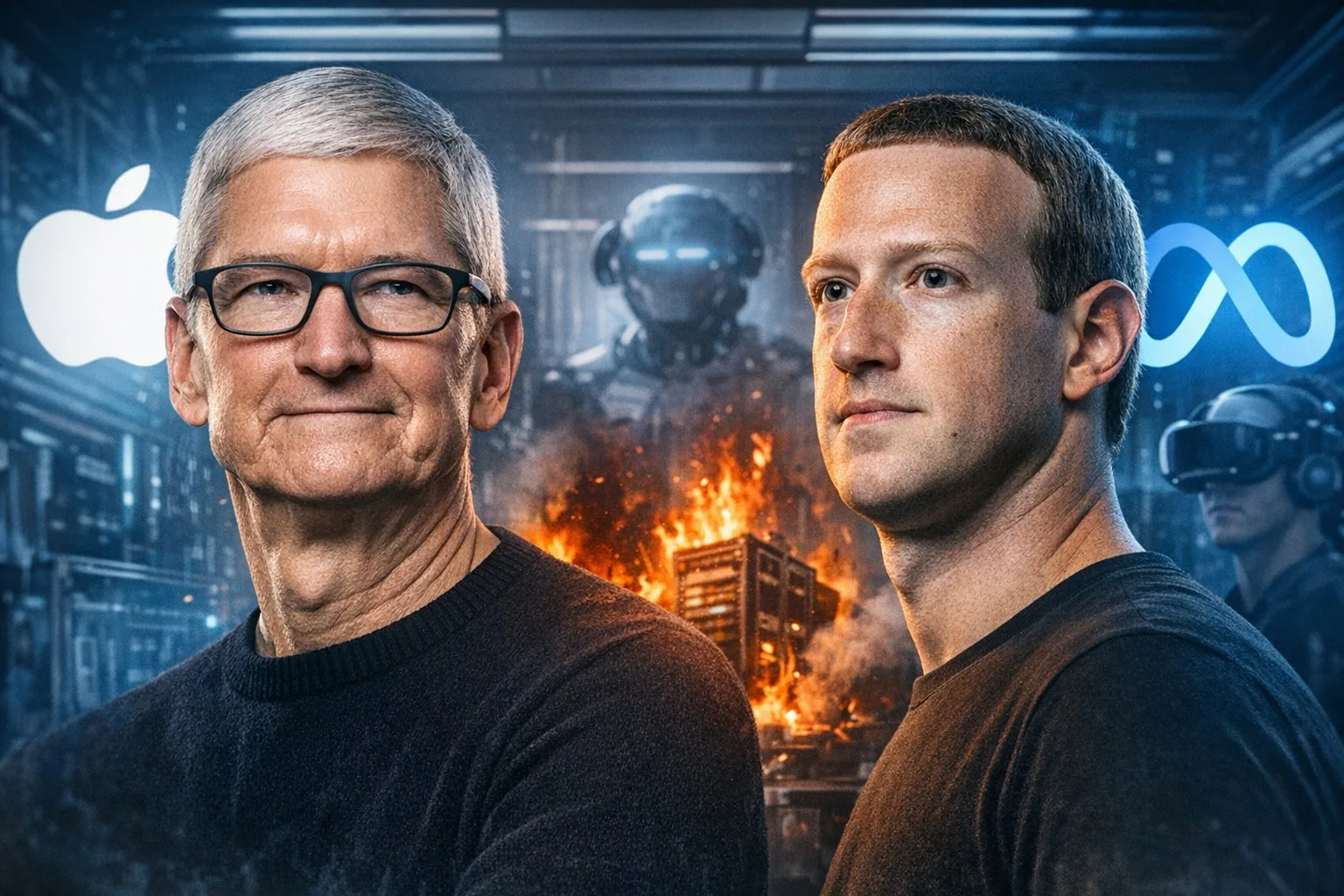
Meanwhile, Apple and Meta are playing a colder game.
Not the most visible game.
The most strategic one.
Apple is trying to become the natural place where AI melts into use.
Meta is trying to become the natural place where AI merges with attention.
One locks in the daily interface.
The other locks in the daily stream.
That is where many leaders are still misreading AI.
They still think dominance will come primarily from raw technical superiority.
They think data centers.
They think benchmarks.
They think models.
They underestimate the real capture layer: the contact surface.
In my book, I make a central distinction: innovation is not just invention or technical brilliance. It exists through implementation, adoption, and its ability to settle into real life. And the coherence between vision, mission, and strategy determines how durable that position becomes. My book addresses this directly in chapter 3 and chapter 8.
Apple does not necessarily need to win the lab
Apple’s start in generative AI was messy from a market-perception standpoint. Even the US tech press pointed to delayed Siri ambitions and a shaky symbolic entry into the race (The Verge).
But looking at Apple only through that lens is a strategic mistake.
In January 2026, Apple said its installed base had surpassed 2.5 billion active devices. That number matters because it describes more than hardware. It describes a global nervous system already present in pockets, on wrists, in ears, on desks, and increasingly across everyday life (Apple Newsroom).
In June 2025, Apple also confirmed two revealing moves. First, Apple Intelligence was extended across iPhone, iPad, Mac, Apple Watch, and Apple Vision Pro. Second, Apple opened its on-device foundation model to developers. In plain English: Apple is not only trying to build its own AI layer. Apple is trying to dissolve AI into its entire ecosystem, including third-party apps, with a promise of privacy, speed, and offline availability (Apple Newsroom).
This is a distribution logic.
This is an integration logic.
This is a habit logic.
The end user will not spend much time asking which model is running underneath.
They will simply notice that everything seems to be there, in the right place, at the right time, inside the right interface.
That is often how power settles in: not when the technology looks impressive, but when it stops being perceived as technology.
Meta does not necessarily need to win the model race either
Meta is playing a different but equally formidable score.
The company ended 2025 with 3.58 billion daily active people across its family of apps. In the same filing, Meta also reported an 18 percent increase in ad impressions in Q4 and more than $72 billion in capex for full-year 2025. This is not just a company building AI. It is already a machine monetizing massive behavior and reinvesting that power into attention optimization (Meta Investor Relations).
The critical point is simple: Meta already owns the places where people watch, react, compare, get distracted, talk, and buy.
That asset is enormous.
Meta is now trying to extend that grip beyond the smartphone. In April 2025, it launched the new Meta AI app as a companion to its smart glasses and web experience, with continuity across devices. The strategic message is clear: start an interaction here, resume it there, and make the assistant a persistent presence rather than a one-off tool (About Meta).
Then Meta Connect 2025 confirmed the company’s fixation on AI glasses. The event focused heavily on that category, with new models, more battery life, stronger audio and vision capabilities, and a clear push to turn glasses into the next access layer for personal computing (The Verge).
Again, the reasoning is not just technological.
It is behavioral.
Meta wants to be where attention takes shape.
Before the query.
Before the click.
Sometimes even before the intention is clearly formed.
The real battle is not only about intelligence
The decisive battle does not only pit the brightest labs against each other. It pits the owners of intelligence against the owners of usage.
The former may invent.
The latter may absorb.
The former may publish a breakthrough.
The latter may turn it into a daily reflex.
Economic history repeats this pattern constantly.
Those who build the technology are not always the ones who capture the long-term value.
Value often migrates toward those who control distribution, interface, customer relationship, usage frequency, and the unavoidable gateway.
Apple has long mastered orchestration through coherence. Its services posted another record year in 2025, with continued expansion across daily-use layers such as Apple Pay, iCloud, the App Store, Apple Music, and Apple TV+. Apple said the App Store alone surpassed 850 million average weekly users globally (Apple Newsroom).
Meta, by contrast, excels at capture engineering and optimization. Its massive usage base, combined with its recommendation systems, ad stack, and conversational interfaces, gives it a force many executives still underestimate: converting accumulated attention into leverage for the next interface shift.
What leaders should understand now
The issue is not only: “Do we have the best AI?”
The issue is becoming:
Where will the relationship settle?
If you are a leader, four questions matter.
1. Who already owns access to the customer?
A new technology never arrives on empty ground.
It always enters territory that is already occupied.
Whoever already owns the terminal, the usage frequency, or the transactional trust starts with a huge advantage.
2. Who controls the interface?
A model can be excellent and remain invisible.
An interface can be average and become unavoidable.
Digital history often rewards the one who simplifies access, not only the one who invents the most.
3. Who turns usage into habit?
An innovation truly wins when it becomes ordinary.
When it no longer needs explanation.
When users no longer “try.”
When they simply “do.”
That is the moment when a product stops being a gadget and becomes a ritual.
4. Who makes exit costly?
Durable economic power appears when leaving the ecosystem becomes painful, clumsy, mentally expensive, or socially inconvenient.
Apple does this through integration.
Meta does it through attention gravity.
The classic mistake of traditional companies
Many companies will make a double mistake.
The first is to believe that buying a model or a copilot is enough to “do AI transformation.”
The second is to believe that value will automatically be captured by the provider of the technical building block.
That is rarely how history ends.
Value tends to concentrate in the hands of whoever:
owns distribution,
organizes friction in its favor,
becomes the natural interface,
turns usage into a norm.
That is why Apple and Meta may leave 2026 without being seen as the absolute winners of the frontier model race, and still end up in a superior position in the next stage: the moment when AI stops being a product and becomes an environment.
The post-AI era may belong to the owners of the relationship
What comes after AI will not be won only by whoever computes best.
It may be won by whoever:
integrates best,
distributes best,
habituates best,
retains best.
Apple already owns the gesture.
Meta already owns the gaze.
And in an economy where technology disappears behind experience, those two positions may matter more than a symbolic victory in the lab.
The serious question for every company is therefore not only which model it should use. It is where exactly it intends to become impossible to bypass.
That is where value capture will happen.
That is where dependency will happen.
That is where power will happen.
And that is exactly where many companies will wake up too late.


References
- (Apple Newsroom) = https://www.apple.com/newsroom/2026/01/apple-reports-first-quarter-results/
- (Apple Newsroom) = https://www.apple.com/newsroom/2025/06/apple-intelligence-gets-even-more-powerful-with-new-capabilities-across-apple-devices/
- (Apple Newsroom) = https://www.apple.com/newsroom/2026/01/2025-marked-a-record-breaking-year-for-apple-services/
- (Meta Investor Relations) = https://investor.atmeta.com/investor-news/press-release-details/2026/Meta-Reports-Fourth-Quarter-and-Full-Year-2025-Results/default.aspx
- (About Meta) = https://about.fb.com/news/2025/04/introducing-meta-ai-app-new-way-access-ai-assistant/
- (The Verge) = https://www.theverge.com/news/777572/meta-connect-2025-news-announcements-mark-zuckerberg-smart-glasses
- (The Verge) = https://www.theverge.com/tech/861957/google-apple-ai-deal-iphone-gemini
- (Reuters) = https://www.reuters.com/technology/apple-tests-siri-feature-that-handles-multiple-commands-once-bloomberg-news-2026-03-31/