Delft, autumn 1676.
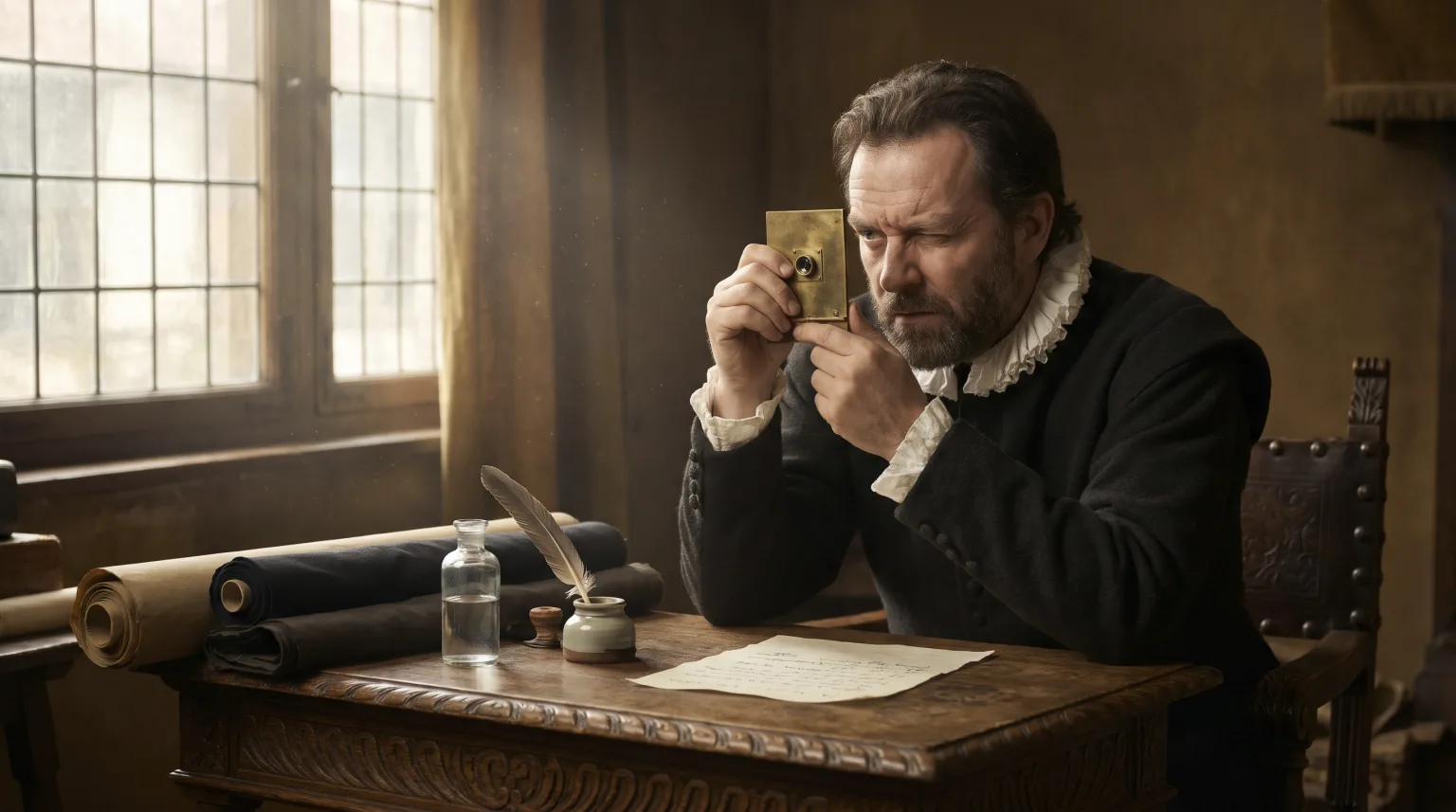
A 44-year-old cloth merchant raises to his eye a brass plate barely five centimetres long. In its centre sits a tiny lens. In front of it, on the tip of an adjustable pin, hangs a drop of rainwater.
He looks. He pulls back. He looks again.
The drop is teeming. Thousands of living things swim, spin, stop and set off again.
Antonie van Leeuwenhoek picks up his pen. In Dutch, the only language he knows, he writes a long letter dated 9 October 1676, addressed to the Royal Society in London (Lens on Leeuwenhoek). He cannot read Latin, the language of the scholars of his day. He never went to university (Hektoen International).
What he describes, nobody has ever seen: an invisible, living population housed in a single drop of water.
This story is making the rounds on social media right now in a very attractive version. An uneducated merchant. An aristocratic elite that takes him for a madman. A delegation sent to Delft that discovers, stunned, that the draper was right. The story works, and it is partly wrong. The accurate version will serve you far better, if you lead a team or a company, than the viral one.
A draper who counted threads
Leeuwenhoek was born in Delft in 1632 into a family of tradespeople: a basket-maker father and a mother’s family of brewers. At sixteen, he became a bookkeeper for a linen draper in Amsterdam. Back in Delft, he opened his own shop selling cloth and haberdashery, including fabrics, buttons and ribbons. In 1660, the city put him in charge of running its council meeting hall (Hektoen International).
In his trade, you judge a fabric by examining its weave up close. Leeuwenhoek learned to work glass and grind lenses. During a trip to London in 1668, he probably saw Micrographia, the book Robert Hooke published in 1665, with its engravings of textiles seen under the microscope (Hektoen International). Keep that detail in mind: the amateur trained himself by reading the expert.
He then built microscopes of an unusual kind. A single lens, clamped between two metal plates, held right up against the eye. His instruments magnified up to about 300 times, while Hooke’s compound microscope reached 40 to 50 times (Hektoen International). His contemporaries’ microscopes magnified about 30 times. His went up to ten times further (TU Delft).
Then he did what curious people do: he pointed his tool at everything within reach. Water from a nearby lake, rainwater, well water, samples from his own mouth. He found single-celled organisms, red blood cells and sperm cells (Hektoen International). I break curiosity down into three behaviours: creating space for serendipity by exploring the unusual, observing in order to spot the unexpected, and asking the questions that lead to understanding. Leeuwenhoek ticks all three boxes, and he started with a simple quality-control tool for cloth (My book, chapter 6).
What the viral version gets wrong
First correction: the Royal Society of the 1670s was nothing like a club of professional researchers. Its members were lawyers, merchants, physicians, aristocrats and landowners, brought together by a shared interest in studying nature (Royal Society). Leeuwenhoek was writing to men many of whom were no more “scientists” than he was, in the modern sense of the word. What separated him from them was language and university, far more than his trade.
Second correction: the record kept by the Royal Society shows a different sequence from a delegation dispatched to Delft. Leeuwenhoek took the initiative. Between May and August 1677, eight witnesses wrote to London to attest to what they had seen in his infusions (Lens on Leeuwenhoek). They included two Lutheran ministers, the minister of the Scottish church in Rotterdam, a Delft lawyer and notary, a doctor of medicine and a medical student from Leiden (Lens on Leeuwenhoek). Some accounts also mention a visit by churchmen and scientists (Hektoen International). The written testimonials remain the documented evidence in the file.
Third correction, which I come back to below: the “secret” lenses were not very secret at all.
Finally, “uneducated” is misleading. Leeuwenhoek could count, keep books, run a business and hold a municipal post. What he lacked was Latin and a university degree. In a company, that nuance matters a great deal: the person without the expected diploma often has expertise nobody has bothered to look at.
The Royal Society didn’t take his word for it, it checked
The Royal Society’s motto, adopted in its first charter in 1662, is Nullius in verba: take nobody’s word for it. It expresses the Fellows’ determination to resist authority and to verify every statement against facts established by experiment (Royal Society).
Look at the timeline. The long letter of 9 October 1676 was read out at meetings in three instalments, in February and March 1677. Part of it appeared in the Philosophical Transactions on 25 March 1677. On 25 October 1677, the Royal Society asked Robert Hooke to replicate the observations (Lens on Leeuwenhoek). At the meeting of 11 November, Hooke failed and was asked to use a better microscope. That same day, the members also heard the testimonials from Delft read aloud (Lens on Leeuwenhoek). On 25 November 1677, Hooke finally succeeded in replicating the observations. On 8 February 1680, Leeuwenhoek was elected a member of the Royal Society (Lens on Leeuwenhoek).
Thirteen months separate the letter from the confirmation. More than three years separate the letter from the election.
This sequence contains what the viral version erases. The Royal Society was demanding with the claim and respectful with the person. It published the letter before it had proof. It read the testimonials at a meeting. It put its best experimenter on the job, who failed, then persisted. Once the proof was in, it elected the draper.
Leeuwenhoek did his part too. He tried to make his numbers checkable: in a letter of October 1677, he explains how he uses a grain of millet as a unit of volume to estimate the number of organisms in a drop of water (Lens on Leeuwenhoek). A merchant who measures, counts and supplies witnesses gives himself every chance of being heard.
The secret that wasn’t one
Leeuwenhoek kept his lenses shrouded in mystery. In 1711, he hinted to German visitors that he had developed an advanced glass-blowing method (TU Delft). For three centuries, people speculated.
In 2018, researchers from TU Delft and Rijksmuseum Boerhaave examined one of his microscopes with neutron tomography, without having to open it. The verdict: a thin lens, ground and polished, with no exotic process involved (TU Delft). In 2021, a study published in Science Advances looked at the instrument held in Utrecht, one of the most powerful. Its lens is a small glass sphere, made with a method that was common at the time (Labroots).
Ordinary methods, extraordinary results. Leeuwenhoek’s edge came from practice and patience. Eleven of his microscopes survive, and it took about 150 years for anyone to build an instrument that could show more (TU Delft).
If you are hunting for your competitors’ secret recipe, this story should calm you down. Most of the time, the difference lies in repeated execution, where nobody is looking.
Faraday and Anning: talent isn’t enough, you need a door
As a teenager, Michael Faraday was apprenticed for seven years to a London bookbinder, George Riebau. A member of the Royal Institution gave him tickets to attend lectures by the chemist Humphry Davy in 1812. In 1824, Faraday was elected to the Royal Society, and in 1831 he discovered electromagnetic induction (AIM25). In between, a door opened: after the lectures, he asked Davy for a job, and Davy hired him in 1813 as a laboratory assistant (Exploring London).
Mary Anning, for her part, searched the cliffs of Dorset. She uncovered ichthyosaurs, plesiosaurs and, in 1828, a pterosaur. London’s Natural History Museum displays several of her finds today. In her lifetime, the Geological Society of London refused to admit her (Natural History Museum). The male scientists who published on her fossils often failed to credit her, including when writing about her ichthyosaur (Google Arts & Culture).
Three paths, three receptions. Leeuwenhoek and Faraday found a door and a verification protocol. Anning found a closed door. Their talent is not in question. The institution’s capacity to receive them is.
Your Leeuwenhoeks are already there, and you are filtering them out
Your company has its own draper who sees something. The maintenance technician who has worked out why the line breaks down on Tuesdays. The customer service agent who hears the same complaint every day, which nobody passes up the chain. The intern from another industry who finds strange what everyone else finds normal.
They rarely have the right title, the right degree or the right vocabulary. Three mechanisms silence them.
The first is NIH syndrome, for “not invented here”: whatever comes from elsewhere looks inferior to what the team would have built itself (My book).
The second is in-group bias. People prefer to surround themselves with others who went through the same training, and some management layers end up made almost entirely of alumni from the same schools (My book, chapter 7).
The third lives inside the outsider: impostor syndrome. Without the diplomas attached to their expertise, they judge themselves illegitimate and keep the idea to themselves. Yet experience outweighs diplomas after a few years, and an idea that isn’t shared has no chance (My book).
Try the exercise. On a scale of 0 to 5, how much is your leadership team subject to NIH syndrome? And when did you last seriously test an idea from someone with no title or degree in the field?
Welcoming the outsider without lowering the bar
Opening the door to outsiders does not mean believing everything. The Royal Society of 1677 gives you a method in five moves.
- Create an entry channel. A London learned society read out at its meetings the letters of a draper who wrote in Dutch. Where do the ideas of people who aren’t in the right meetings land in your organisation?
- Apply the same proof to everyone. Nullius in verba applies to the draper as much as to the head of R&D. If leadership ideas pass without testing while ideas from the field must prove everything, you are running a social filter dressed up as rigour.
- Give replication time to fail. Hooke missed his first attempts before succeeding. How many of your projects were buried after a single failed test?
- Give credit by name. Mary Anning’s story shows what happens when an institution takes the discoveries and erases the discoverer. Your talent watches this kind of behaviour, and draws its own conclusions.
- Protect the full cycle. I apply a simple model to my own life: exploration, discovery, validation, then optimisation (My book, chapter 16). Leeuwenhoek went all the way through it. He explored drops of water, discovered organisms, won validation from London, then kept publishing new observations for years, from sperm cells in 1677 to muscle fibres in 1682 (Hektoen International).
The essentials
Remember four things:
- The Royal Society that ended up electing Leeuwenhoek was itself a circle of educated amateurs, which had made verification its rule.
- The outsider was believed because he made his claims checkable: measurements, witnesses, a reproducible observation.
- The “secret” of his lenses rested on ordinary techniques and exceptional execution.
- Your Leeuwenhoeks are already on your teams. NIH syndrome, in-group bias and impostor syndrome silence them before they even write their letter.
Does your organisation have a Hooke, someone whose role is to replicate an outsider’s idea honestly before judging it? If nobody holds that role, appoint someone on Monday morning. Innovate or agonize: the choice is up to you.



References
- (My book) https://philippeboulanger.com/book/
- (Lens on Leeuwenhoek) https://lensonleeuwenhoek.net/timeline/tax/Royal%20Society
- (Lens on Leeuwenhoek) https://lensonleeuwenhoek.net/node/6909
- (Lens on Leeuwenhoek) https://lensonleeuwenhoek.net/node/5340
- (Hektoen International) https://hekint.org/2018/10/23/van-leeuwenhoeks-discovery-of-animalcules/
- (Royal Society) https://www.royalsociety.org/about-us/who-we-are/history/
- (Royal Society) https://royalsociety.org/about-us/history/
- (TU Delft) https://tudelft.nl/en/2018/tu-delft/mystery-of-superior-leeuwenhoek-microscope-solved-after-350-years
- (Labroots) https://labroots.com/trending/microbiology/20452/sneaky-antoni-van-leeuwenhoek-duped-curious-academics
- (AIM25) https://atom.aim25.com/index.php/faraday-michael-1791-1867-chemist-and-natural-philosopher-3
- (Exploring London) https://exploring-london.com/tag/royal-institution/
- (Natural History Museum) https://www.nhm.ac.uk/discover/mary-anning-unsung-hero.html
- (Google Arts & Culture) https://artsandculture.google.com/story/PgXB8g-VfbBAJA