“Did you see this morning’s pitches? They look just like last year’s.”
Thomas put his coffee cup down on the white tablecloth of the buffet. Around him, two hundred employees of the mutual insurer were chatting, plates in hand. The room was full, the catering excellent, and the guest speaker had received polite applause.
Four years earlier, Thomas, head of HR and transformation at a regional mutual insurance company, had launched the company’s first “innovation day.” An outside speaker, a half-day hackathon, teams pitching in front of the executive committee. For weeks, people talked about nothing else in the corridors. Ideas came out of drawers. A claims handler dared to present a project to the CEO, something nobody had ever seen.
This year, attendance had gone up again. The indicators were green. And yet Thomas felt that something had gone out. People came, they listened, they ate. Nobody jumped anymore.
Thomas doesn’t exist under that name, but I’ve met him dozens of times under other names. To understand what is happening to him, I suggest we look at the floor.
A corridor that ripples
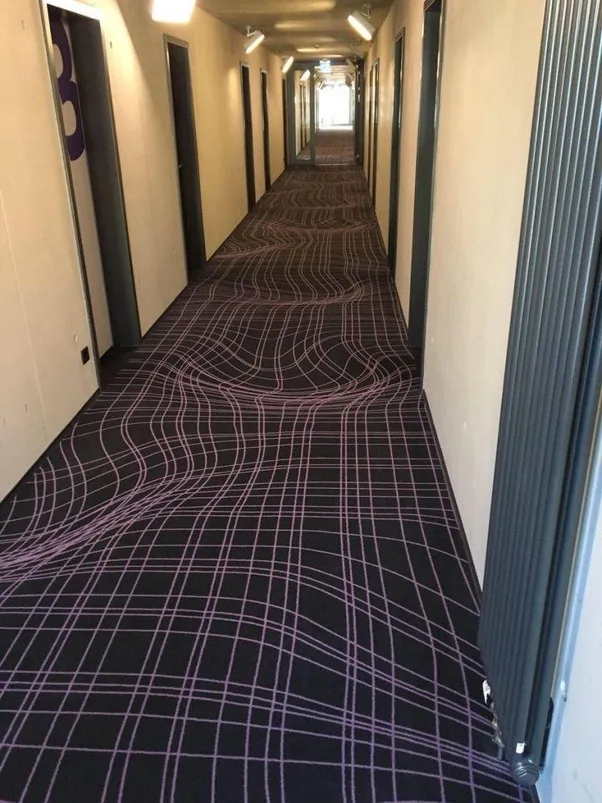
I recently came across a photo of a hotel corridor. Beige walls, a row of dark doors, a large purple “3” painted on the wall. Nothing remarkable, except the carpet: black, covered with a grid of purple lines that sink, rise and ripple like a rough sea.
The floor is flat. The door frames, skirting boards and radiator stay perfectly straight. Only the grid bends. Yet the first time you lay eyes on it, your brain hesitates. It tells you to slow down, to lift your foot, to watch out for a step that doesn’t exist.
That carpet reminds me of what I do to my audiences. I open most of my keynotes with an experiment that lasts a few seconds and traps the brain of the whole room. I won’t describe it here, the surprise is too precious. I’ll tell you just one thing: the rare people who give the right answer are the ones who have already been through it (My book, chapter 6).
Remember that detail. Everything else in this piece follows from it.
The crosswalk that floats
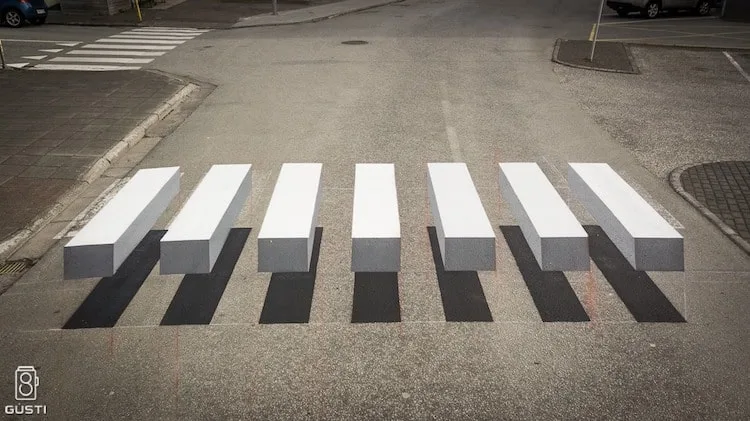
In 2017, Ísafjörður, a small fishing town in north-west Iceland, had a pedestrian crossing painted so that its white stripes seem to float above the road. Seen from an approaching car, they look like blocks laid across the street. The idea came from the town’s environmental commissioner, Ralf Trylla, who had been inspired by a similar design he had seen in India (My Modern Met).
India had led the way. In Ahmedabad, two artists, Saumya Pandya Thakkar and Shakuntala Pandya, painted crossings of this kind at the request of the company that manages the highways, near areas used by schoolchildren. Their starting point was a simple observation: a standard crosswalk slows almost nobody down. Fast Company cites a Swedish study in which drivers stopped for pedestrians only 5% of the time (Fast Company).
The principle is the same as the carpet. The road is flat, but the driver’s brain sees an obstacle. It slows down before it has had time to reason. Your System 1 makes the call, the fast, automatic system that links things without effort. Your System 2, slower and analytical, hasn’t been consulted yet (My book).
Researchers wanted to measure the effect. A study published in 2019 in the journal FME Transactions compared, in virtual reality, how drivers reacted to a 3D crosswalk and to trompe-l’oeil speed bumps. The authors found statistically significant differences in drivers’ willingness to reduce their speed (FME Transactions).
So far, so good. The crosswalk works.
The day the illusion stops working
Now imagine you live in Ísafjörður. You drive over that crosswalk twice a day, to work and back. The first Monday, you brake. The second, a little less. After a month, your eyes slide over it without seeing it.
That is what research carried out in 2012 at Western Michigan University observed. According to Parking Today’s account of it, the 3D illusions did slow traffic when they were first installed, then the novelty wore off and motorists went back to the behavior they had at an ordinary crossing (Parking Today). I couldn’t access the original study, so I’m giving you this result for what it is: a second-hand account, consistent with what we know about the brain.
Because the phenomenon has a name: habituation. It is the simplest form of learning there is. When a stimulus repeats without consequence, the response decreases (Wikipedia). Your brain saves energy. It files everything it has already seen under “known, harmless” and keeps its attention free for what is new.
In 2018, when a Montreal borough was testing this kind of marking in its turn, the Canadian press was already noting that there were few empirical studies on the long-term effect of these crossings on road safety (Times Colonist). Everyone got excited about the effect on day one. Few people measured day one hundred.
Go back to my opening experiment. The people who don’t fall for it are the ones who have already seen it. Their brain doesn’t even need to reason anymore, it has filed the answer. The driver in Ísafjörður and the person attending my keynote for the second time are living the same phenomenon. An illusion only works on a brain that hasn’t met it yet.
Thomas repainted the same crosswalk four times
Back to our head of transformation.
Thomas’s first innovation day worked like the Ísafjörður crosswalk on its opening day. Employees weren’t expecting anything like it. Their brain saw an obstacle in the routine, it slowed down, it looked. Some people took a chance.
Then Thomas did what most organizations do with something that works: he copied it. Same format, same season, same agenda, same buffet. He repainted the same crosswalk in the same place, four years in a row, and he is surprised that nobody brakes anymore.
The trickiest part is his metrics. Attendance is up. Satisfaction surveys are good. Everything Thomas measures tells him the event is a success. But he measures attendance. The effect shows up nowhere in his spreadsheets. He counts the cars that drive over the crosswalk without checking whether they slow down.
I write it often: our past success can be our greatest enemy. It makes us lower our guard. Thomas’s innovation day has become a comfortable ritual, and comfort is precisely the state in which organizations stop innovating without noticing.
What I apply to my own keynotes
I’m the first one exposed to this trap. A keynote that works is a huge temptation: play it again, identically, everywhere, forever.
That’s why I hold myself to a simple rule. I test something new at almost every talk I give: a new experiment, a new way of presenting a topic, a new conclusion or a new call to action. Even when a segment works very well, I look for ways to improve it or replace it with something more effective. As a result, I never give the same keynote twice (My book, chapter 15).
My opening experiment itself took three years to mature, through trial and error and analysis of audience reactions. And I know it has an expiry date. The day a significant share of the room knows the answer, I’ll have to replace it. Magicians have always known this: a trick is worth the surprise of the person discovering it.
How to repaint your crosswalk
The good news is that habituation can be undone. Psychologists call it dishabituation: when the stimulus changes, or a new stimulus comes in, the response returns (Encyclopedia.com). Your brain starts looking again as soon as the scenery moves.
For Thomas, and maybe for you, here is what that means in practice.
Change the format before it wears out. Don’t wait for boredom to set in before you move. If your innovation day has happened three times in the same form, the fourth one has to surprise. A different venue, a different length, a different audience, different rules. Why not a day with no pitches at all, entirely devoted to testing last year’s idea in real conditions?
Measure the effect rather than attendance. The number of participants tells you nothing about what is happening in their heads. Ask yourself what has changed three months after the event: how many ideas were tested, how many people dared to propose something for the first time.
Borrow fresh eyes. Newcomers haven’t yet filed your scenery under “known.” Ask them what surprises them, what looks odd to them, what nobody notices anymore. They are the only drivers still braking at your crosswalk.
Finally, accept killing what worked. It’s probably the hardest part. A proven format inspires confidence, and nobody likes to abandon a success. Yet an innovation ritual that no longer surprises anyone no longer does its job. It only keeps alive the illusion that you are still innovating.
The essentials
Remember four things:
- An illusion only works on a brain that hasn’t met it yet. 3D crosswalks slow drivers down at first, then the novelty effect fades.
- Habituation is a normal brain mechanism: it stops reacting to what repeats without consequence, to keep its attention available.
- Your innovation rituals follow the same rule. A format repeated identically ends up as scenery nobody sees.
- Measure the effect of your initiatives rather than their attendance, and change the format before it wears out.
Thomas still has time. His fifth innovation day can become a floating crosswalk again, as long as he agrees to repaint the road.
And you, how many times have you repainted the same crosswalk?



References
- (My book) https://philippeboulanger.com/book/
- (My Modern Met) https://mymodernmet.com/3d-crosswalk-iceland
- (Fast Company) https://www.fastcompany.com/3059344/these-optical-illusions-make-drivers-slow-down-for-crosswalks
- (FME Transactions) https://doaj.org/article/070dc111eb9845e6a1dba5a31cc54fb8
- (Parking Today) https://parkingtoday.com/article/crosswalks-in-3d-good-idea-or-hazard
- (Wikipedia) https://en.wikipedia.org/wiki/Habituation
- (Times Colonist) https://www.pressreader.com/canada/times-colonist/20180712/281694025547167
- (Encyclopedia.com) https://www.encyclopedia.com/medicine/encyclopedias-almanacs-transcripts-and-maps/habituation