When a coffee size becomes a weak signal
Today, Starbucks lost a customer over a cappuccino size. This customer is me.
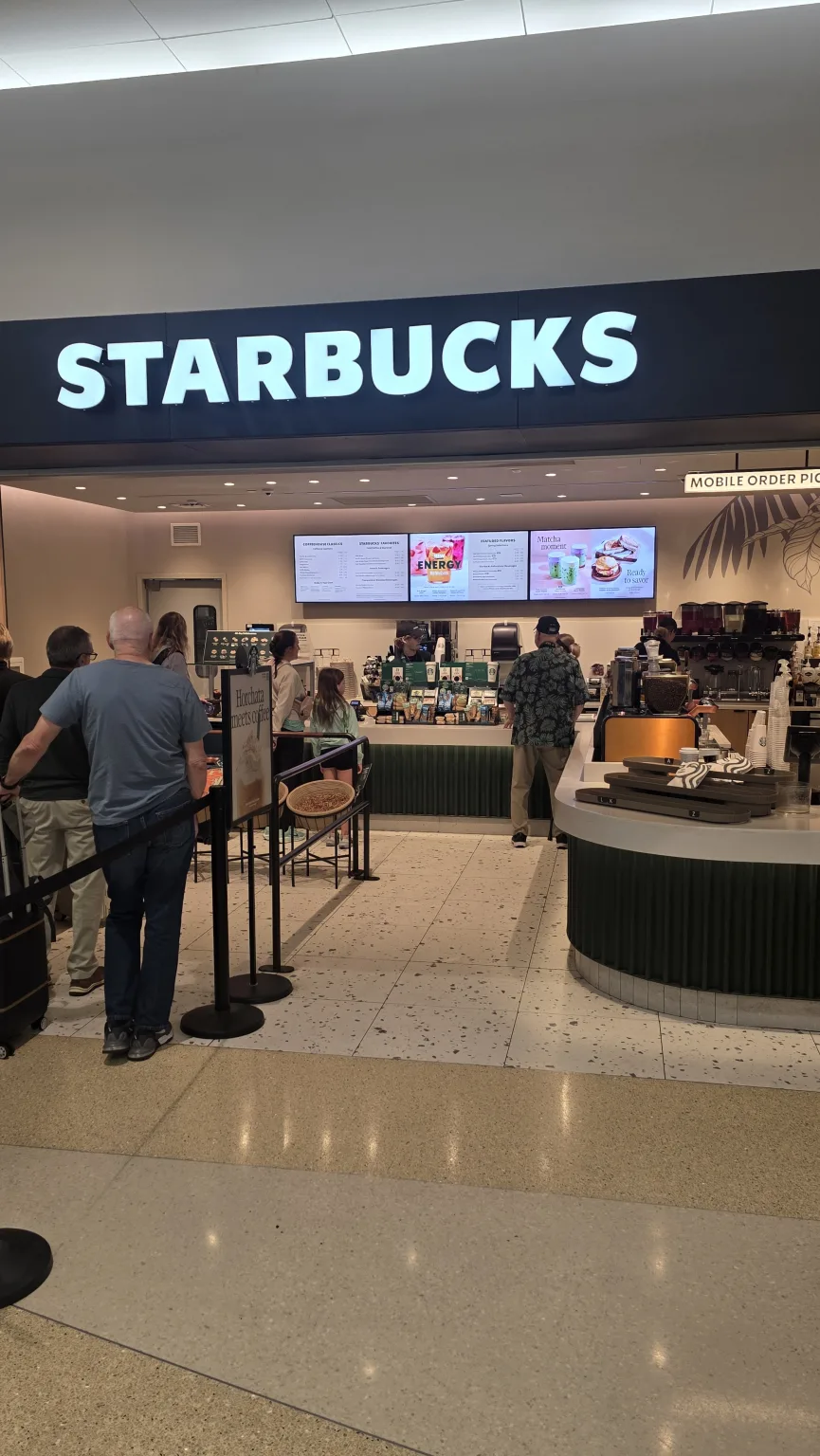
At Sarasota airport, I wanted a small cappuccino.
Not a bucket.
Not a lukewarm foam swimming pool.
Not a demonstration of pricing power.
A small one.
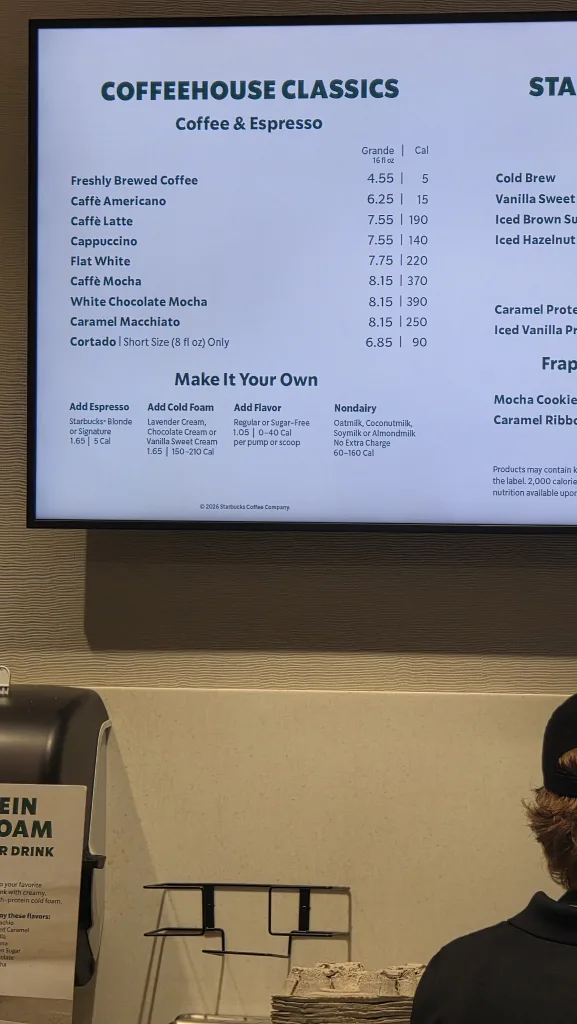
The implicit answer from the displayed menu was simple: here, small does not exist. The only visible option is Grande.
It is tiny.
And it is huge.
Because in an airport, the customer is no longer completely a customer. The customer becomes captive.
He is hungry.
He is waiting for a flight.
He does not have twenty alternatives.
He sees the line.
He understands the message: “You want coffee? You pay more.”
On paper, the logic can look rational.
Higher average basket.
Higher margin.
Higher profit per transaction.
In the lived reality, it feels like a small slap in the face of customer experience.
The problem is not only the price. The problem is the feeling of being trapped.
Starbucks’ official website lists several cappuccino sizes, including Short 8 fl oz, Tall 12 fl oz, Grande 16 fl oz, and Venti 20 fl oz (Starbucks). Sarasota Bradenton International Airport also lists Starbucks among its dining options (Fly SRQ). So the point is not that a small format cannot exist inside the Starbucks universe. The point is that the option was not visible in a context where customer freedom is already reduced.
That is where the experience breaks.
Captive customers remember
A company can sometimes confuse market power with commercial intelligence.
In an airport, the temptation is strong. Alternatives are limited, time is constrained, security has already been cleared, and the traveler cannot simply walk out to compare cappuccino prices across three nearby streets.
The environment becomes a golden cage.
A Vanderbilt Law School analysis of captive pricing notes that airport vendors may benefit from limited competition and passenger restrictions to charge high prices (Vanderbilt Law School). The American Prospect also notes that “street pricing” rules exist in many airports to limit price gaps, but enforcement can be difficult without constant monitoring (The American Prospect).
In plain terms: airports know the issue.
Regulators know the issue.
Customers feel it immediately.
And the feeling of being exploited is far more dangerous than a high price.
A customer may accept paying more at an airport. He knows rent is high, logistics are specific, operating hours are constrained, and staff work in a particular environment.
What he accepts far less easily is the impression that the simplest choice has been deliberately removed.
In customer experience, price is information.
Choice is breathing space.
Constraint is irritation.
When a company removes the breathing space, it turns the transaction into friction.
Forced upsell is not commercial innovation
Upsell can be legitimate.
Offering a larger size, an extra option, an additional product, a richer experience: fine.
As long as the customer still feels he is choosing.
The problem appears when upsell becomes mandatory.
At that point, the company is no longer selling a better option. It is removing the reasonable option.
And that changes everything.
The customer psychology is simple: “I did not choose Grande. I was pushed into Grande.”
That nuance is strategic.
In many companies, entire teams optimize customer journeys to increase average basket size. They test menus, prices, options, bundles, sizes, placements, and purchase sequences.
All of this can be perfectly rational.
Until local optimization destroys the global relationship.
A few extra dollars on one transaction can cost much more in trust capital.
A brand is not only what it promises in campaigns. A brand is what it does when the customer has less power.
That is when the relationship reveals itself.
When the customer is free, commercial courtesy is easy.
When the customer is captive, commercial ethics becomes visible.
The Kano model at the Starbucks counter
This is exactly what I discuss through the Kano model in my book, chapter 12, with the distinction between essential, linear, and exciting features .
In the Kano model, some attributes are basic factors. Their presence does not necessarily create enthusiasm. Their absence creates immediate dissatisfaction. Empirical research on the Kano model confirms the distinction between basic factors, performance factors, and excitement factors (PMC).
In a coffee shop, being able to choose a small size is not an exciting feature.
Nobody is going to post on LinkedIn: “Amazing, Starbucks let me buy a small cappuccino.”
It is a basic expectation.
When that basic expectation disappears, the experience becomes irritating.
That is where many brands get it wrong.
They invest in mobile apps, loyalty programs, seasonal drinks, designed cups, inclusive campaigns, lighting, playlists, and storytelling.
Then they forget one essential detail: allowing the customer to buy what he actually wants.
That detail becomes stronger than the entire marketing layer.
The customer does not remember the logo.
He remembers the moment he felt trapped.
The commercial micro-betrayal
Large brands do not always crack because of a spectacular scandal.
Sometimes, they crack through an accumulation of micro-betrayals.
A removed option.
A hidden size.
A price increase without explanation.
A discount that becomes unreadable.
A customer service path that sends people to a chatbot.
An app that makes cancellation harder than subscription.
A journey that turns customer freedom into a maze.
Each micro-betrayal can look defensible in a spreadsheet.
Each one can be rationalized.
“The margin impact is positive.”
“Conversion is up.”
“Average basket is improving.”
“Customers are not protesting.”
“The line is still long.”
But the absence of protest is not proof of satisfaction.
In an airport, an unhappy customer may buy anyway. He has no time, no energy, and no obvious alternative.
He pays.
Then he leaves.
And sometimes, he never comes back.
Or worse: he tells the story.
Customer experience is judged in asymmetric moments
The customer relationship becomes truly revealing when the power balance is asymmetric.
When the customer is rushed.
When he does not understand all the options.
When he is dependent.
When he is tired.
When he cannot compare.
When he cannot leave.
That is where the company reveals its true level of consideration.
In a world saturated with customer obsession rhetoric, the proof is not in the promise. It is in restraint.
Having the ability to extract more value does not mean you should do it.
That is true in airports.
It is true in software.
It is true in banking.
It is true in insurance.
It is true in subscriptions.
It is true in digital platforms.
It is true wherever the customer becomes dependent on a system.
Companies that confuse dependence with loyalty take a major risk.
Dependence stops as soon as a credible alternative appears.
Loyalty survives the presence of alternatives.
That is the difference.
The trap of “it works, so it is fine”
A line in front of an airport Starbucks can create the illusion that everything is fine.
Customers buy.
Receipts print.
Margin exists.
The flow continues.
But immediate buying behavior does not tell the whole story.
A captive customer can buy while developing aversion toward the brand.
That is one of the blind spots of many organizations: they measure the transaction, but they do not measure emotional erosion well.
They see revenue.
They do not see lost trust.
They see average basket.
They do not see the damaged promise.
They see conversion.
They do not see resentment.
In an economy of attention and recommendation, resentment spreads quickly.
A simple, clear, understandable negative experience becomes instantly tellable.
“I wanted a small cappuccino. They only showed Grande.”
Everyone understands.
Everyone can picture it.
Everyone has lived a similar version of it.
That is why micro-irritants are so powerful. They are universal.
What brands should measure
The right indicator is not only: how much did we make on this transaction?
Companies should also measure:
How much trust did we consume?
How much freedom did we remove from the customer?
How much frustration did we create?
How many customers will return voluntarily?
How many will talk about us with irritation?
How many will now associate our brand with a feeling of abuse?
Useful commercial innovation is not about trapping the customer inside the best possible funnel.
It is about designing an experience where the customer feels respected even when paying more.
Commercial elegance means leaving a door open.
Even if the customer chooses Grande.
Even if he adds an extra shot.
Even if he buys a pastry.
Even if he spends more.
He must be able to say: “I chose.”
That feeling of choice can be worth more than the product itself.
What this scene tells leaders
This cappuccino story may seem anecdotal.
It is not.
It speaks to how companies arbitrate between immediate margin and lasting trust.
It speaks to the temptation to optimize captivity rather than honor the relationship.
It speaks to small operational decisions that seem invisible from headquarters, but become highly visible at the counter.
It speaks to the gap between brand strategy and lived reality.
On a slide, “customer centricity” sounds good.
In front of a menu where the small size has disappeared, the customer hears something else.
He hears: “We have power, and you need us.”
At that moment, the brand loses more than a cappuccino.
It loses a piece of preference.
The real cost of mandatory Grande
Starbucks probably does not need me to sell coffee.
But I no longer need Starbucks to drink a cappuccino.
That is often how the rupture between a brand and a customer begins.
Not with a grand declaration.
With a tiny irritation.
With a feeling of abuse.
With a cappuccino size.
A company can gain a few dollars today by making the captive customer more profitable.
But tomorrow, it may lose something much harder to rebuild: the desire to come back freely.
👉 When does margin optimization become silent destruction of customer experience?
Yes, I also talk about these commercial micro-betrayals in my keynotes, workshops, and advisory work. This is often where major brands begin to crack.



References
(Starbucks) = https://www.starbucks.com/menu/product/409/hot
(Fly SRQ) = https://flysrq.com/dining
(Vanderbilt Law School) = https://cdn.vanderbilt.edu/vu-URL/wp-content/uploads/sites/412/2025/11/06170435/Price-Gouging-Captive-Customers.pdf
(The American Prospect) = https://prospect.org/2025/12/05/trapped-at-concession-stand-captive-pricing/
(PMC) = https://pmc.ncbi.nlm.nih.gov/articles/PMC5584930/
(WFTV) = https://www.wftv.com/news/local/are-airport-vendors-charging-too-much-food-drinks-action-9-put-them-test/5VULTK6BUJHORGXZO3HCFX5VTM/