An ocean vacuum. This is where we are
The Lépine Competition has just rewarded an ocean vacuum.
Yes, this is where we are.
While some organizations stack green promises into recyclable PowerPoint decks, an inventor from Saint-Junien put his hands directly into the problem.
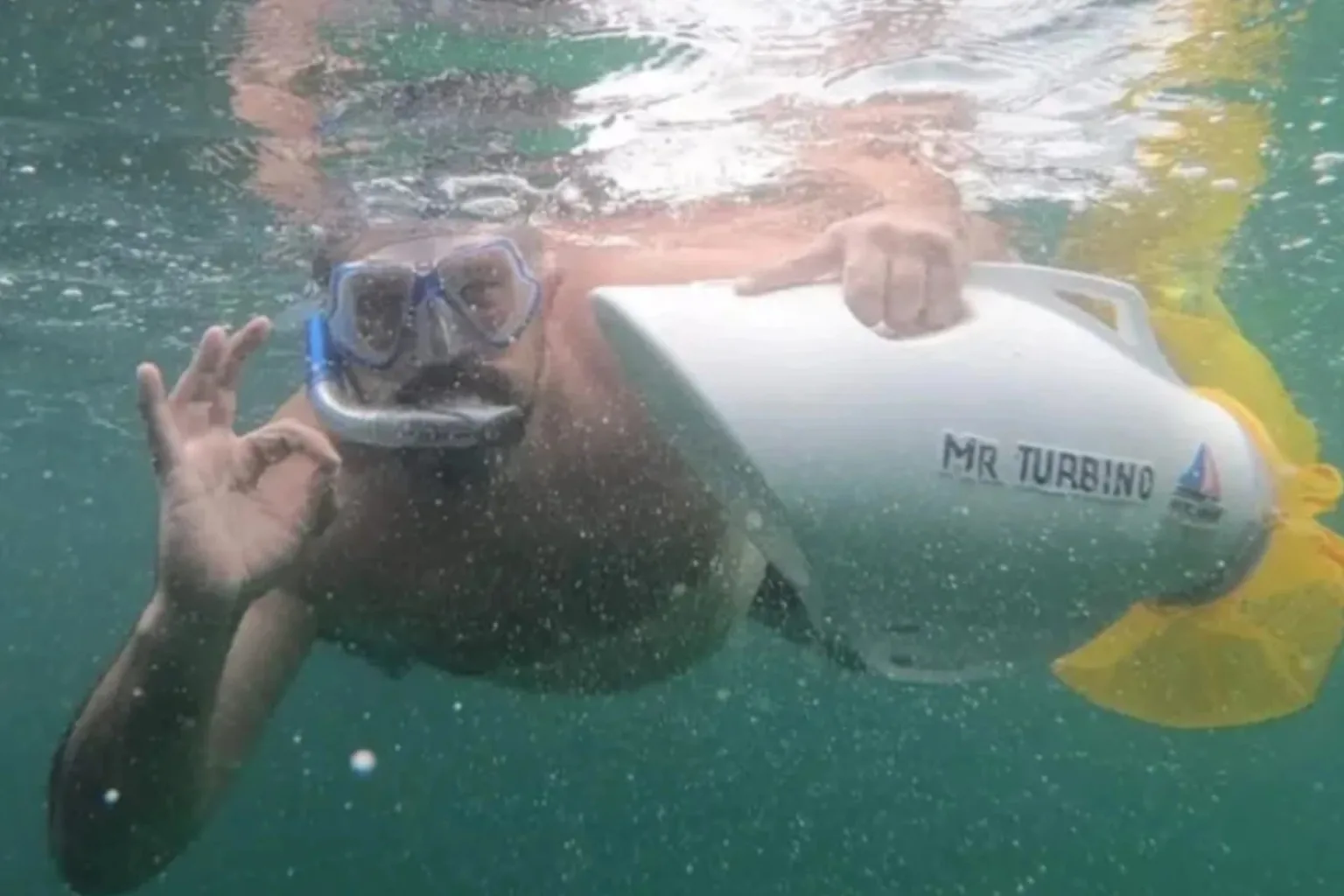
Alan D’Alfonso Peral designed Mr Turbino, an underwater device for seabed cleanup. Mr Turbino’s official website presents it as an eco-friendly underwater robot designed to remove plastic waste while protecting marine life. The same site says missions can be tracked through the Ocean Tracker app. (Mr Turbino)
The solution is also listed in the Solar Impulse Solutions Explorer as an underwater pneumatic vacuum using a low-pressure air vortex to safely collect plastic waste. The page identifies Association Recyclamer, based in Saint-Junien, as the organization behind the solution and indicates a maturity level of TRL 9 / CRI 2. (Solar Impulse)
The official 2026 Lépine Competition winners list states that Mr Turbino received the Grand Prix du Concours Lépine, Prix du Président de la République, for this device designed to clean up seabeds. (Concours Lépine)
It almost feels insulting to our era.
We have AI systems capable of writing poems, rockets that land back on Earth, glasses that want to replace our eyes, software agents that write reports, analyze data and respond to customers.
And yet we still need to invent a machine to pick up our trash at the bottom of the ocean.
That contrast says a lot about our time.
We are fascinated by technologies that shine. Much less by technologies that clean. We applaud spectacular demos. We barely look at solutions that confront mud, waste, cold water, physical constraints and real problems.
Yet this is often where innovation truly earns its name.
Innovation goes underwater
The most fascinating part of Mr Turbino is not only the object.
It is the journey.
Years in the field. Prototypes. Tests. Failures. Rebuilds. Conviction. Adjustments. Feedback. Constraints. Limits.
In other words: innovation.
Not the kind that lives in lukewarm-coffee brainstorming sessions.
Not the kind that stays as a clean concept on a white slide.
Not the kind that produces slogans in 42-point font before vanishing into a shared folder.
The kind that turns an idea into implementation.
The kind that accepts that the real world resists, stains, breaks and forces you to start again.
In my book, chapter 3, I draw a distinction many organizations forget: creativity imagines, invention creates, but innovation implements. Without implementation, we cannot speak of innovation.
That sentence should be printed in every executive committee room.
An idea that stays clean on a whiteboard cleans up nothing.
An invention that remains in demonstration mode changes nothing.
Innovation goes underwater.
It confronts the waste.
It comes back covered in reality.
Plastic does not need storytelling
This topic reaches far beyond a beautiful inventor story.
The United Nations Environment Programme estimates that 19 to 23 million tonnes of plastic waste leak into aquatic ecosystems every year. The same source estimates that the volume of plastics already in the ocean is between 75 and 199 million tonnes. (UNEP)
That is the setting.
Not a conference setting.
Not a metaphor.
A physical, measurable, visible and persistent setting.
NOAA explains that microplastics are plastic pieces or fibers smaller than 5 millimeters, sometimes invisible to the naked eye, found throughout the ocean and small enough to be eaten by wildlife. (NOAA)
So the problem will not be solved by changing vocabulary.
We can talk about circular economy. We can talk about sobriety. We can talk about impact. We can talk about responsibility. All these words are useful when they trigger action.
When they dress up inaction, they become another form of pollution.
The Ellen MacArthur Foundation has long promoted a systemic transformation of the plastics economy, with a vision in which plastics no longer become waste. (Ellen MacArthur Foundation)
That vision matters.
But a vision without implementation remains an elegant promise.
Behind the machine, a community of action
There is also an associative ecosystem behind Mr Turbino.
Recyclamer describes itself as a nonprofit association active since 2016 in the protection of aquatic ecosystems. It says it organizes underwater and coastal cleanup missions in France, Spain and the Mediterranean, as well as environmental education programs in schools, marinas and local communities. (Recyclamer)
This matters because environmental innovation is not limited to the machine.
It involves the field.
Divers.
Associations.
Local authorities.
Citizens.
Data.
Education.
Repeated missions.
A robot alone does not change a system.
A robot integrated into a community of action can start moving the lines.
This is what many organizations forget when they talk about innovation. They want the magic object. They want the spectacular technology. They want the announcement that sounds modern.
They forget the ecosystem that makes innovation useful.
Innovation never lives alone. It needs use cases, partners, relays, maintenance, trust, proof and continuity.
It needs a world around it.
Organizations confuse intention with innovation
Organizations love intentions.
They announce ambitions.
They publish charters.
They create committees.
They launch programs.
They organize seminars.
They draw roadmaps.
Then reality arrives.
Insufficient budget.
Competing priorities.
Unclear governance.
Conflicting objectives.
Misaligned functions.
Overloaded committees.
Fear of risk.
Fear of failure.
Fear of looking naive.
Fear of getting their hands dirty.
So the idea remains suspended.
It does not really die. It floats inside the organization like an old PowerPoint file nobody dares to delete.
That is exactly where the difference between communication and transformation appears.
A company can communicate about innovation without innovating.
It can have a lab, a chief innovation officer, a wall mural, an annual hackathon, an internal newsletter, a space with colorful beanbags and biodegradable sticky notes.
None of it counts if ideas do not pass the implementation test.
Innovation requires a change of state.
It must move from intention to experimentation.
From experimentation to use.
From use to adoption.
From adoption to impact.
The rest is managerial decoration.
Clean technology does not excuse dirty thinking
Mr Turbino carries an almost ironic dimension.
A device that vacuums pollution sends us back to our own mental pollution: our inability to deal with root causes while celebrating catch-up solutions.
Of course, we need tools to clean up.
Of course, we need machines, devices, technical innovations and entrepreneurs who take action.
But a society that invents plastic vacuums should also ask why it keeps producing so much material to vacuum.
Useful innovation should not only correct damage.
It should also question the systems producing that damage.
This is where the topic becomes deeper for organizations.
Many companies love treating symptoms.
A customer complains? Create a form.
An employee disengages? Launch a survey.
A process blocks progress? Add an approval step.
A product fails? Change the packaging.
A market shifts? Order a study.
All of this can be useful.
But when nobody goes deep into the problem, the organization merely moves the waste.
It hides it elsewhere.
It renames it.
It compresses it.
Then it wonders why the system still smells.
Innovation accepts the mess of reality
There is a deeply physical dimension to innovation.
Even when it concerns digital tools, AI, data or strategy, innovation eventually meets reality.
A user does not understand.
A customer refuses to pay.
A manager blocks.
A supplier cannot follow.
A regulation slows everything down.
A team gets tired.
A technology promises more than it delivers.
A business model that looked beautiful in Excel collapses when it meets the market.
That is why innovation is not a discipline of pure imagination. It is a discipline of landing.
An idea must land in a use case.
A use case must land in a behavior.
A behavior must land in an organization.
An organization must land in a business model.
And every landing creates friction.
Serious innovators do not run away from friction.
They study it.
They use it.
They learn from it.
That is exactly what many organizations refuse to do.
They want innovation without discomfort.
Transformation without tension.
Creativity without contradiction.
Impact without effort.
Growth without self-questioning.
Result: clean intentions and dirty outcomes.
From “we should” to “we built it”
The oceans will not be saved by slogans.
They will be helped by women and men capable of moving from “we should” to “we built it.”
This applies to ecology.
It also applies to business.
“We should listen better to customers.”
“We should simplify our processes.”
“We should use AI intelligently.”
“We should reduce our environmental footprint.”
“We should give teams more autonomy.”
“We should stop killing ideas before their first test.”
Fine.
Who builds?
Who tests?
Who funds?
Who makes the decision?
Who accepts useful failure?
Who protects those who take the risk of doing?
Who goes underwater?
Innovation often begins at the exact moment when someone stops waiting for the system to be perfect before acting.
It begins when a person, a team or a leader decides that a problem deserves more than a meeting.
What Mr Turbino tells leaders
Mr Turbino is more than a cleanup device. It is a mirror.
It reminds us that innovation rarely starts with a grand sentence. It more often starts with discomfort, frustration, cold anger or stubborn observation.
Something is wrong.
Someone refuses to get used to it.
Then someone builds.
For leaders, the message is clear: look where your teams see waste you no longer see.
Process waste.
Time waste.
Energy waste.
Talent waste.
Meeting waste.
Abandoned idea waste.
Lost engagement waste.
An innovative organization learns to spot its own seabeds.
It dares to look at what has accumulated below the surface: delayed decisions, unfinished projects, unresolved irritants, broken promises.
Then it builds devices to clean.
Not speeches.
Devices.
Routines.
Decisions.
Budgets.
Experiments.
Responsibilities.
Commitments.
Leave the PowerPoint
The next time an organization announces a major innovation ambition, I would like to ask a simple question:
What is your Mr Turbino?
Not your slogan.
Not your manifesto.
Not your internal campaign.
Your real device.
The one that goes underwater.
The one that collects waste where it actually is.
The one that proves the idea has left the surface.
In every organization, some ideas deserve to leave PowerPoint and get their hands dirty.
Most of them do not require a massive budget.
They require managerial courage.
The courage to experiment.
The courage to learn.
The courage to admit that reality does not obey slides.
The courage to prefer a small imperfect implementation to a large immobile intention.
👉 Which idea in your organization finally deserves to leave PowerPoint and get its hands dirty?
Of course, I address this topic in my keynotes, workshops and advisory work. With, when needed, a vacuum cleaner for dusty ideas.

References
- (Le Populaire) = https://www.lepopulaire.fr/saint-junien-87200/economie/l-inventeur-de-saint-junien-remporte-le-concours-lepine-avec-son-invention-qui-permet-de-depolluer-les-oceans_14983351/
- (Concours Lépine) = https://www.concours-lepine.com/palmares-edition-2026
- (Mr Turbino) = https://mrturbino.com/en
- (Solar Impulse) = https://solarimpulse.com/solutions-explorer-fr/mr-turbino-benthic-plastic-recovery-solution
- (Recyclamer) = https://www.recyclamer.org/
- (UNEP) = https://www.unep.org/topics/ocean-seas-and-coasts/ecosystem-degradation-pollution/plastic-pollution-marine-litter
- (NOAA) = https://marinedebris.noaa.gov/what-marine-debris/microplastics
- (Ellen MacArthur Foundation) = https://www.ellenmacarthurfoundation.org/the-new-plastics-economy-rethinking-the-future-of-plastics