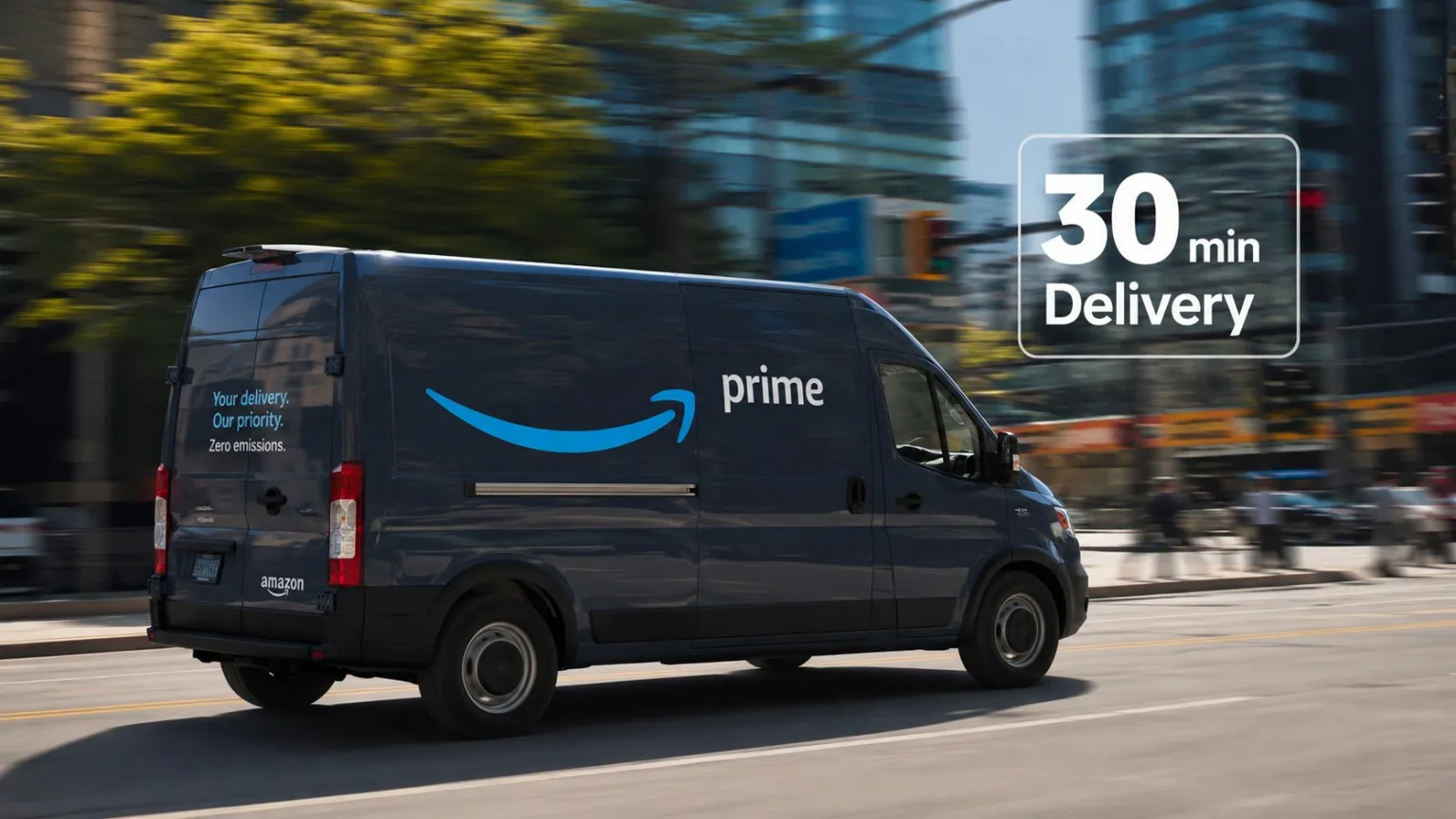
The new frontier of commerce is no longer price. It is impatience.
Amazon has just made your patience obsolete.
For years, we called it online commerce.
In reality, it was still old-fashioned commerce, with a prettier screen.
You clicked.
You waited.
You tracked a package like a digital IV drip.
Then Amazon moved the red line: Amazon Now, 30-minute delivery on thousands of everyday products across several U.S. cities.
Fruit.
Toothpaste.
Eggs.
AirPods before a flight.
A last-minute emergency transformed into a consumption habit.
Suddenly, speed becomes a product.
Amazon is no longer only selling objects.
Amazon is selling the abolition of the mental delay between “I need it” and “it is at my door.”
Speed has become an emotional interface
Many companies still look at delivery as a logistics cost.
Amazon looks at it as an emotional interface.
Waiting creates friction.
Friction creates abandonment.
Abandonment creates an opportunity for whoever knows how to remove friction.
The power of Amazon Now is not only in the 30-minute promise. It lies in the psychological repositioning of commerce: buying moves from planning into reflex.
Before, you made a list.
Now, you fill an immediate gap.
Before, you went shopping.
Now, you trigger an arrival.
Before, delivery was the consequence of an order.
Now, it becomes part of the value proposition.
Commerce is no longer just a transaction. It is an instant answer to a micro-frustration.
Amazon is not just reducing a delay. Amazon is redefining a norm.
This is where the topic becomes interesting for leaders.
Amazon is not only delivering faster. Amazon is changing expectations.
When a company of that scale shifts a norm, customers no longer compare Amazon only with its direct competitors. They start comparing all their experiences with this new level of fluidity.
The slow quote becomes more irritating.
The customer service reply that takes three days becomes less acceptable.
The refund that takes two weeks feels prehistoric.
The internal validation that blocks a decision for ten days becomes absurd.
The sales meeting postponed to the following week becomes suspicious.
Amazon is not only changing e-commerce.
Amazon is increasing collective intolerance toward slowness.
That is the real danger for established organizations: they think they are being compared with their historical competitors. In reality, they are being compared with the best experiences their customers have lived in any sector.
Your customer does not ask: “Is this company faster than its direct competitor?”
Your customer asks: “Why is this still so painful?”
“Day 1” is not a slogan. It is operational discipline.
In my book, chapter 8, I discuss Amazon as a customer-obsessed organization capable of staying in “Day 1” mode through agility, fast decisions, and continuous experimentation.
This logic appears in Amazon’s own communications: the “Day 1” mentality is described as a way of working with the entrepreneurial energy of a first day, while first seeking to earn and keep customer trust.
Jeff Bezos explained it in his 2016 shareholder letter: customer obsession protects “Day 1” vitality because customers remain dissatisfied even when they say they are happy.
Many executive committees should print that idea and put it on the door of their meeting rooms.
A satisfied customer is not necessarily an immobile customer.
A satisfied customer can become impatient.
A satisfied customer can be re-educated by a better experience elsewhere.
A satisfied customer can leave without anger, simply because another company removed a friction they had stopped naming.
So 30-minute delivery is not a gadget.
It is a declaration of war against slowness.
The trap: believing this is only about logistics
Of course, not everyone has Amazon’s warehouses, algorithms, drivers, micro-hubs, and financial power.
Not everyone can deliver in 30 minutes.
Not everyone should deliver in 30 minutes.
Not everyone will win by copying Amazon.
The point is not to copy Amazon.
The point is to understand what Amazon reveals: every organization has delays that have become invisible because they are old.
Delays nobody truly defends.
Delays nobody seriously measures.
Delays teams accept because “it has always worked this way.”
Delays customers endure because they have not yet found better.
This is often where innovation begins: in a delay nobody questions anymore.
Where are you making your customers wait for no valid reason?
The dangerous question in any organization is not: “How could we be as fast as Amazon?”
It is far more uncomfortable:
Where are we making our customers wait for no valid reason?
In quotes.
In sales replies.
In internal approvals.
In refunds.
In appointments.
In decisions.
In handoffs between departments.
In follow-ups never sent.
In contracts sleeping in inboxes.
In aging support tickets.
In commercial promises waiting for internal signatures.
Innovation rarely starts with a futuristic big idea.
It often starts with the removal of friction.
One less form.
One less approval.
One automated follow-up.
One clarified deadline.
One faster answer.
One simpler journey.
One decision moved closer to the field.
Some companies dream of generative AI while they have not even reduced customer response times.
Some organizations talk about customer experience while asking customers to wait as if their time had no value.
Some executive teams want to innovate while imposing four signatures to test a simple idea.
Slowness is not always a technology problem.
It is often a cultural symptom.
Speed only matters when it removes real friction
There is a warning, however: speed for the sake of speed can become absurd.
Not every wait is irritating.
Not every urgency is useful.
Not every customer wants to pay more to go faster.
A 2025 McKinsey survey reported that more than 95% of respondents prefer free standard delivery over paid expedited delivery, and that cost is the top factor when assessing e-commerce deliveries.
That is why the issue is not speed alone.
The issue is the perceived value of speed.
Amazon Now is relevant when the removed delay corresponds to a real tension: dinner ingredients, a missing product, non-prescription medication, a forgotten cable, headphones before a flight.
In your company, accelerating a process without understanding the real customer frustration may simply cost more without creating more value.
Accelerating a bad journey does not create a good experience.
Accelerating a bad decision does not create a good strategy.
Accelerating a useless service does not create innovation.
Speed must be aimed at customer friction.
Your real competitor is the new level of expectation
Amazon Now is part of a wider battle around instant commerce. Axios describes this shift as a race where retailers try to deliver certain products faster than customers could go and buy them themselves.
That sentence should make many organizations nervous.
When the external experience becomes faster than the customer’s own action, behavior changes.
Why go out?
Why wait?
Why call?
Why follow up?
Why accept friction?
And above all: why stay loyal to a company that still imposes its internal slowness on the customer?
This goes beyond retail. It concerns banking, insurance, healthcare, industry, professional services, B2B, public services, training organizations, consulting firms, and software companies.
Wherever a customer waits, a company can be replaced by another that has understood that time has become a strategic raw material.
Corporate slowness deserves a public autopsy
Thirty-minute delivery is not a universal model.
But it is a signal.
A signal saying: customers will keep becoming less patient when technology, logistics, and organizations prove that certain waits were artificial.
A signal saying: historical delays will become harder to defend.
A signal saying: innovation is not always found in a new product, but sometimes in the disappearance of an irritant.
That is precisely why I dissect this kind of mutation in my keynotes, workshops, and advisory work.
Because corporate slowness sometimes deserves a public autopsy.
Not to humiliate teams.
To free customers.
To wake up leaders.
To confront the organization with its real frictions.
The question to ask now in your business:
Which “normal” delay is becoming unbearable for your customers?
And above all: who in your organization still benefits from treating it as normal?



References
(TechCrunch) = https://techcrunch.com/2026/05/12/amazon-expands-30-minute-delivery-across-the-u-s/
(Amazon) = https://www.aboutamazon.com/news/retail/amazon-now-30-minute-delivery
(AP News) = https://apnews.com/article/amazon-30-minute-delivery-ultrafast-cities-6d22ea18737c99098ff7e6a4ee918bf3
(Axios) = https://www.axios.com/2026/05/12/amazon-delivery-speed-war-walmart-target
(McKinsey) = https://www.mckinsey.com/industries/logistics/our-insights/what-do-us-consumers-want-from-e-commerce-deliveries
(Amazon 2016 Letter) = https://www.aboutamazon.com/news/company-news/2016-letter-to-shareholders
(Amazon Europe) = https://www.aboutamazon.eu/who-we-are
(Amazon Prime Delivery Record) = https://www.aboutamazon.com/news/retail/amazon-prime-same-day-next-day-delivery-2025