The body has entered the age of control panels
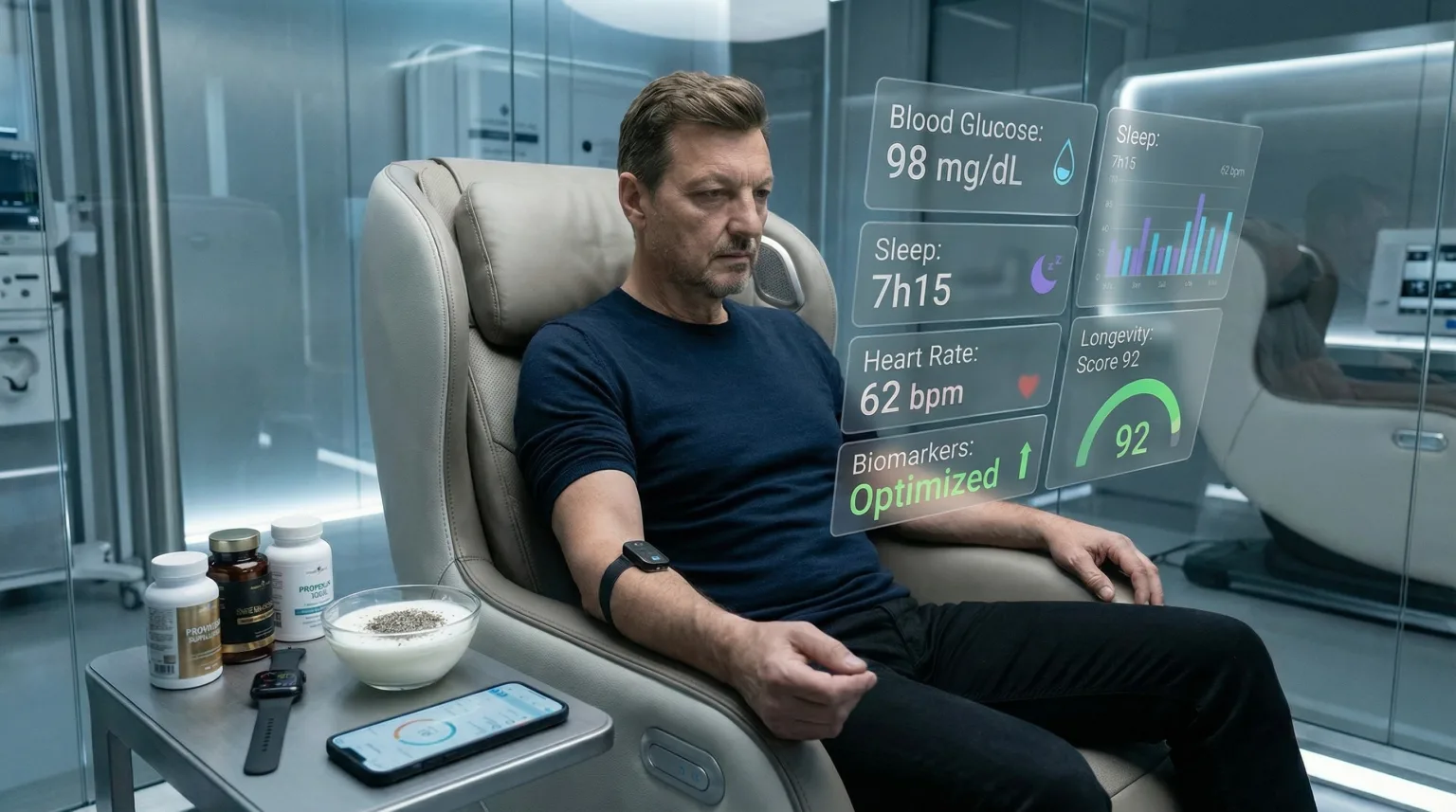
Yesterday, eating well was common sense. Today, it increasingly looks like an interface.
We no longer eat only to nourish ourselves. We eat to read signals, track curves, compare variations, anticipate aging, and regain control over a body we long left to instinct, doctors, or chance.
A glucose sensor on the arm.
A watch tracking sleep.
An app rating your meal.
An intermittent fasting protocol.
A “longevity” check-up sold like a strategic investment.
This shift is fascinating because it reveals a deep cultural change. We no longer want only to live better. We want to measure what is happening inside us. We no longer want to wait for the verdict. We want to intervene before it arrives. We no longer want to endure aging. We want to negotiate with it.
That is where biohacking begins. Not in science fiction. Not in a basement full of machines. It begins in the kitchen, in the bathroom, in the morning routine, in the daily relationship with sugar, sleep, energy, and fatigue.
That is precisely why the topic has become strategic.
From wellness to dashboards
This movement is no longer marginal. Demand around healthy aging keeps growing, and McKinsey notes that up to 60 percent of consumers across markets say healthy aging is a “top” or “very important” priority. At the same time, new services are multiplying: epigenetic age tests, supplements claiming to slow cellular aging, remote physical therapy solutions, and personalized prevention offers.
In other words, the market understood something before many institutions did: health is no longer seen as only a medical issue. It is becoming a personal operating system.
The moment an anxiety can be measured, it can be sold.
The moment a longevity promise can be framed, it can be marketed.
The moment an indicator can be displayed in an app, it becomes an engagement lever.
The body is no longer only an organism. It becomes a system to optimize.
That is where innovation steps in. Not as a gimmick. As a transformation of the relationship to self.
Biohacking is useful when it keeps a compass
In my book, chapter 17, I explain that biohacking becomes valuable when it relies on a simple logic: vision, methods, experimentation, and learning. I also note that tools exist to experiment and measure what suits us, and that what suits us is individual.
That changes everything.
Intelligent biohacking does not mean obeying numbers blindly. It means observing, testing, learning, and adjusting.
In the same chapter, I also point out that the order in which foods are eaten can reduce glucose spikes, and that a twenty-minute walk after a meal can help blunt them.
That is the crucial distinction.
On one side, there is lucid biohacking, almost humble.
It measures to understand.
It experiments to improve.
It learns to decide better.
On the other side, there is anxious biohacking.
It measures to self-soothe.
It multiplies signals.
It confuses data with truth.
It turns every meal into a permanent clinical inspection.
The first clarifies.
The second drains.
The sensor does not think for you
Continuous glucose monitors capture this ambiguity perfectly.
In 2024, the FDA cleared the first over-the-counter CGM in the United States for adults not using insulin, including people without diabetes who want to understand how diet and exercise affect blood sugar.
That sends a massive market signal. When a medical technology moves into consumer space, its status changes. It no longer only treats. It also educates, seduces, worries, and retains.
But Harvard Health also points out that there are still relatively few studies on the usefulness of these monitors for people without diabetes, and that there is currently no solid evidence of their value for that population.
That is the modern paradox.
Technology moves faster than our collective judgment.
The market moves faster than scientific consensus.
The desire to know moves faster than our ability to interpret what we see correctly.
The danger is not the tool. The danger is the illusion of mastery the tool can create.
A graph does not make you wise.
A score does not make you healthy.
A notification does not make you clear-sighted.
Aging is no longer only a destiny. It is a business model.
The subject becomes even more sensitive when longevity enters the conversation.
Approaches related to cellular reprogramming and slowing aging are gaining visibility. Clarivate notes that partial epigenetic reprogramming has advanced rapidly toward human trials, with a highly ambitious goal: resetting cellular age without triggering major risks such as cancer.
We have therefore moved from an imagination of prevention to an imagination of reprogramming.
For a long time, health aimed to avoid the worst.
Now part of the market promises to delay wear, push back decline, and sometimes even rewrite part of the biological trajectory.
This is where leaders, experts, and consumers need to recover some composure.
The bigger the promise, the more formidable the marketing can become.
The stronger the hope, the thinner the line becomes between serious medicine, careful experimentation, scientific storytelling, and the business of fear.
Biohacking touches a very deep nerve of our era: a growing intolerance for vulnerability.
We tolerate less and less the idea of a body that fluctuates, tires, slows down, or stays partly opaque. We want signals. We want proof. We want levers. We want controls.
The problem is that living systems have never been obedient machines.
Control reassures. Obsession distorts.
The backdrop is broader than sensors or clinics.
We live in societies where overweight and obesity continue to rise at scale. WHO reports that in 2022, 1 in 8 people worldwide were living with obesity, adult obesity had more than doubled since 1990, and adolescent obesity had quadrupled.
In England, NHS data published in 2026 still showed that, for 2024, 30 percent of adults were living with obesity and 66 percent were either overweight or living with obesity.
In that context, dismissing measurement tools, nutritional protocols, intermittent fasting, or better routines would make little sense. Scientific literature on intermittent fasting suggests possible effects on some metabolic markers and aging-related pathways, even though those effects do not translate identically to everyone.
So the point is not to mock biohacking.
The point is to resist its religious drift.
Beyond a certain threshold, optimization stops being hygiene and becomes surveillance.
Beyond a certain threshold, self-attention stops being intelligence and becomes fixation.
Beyond a certain threshold, health innovation stops being lived progress and becomes a permanent state of pressure.
The problem is not data itself. It is its grip.
Useful innovation does not take away your judgment
Biohacking also offers a strong lesson for innovation itself.
People are now looking for the same thing organizations want:
measure what matters,
spot weak signals,
test quickly,
correct without drama,
improve before crisis forces the move.
Seen that way, biohacking is a feedback culture applied to the living body.
That is also why it is so compelling.
It gives people the feeling of taking the wheel again.
It turns health into a learning field.
It replaces fatalism with iteration.
That logic is immensely valuable when it stays in service of judgment.
It goes off track when it replaces judgment.
Technology can help you observe.
It should not decide your inner peace.
Measurement can help you improve.
It should not colonize your relationship with pleasure.
Innovation can help you live better.
It should not turn every bite, every night, and every dip in energy into a micro-trial.
What the clearest minds will do differently
The clearest minds will not be the ones who buy every sensor.
They will be the ones who ask three simple questions before adopting a new tool.
What does this actually measure?
What does it really change in my decisions?
What might it damage in my relationship with myself?
The future of personal health will not be decided only by the sophistication of technologies. It will be decided by our ability to remain more intelligent than the dashboards we install in our lives.
Between informed health and sensor religion, there is a ridgeline.
Part of our freedom will be decided there.


References
(WHO) = https://www.who.int/news-room/fact-sheets/detail/obesity-and-overweight
(Harvard Health) = https://www.health.harvard.edu/healthy-aging-and-longevity/should-i-use-a-continuous-glucose-monitor
(FDA) = https://www.fda.gov/news-events/press-announcements/fda-clears-first-over-counter-continuous-glucose-monitor
(McKinsey) = https://www.mckinsey.com/industries/consumer-packaged-goods/our-insights/future-of-wellness-trends
(Clarivate) = https://clarivate.com/life-sciences-healthcare/blog/why-longevity-might-be-biopharmas-next-big-thing/
(New England Journal of Medicine) = https://www.nejm.org/doi/full/10.1056/NEJMra1905136
(Johns Hopkins Medicine) = https://www.hopkinsmedicine.org/news/newsroom/news-releases/2019/12/intermittent-fasting-live-fast-live-longer
(NHS England Digital) = https://digital.nhs.uk/data-and-information/publications/statistical/health-survey-for-england/2024/adults-overweight-and-obesity