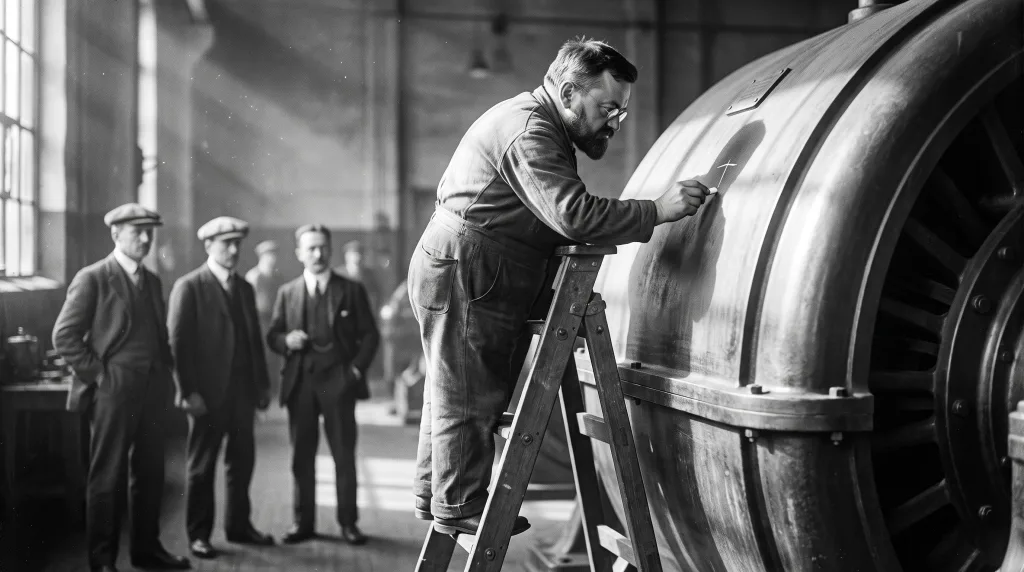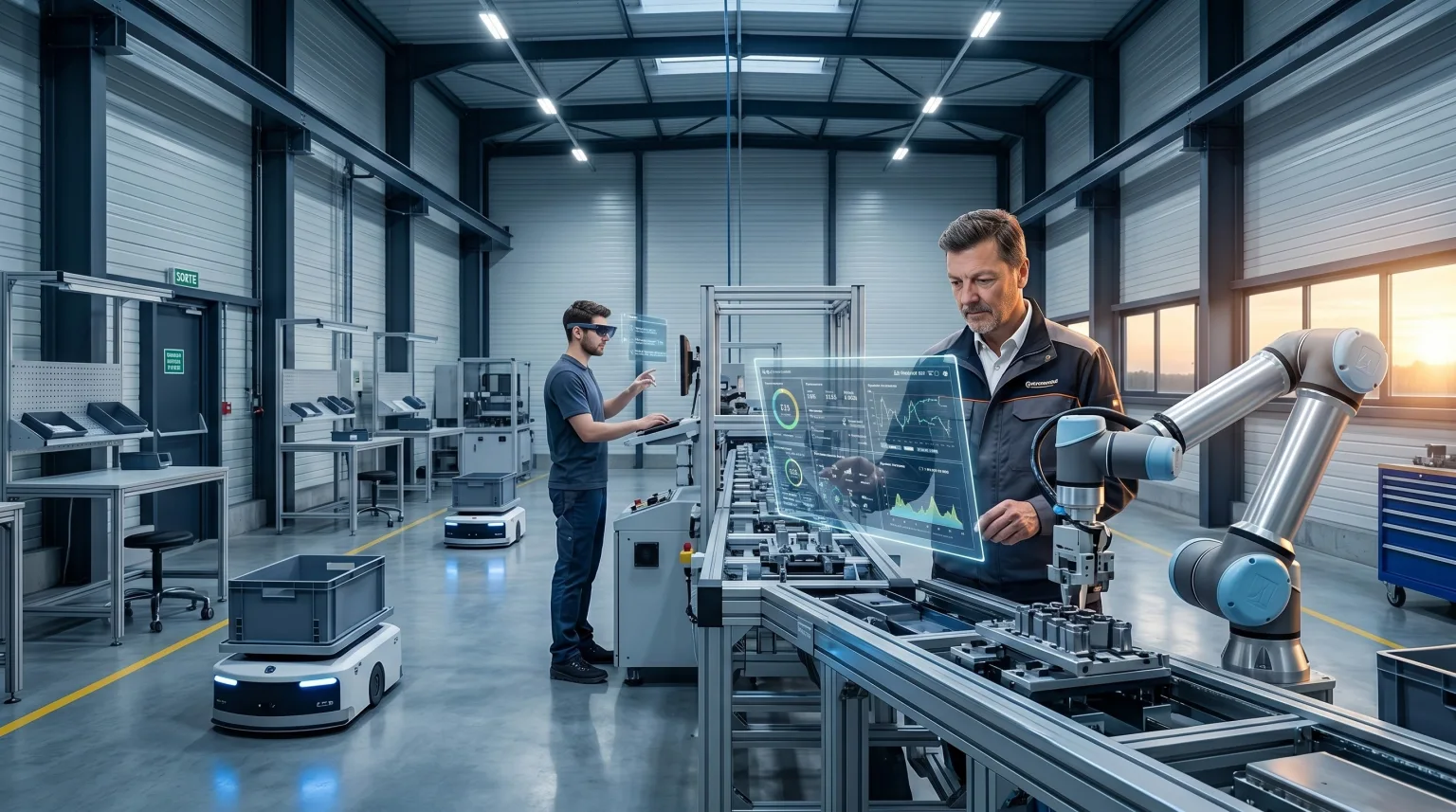
Hiring alone will not save industry.
Public debate loves reassuring solutions. Attract more candidates, open more training programs, improve employer branding, streamline sourcing, and then wait for the system to recover.
The problem is that the industrial equation has changed.
The French government has just presented a national roadmap for industrial attractiveness and employment, targeting 600,000 sustainable hires from 2026, while the sector faces around 1 million retirements by 2030. The same official communication also highlights 220,000 hiring projects in 2025, with 55% considered difficult to fill (DGE, Boursorama).
In other words, this is not a temporary labor shortage. It is structural, persistent, and large-scale.
In that kind of environment, hiring better still matters. Hiring more is no longer enough.
Yes, AI and robots are part of the answer
The key is understanding what kind of answer.
If AI is treated as an office gadget and robotics as trade-show decoration, companies will remain trapped in technological theater.
If, on the contrary, they are used as levers for process innovation, the discussion becomes serious.
In my book, chapter 14, I propose a very simple test:
1. Does AI increase productivity and quality?
2. Does it allow us to do now what was previously impossible?
That filter changes everything.
In industry, it is particularly useful.
A robot that takes over repetitive, dangerous, or physically exhausting work does more than replace a task. It redesigns where human value is best deployed on the factory floor.
An AI system that anticipates equipment failure, accelerates visual quality control, supports planning, turns technical documents into usable knowledge, or captures the decision logic of senior experts before they retire is not a passing trend. It reshapes the company’s ability to produce, learn, and decide.
The OECD explicitly notes that AI in manufacturing contributes to predictive maintenance, quality assurance, worker safety, process optimization, and stronger decision-making. The report also notes that generative AI can help replicate the decision logic of experienced workers, including those nearing retirement (OECD).
The real issue is not the machine, but the industrial model
Many companies still think of labor shortages as a temporary accident.
They are not.
Some skills are leaving the factory.
Others are becoming scarce.
Others must be rebuilt faster than before.
At the same time, expectations around quality, traceability, sovereignty, energy efficiency, and competitiveness keep rising.
In that context, treating the problem only through recruitment is like pouring water into a leaking bucket without looking at the hole.
The real challenge is this: how do you create more value with less friction, less dependence on hard-to-find skills, and more operational resilience?
That is where AI and robotics become strategic.
Not as magical replacements for humans.
As capacity multipliers.
Industry needs intelligent automation, not decorative automation
The countries moving fastest industrially are not waiting for the labor market to become comfortable again. They are redesigning their production systems.
According to the IFR, global robot density in manufacturing reached 177 robots per 10,000 employees in 2024. In Europe, it rose to 148 robots per 10,000 employees. The IFR also points out that governments are supporting industrial modernization, but that these programs mainly benefit companies already aware that robotic automation solves a real problem (IFR, IFR).
That point matters.
The delay is not always technological.
It is often cognitive.
Many companies know how to buy a machine.
Far fewer know how to redesign the process around it.
Many know how to launch an AI pilot.
Far fewer know how to redefine roles, skills, information flows, and performance metrics so that the pilot becomes a real transformation.
Useful automation requires managerial maturity.
Hiring still matters, but its purpose is changing
This is the paradox.
The more intelligently industry automates, the more it still needs people.
Just not for the same roles.
It needs technicians who supervise.
Operators who can run robotic cells.
Maintenance teams able to interpret weak signals.
Hybrid profiles between production, data, quality, and field operations.
Managers who understand that the scarce skill is no longer just execution, but orchestration.
Even the government roadmap points in that direction when it stresses the rapid evolution of required skills, the need to adapt training, develop innovative recruitment methods, and support SMEs and mid-sized companies (DGE, Higher Education and Research).
This means recruitment must move from a replacement logic to a recomposition logic.
You do not replace retirement one-for-one in an industry that is transforming.
You redesign the value chain.
The most expensive mistake: adding tools without redesigning processes
This is where many organizations sabotage themselves.
They want AI without strategy.
Robotics without flow redesign.
Automation without upskilling.
Modernization without managerial courage.
The result is predictable: a few demos, a few licenses, one robotic cell, one press release, and then the same bottlenecks, the same absurd validation loops, the same silos, and the same fears.
A process innovation only has value when it truly changes how production happens.
In my book, chapter 14, the principle is clear: AI should redefine how work gets done, and its adoption becomes effective only when it follows a structured, iterative logic supported by vision, an exploration team, and deployment metrics.
Without that, the tool is absorbed by the existing disorder.
And disorder wins.
The deepest French issue is cultural
France does not only lack workers.
It sometimes lacks clarity about what should be automated first.
In some cases, the task should be automated.
In others, the documentation flow.
In others, anomaly detection, scheduling, knowledge transfer, or workstation safety.
And in a significant number of companies, what urgently needs automation is the managerial reflex that assumes a twenty-first century industrial transformation can be handled with a twentieth century HR toolkit.
Recruitment is a lever.
Training is a lever.
Employer attractiveness is a lever.
Retention is a lever.
But the winning sentence is different: produce differently.
AI and robots are therefore not the solution.
They are part of the solutions when they are embedded in a strategy that transforms processes, skills, and management.
Otherwise, companies will keep struggling to hire in order to feed a system that has become too fragile to hold for long.
What must change now
French industry will not win the talent battle simply by promising jobs.
It will win by proving that it knows how to transform work.
It will win by removing from people the tasks that wear them down, expose them, or slow them down.
It will win by capturing know-how before it leaves through retirement.
It will win by using AI and robotics to improve quality, safety, knowledge transfer, and decision-making capacity.
It will finally win when leaders understand that a labor shortage is not only an HR issue.
It is a signal for industrial redesign.
References
(Boursorama) = https://www.boursorama.com/actualite-economique/actualites/un-million-de-departs-a-la-retraite-d-ici-2030-face-au-besoin-de-main-d-oeuvre-dans-l-industrie-le-gouvernement-annonce-un-plan-pour-faciliter-les-recrutements-995029c6d439a49215cd04b3fcdfa585
(DGE) = https://www.entreprises.gouv.fr/la-dge/actualites/une-feuille-de-route-nationale-pour-renforcer-lattractivite-et-lemploi-dans-industrie
(Ministry of the Economy) = https://presse.economie.gouv.fr/le-gouvernement-presente-la-feuille-de-route-nationale-pour-lattractivite-et-lemploi-dans-lindustrie/
(France Travail) = https://www.francetravail.fr/candidat/decouvrir-le-marche-du-travail/besoins-en-main-doeuvre.html
(IFR) = https://ifr.org/ifr-press-releases/news/robot-density-surges-in-europe-asia-and-americas
(IFR Executive Summary) = https://ifr.org/img/worldrobotics/Executive_Summary_WR_2025_Industrial_Robots.pdf
(OECD) = https://www.oecd.org/en/publications/progress-in-implementing-the-european-union-coordinated-plan-on-artificial-intelligence-volume-2_3ac96d41-en/full-report/ai-in-manufacturing_5df4a60d.html