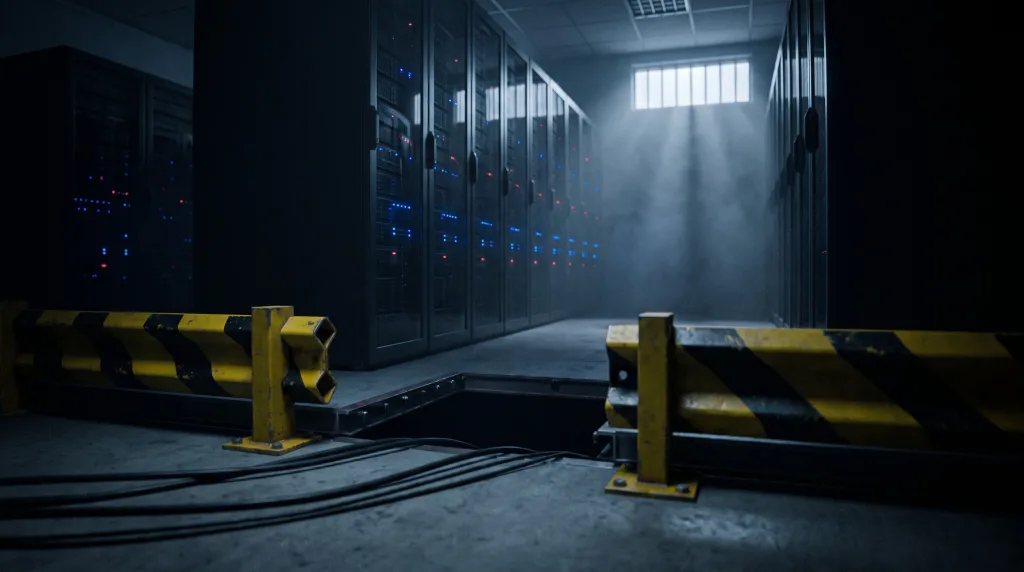
For months, we were sold the same disaster movie.
AI arrives.
Jobs collapse.
Humans watch the machine steal their chair.
Except the story is subtler. And much more dangerous.
OpenAI has published The AI Jobs Transition Framework, an analysis of more than 900 occupations covering almost the entire U.S. labor market. The result: 18% of jobs face high short-term automation risk, 24% are likely to be transformed, 12% could grow thanks to AI, and 46% appear less likely to experience significant short-term change. (Blog du Modérateur)
Not 80%.
Not everyone.
18%.
But here is the trap: being spared does not mean staying intact.
The job survives, the way of working disappears
The public debate loves simple numbers.
How many jobs destroyed?
How many roles replaced?
How many humans still useful in the org chart?
This obsession is reassuring because it turns a systemic shift into a spreadsheet. One red cell, one orange cell, one green cell. Job threatened. Job transformed. Job protected.
Work does not obey such comfortable sorting.
A role can keep its title while losing 60% of its historical gestures. A salesperson can remain a salesperson, but no longer prospect, qualify, write, follow up or prepare meetings in the same way. A lawyer can remain a lawyer, while research, synthesis and document preparation shift toward AI tools. A marketer can remain a marketer, while producing, testing and personalizing at a speed that makes old campaign cycles obsolete.
The job does not always disappear.
Its old grammar does.
AI does not only replace. It recomposes.
OpenAI emphasizes a key point: technical exposure to AI alone does not predict the disappearance of a job. Some occupations still depend on human necessity, whether physical, relational or regulatory. OpenAI estimates that these forms of human necessity apply to 80.7% of the jobs analyzed. (Blog du Modérateur)
In other words, the machine may perform part of the work, but humans remain necessary to act in the real world, create trust, assume responsibility or validate a decision.
This is exactly where many companies will make mistakes.
They will think the challenge is to replace tasks.
The challenge is to redesign work.
Replacing a task without rethinking the job is like installing an electric engine in a cart and wondering why it still does not look like a Tesla.
The danger is not disappearance. It is inertia.
In my book, I explain that AI is not only a technology: it is a process innovation (my book, chapter 14).
It changes the way we produce, decide, write, sell, diagnose, organize, create, learn and cooperate.
This is where the shift becomes deep.
A company can use AI and remain trapped in its old meetings.
It can automate minutes and keep slow decisions.
It can generate content faster and produce more noise.
It can equip teams without transforming methods.
It can buy the rocket and keep driving it like a scooter.
The issue is not only tool adoption.
The issue is the absence of organizational thinking around the tool.
Stanford’s 2025 AI Index notes that 78% of organizations reported using AI in 2024, up from 55% the year before, and that research shows productivity gains in several contexts. (Stanford HAI)
But using AI and transforming work are two very different things.
Saved time can become a trap
AI’s naive promise can be summarized in three words: save time.
Fine.
To do what?
If saved time is only used to stack more tasks into the day, we will have created a machine for accelerating exhaustion.
If saved time is used to send more emails, produce more slides, respond faster to more demands, we will not have improved work. We will have industrialized agitation.
The strategic issue lies elsewhere: what happens to the quality of work when AI takes over part of the useless work?
It should help us prepare decisions better.
Listen to customers better.
Support employees better.
Learn better.
Write better.
Sell better.
Design better.
Live better at work.
The ILO has also stated that the dominant effect of generative AI may be job augmentation rather than full automation. (ILO)
That is the decisive terrain: augmentation, not only substitution.
The company must speak before it automates
The companies that fail with AI will not necessarily be those that lay off too many people.
They will be those that automate without vision, communication or psychological safety.
Those that announce tools without explaining what changes.
Those that speak about productivity without speaking about skills.
Those that promise efficiency and deliver anxiety.
Those that ask employees to be agile while management remains frozen.
The OECD notes that AI is transforming labor markets, workplace practices and hiring processes, bringing opportunities as well as risks linked to automation, loss of agency, bias, privacy and lack of transparency. (OECD)
AI transformation is not just an IT project.
It is a trust project.
If employees believe every automation prepares their eviction, they will hide their know-how.
If they feel AI is meant to augment them, they will share their irritants, absurd routines and low-value tasks.
In the first case, the organization tenses up.
In the second, it learns.
Jobs will become more hybrid
The OpenAI report also shows that 12% of jobs could see employment growth because of AI, especially when lower costs expand demand. (Blog du Modérateur)
This idea is counterintuitive but essential.
When a task becomes cheaper, it does not always destroy demand. It can increase it. More people can access the service. More projects become economically possible. More variations can be tested.
An AI-augmented designer can produce more options.
An AI-augmented developer can prototype faster.
An AI-augmented consultant can analyze more scenarios.
An AI-augmented trainer can personalize more learning materials.
But this potential growth requires the human role to evolve.
The professional will no longer be only the person who executes.
They will become the person who frames, arbitrates, verifies, contextualizes, humanizes and assumes responsibility.
The rare skill: knowing how to work with AI
McKinsey estimates that up to 30% of hours worked could be automated by 2030 in the United States and Europe, driven by generative AI and other technologies. (McKinsey)
This does not mean that 30% of jobs will disappear. It means the content of work will move.
And when the content of work moves, skills must follow.
The rare skill will not simply be “knowing how to use ChatGPT.”
It will be knowing how to formulate an objective.
Break down a problem.
Identify what can be automated.
Spot what must remain human.
Check quality.
Understand bias.
Protect data.
Communicate clearly.
Evolve collective routines.
AI rewards those who think well before prompting fast.
Management will be judged on clarity
With AI, leaders and managers will be exposed.
Not because AI will immediately replace them.
Because it will reveal their blind spots.
A manager who cannot prioritize will generate more confusion with AI.
A leader who cannot explain a vision will accelerate the fog.
An organization that confuses control with performance will automate distrust.
A culture that punishes mistakes will block useful experimentation.
AI amplifies existing systems.
If the system is clear, it accelerates.
If the system is sick, it spreads symptoms faster.
That is why AI-driven process innovation must be designed with teams, not imposed as another software layer.
Tomorrow’s job begins with a simple question
In your job, is AI mostly removing useless work, or is it already pushing you toward more intelligent work?
This question is more useful than abstract fear of replacement.
It forces us to look at concrete gestures.
Repetitive tasks.
Irritants.
Slow decisions.
Lost information.
Useless approvals.
Meetings that survive only because nobody dared to bury them.
AI may not delete your job.
It may do something more disturbing: show you that your way of working was already outdated.
And then, the HR carpet catches fire fast.


References
(Blog du Modérateur) = https://www.blogdumoderateur.com/openai-metiers-presentent-risque-eleve-automatisation-court-terme/
(OpenAI) = https://cdn.openai.com/pdf/the-ai-jobs-transition-framework_report.pdf
(Stanford HAI) = https://hai.stanford.edu/ai-index/2025-ai-index-report
(ILO) = https://www.ilo.org/publications/generative-ai-and-jobs-global-analysis-potential-effects-job-quantity-and
(OECD) = https://www.oecd.org/en/topics/future-of-work.html
(McKinsey) = https://www.mckinsey.com/mgi/our-research/a-new-future-of-work-the-race-to-deploy-ai-and-raise-skills-in-europe-and-beyond