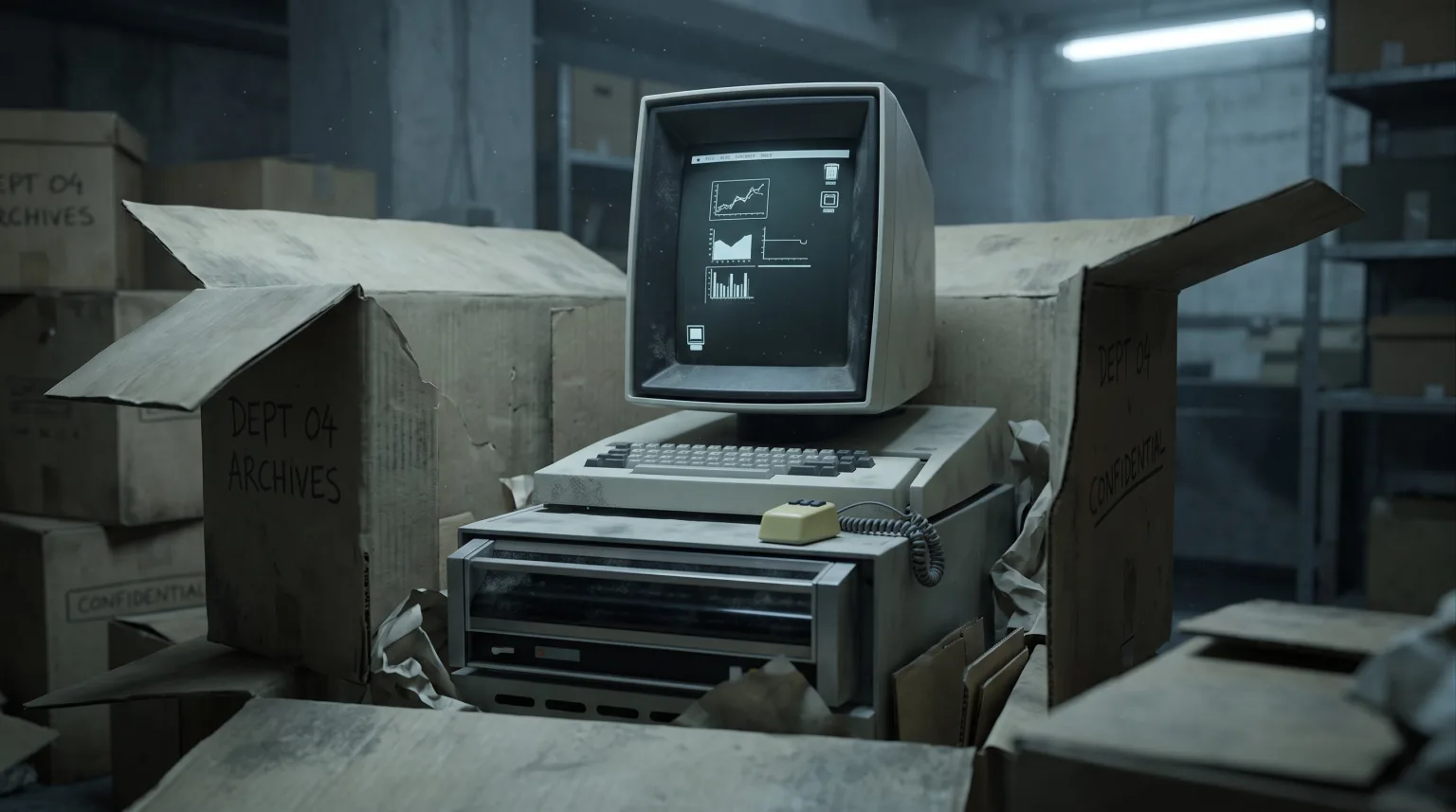
Palo Alto, spring 1973. An engineer sets a machine on a table, switches on a vertical screen the size of a sheet of paper, grabs a small box on wheels and slides a cursor across the display. Around him, Xerox executives watch. In front of them sits the first modern personal computer in the world: windows, menus, a mouse, and an Ethernet network wiring the workstations together (Wikipedia). Nobody in the room says it out loud, but the machine that will shape the next forty years has just been switched on. A few years later, it will sit in a cupboard.
Xerox had done everything by the book. The company had funded a research center in Palo Alto, PARC, with one clear instruction: invent the office of the future. The engineers delivered the Alto, a graphical interface, the mouse, the local network (Computer History Museum). The future was there, on the table. And management buried it. The reason fits in a single word: the Alto used no toner.
I know this scene well, because I have watched it replay a hundred times in boardrooms, wearing different suits and different names. It tells the central paradox of corporate innovation. And it explains why your best idea, the one you believe is out of the box, stands a strong chance of ending up in the same cupboard as the Alto.
The “box” is your business model
When a leader asks you to think out of the box, take a moment to look at what that box actually is. The box is the company’s current business model. Its safety zone, its core competency, the machine that produces this quarter’s numbers. At Xerox, the box was called toner. The money came from big copiers and the ink they consumed. A personal computer promising the paperless office did not threaten a product, it threatened the very source of revenue.
Winston Churchill captured this reflex when he described the entrepreneur seen at times “as a man to be shot down, at times as a cow to be milked.” Xerox milked its cow with discipline. Asking its executives to sabotage that milking in the name of an experimental machine meant asking them to saw off the branch their bonus was sitting on. They chose the branch. And they let Steve Jobs, then others, walk away with the ideas. Jobs would say it plainly years later: Xerox could have owned the entire computer industry (MakeUseOf).
That is the first trap. When leadership calls for out-of-the-box boldness, it is almost always asking for optimization inside the box. It wants you to paint the box a brighter color. It does not want you to set it on fire.
Why your boss cannot say yes
Your manager is caught in the same machinery, and you should understand that before resenting them. A middle manager is not bonused on paradigm shifts. They are measured on indicators tied to the current quarter. A genuinely disruptive idea means risk, ambiguity, heavy upfront cost. If your project needs eighteen months of development, retraining the sales force and cannibalizing an existing product, it threatens their bonus and their security. Most organizations reject these ideas the way a body rejects an incompatible transplant.
In my book, in the chapter on the organizations and structures pillar, I describe the three horizons model, the framework popularized from the work of McKinsey consultants. Horizon 1 is the cash machine, today’s sales, the ones you optimize. Horizon 2 holds the growth engines scaling up. Horizon 3 holds the uncertain bets, where you only have to prove they solve a real customer problem. At Intuit I saw a clear budget split: around 60% to horizon 1, 30% to horizon 2, 10% to horizon 3 (Book).

The Alto was a horizon 3 bet placed on the table of executives paid entirely on horizon 1. Xerox’s tragedy is not a shortage of ideas. It is having handed the fate of a horizon 3 to people whose job, bonuses and survival instinct were welded to horizon 1. Clayton Christensen gave this phenomenon a name in his study of strong companies killed by new technologies: the innovator’s dilemma (Harvard Business Review). Well-managed companies, the ones that listen to customers and invest with rigor, are exactly the ones that miss the next wave.
On top of this economic machinery sits a mental one, and that is where I spend most of my time with teams. Status quo bias freezes a whole team the moment a single cautious member prefers the known order. When the manager or the leader carries that bias, the situation becomes very difficult. I cover it at length in my book, in the chapter on the team’s lived experience (Book). We are not thinking machines that feel, we are feeling machines that think, said the neuroscientist Antonio Damásio. Your boss does not coldly compute the rejection of your idea. They feel it as a threat, before they even analyze it.
The adjacent possible: sell a faster train, not teleportation
If you want to survive corporate innovation, learn to master what the biologist Stuart Kauffman calls the adjacent possible (TED). The idea is simple and formidable: complex systems, in nature as in technology, move forward one step at a time. Each step opens the door to the next room, never the one fifty years ahead. Breakthroughs are almost never the work of a lone genius leaping a generation. They explore the palace of the possible one room at a time.
The operational lesson fits in one image. Do not pitch a teleporter to a railroad company. Pitch a faster train. Frame your innovation as a logical extension of the current workflow, an idea that de-risks the company’s tomorrow rather than a rupture that scares it today. The door you open has to touch the wall of the room your listener already stands in.
This does not mean abandoning ambitious ideas. It means dressing them as a step you can take. Amazon did not start with the cloud, but with books. Netflix did not start with streaming, but with DVDs sent by mail. Each room opened the next. The adjacent possible is the difference between an idea admired in a meeting and an idea funded on Monday morning.
Reading the real request behind “think out of the box”
The next time a leader asks you for an out-of-the-box idea, translate the sentence before you answer. Nine times out of ten, they are asking for a better way to do exactly what the company already does. You can give them that, and earn credit, budget and trust. That is the fuel you will need next.
Here is how I work with the teams I coach. First, measure. Before, during, after. Any innovation idea that cannot say how it will be measured is an assumption, and assumptions should be killed early through experimentation, not framed and hung on the wall. Then, tie the idea to a fear the leader already holds: a competitor moving, a margin eroding, a customer aging. An innovation that answers a fear gets through the door. An innovation that creates a fear stays outside. Finally, slice it. A horizon 3 bet swallowed whole triggers the transplant rejection. The same bet served as three horizon 2 experiments, each profitable and verifiable, gets digested.
And if you truly want to burn the box
There remains the case of real ruptures, the ones that fit no existing horizon because they create their own market. Let us be clear: if you want to build an entirely new box, you will most often have to leave the company and start your own. That is what Jobs did with what he saw at PARC. It is what founders do when they leave after realizing their idea will never survive the organism that employs them.
But a third path exists, the one I defend in my explorations. A company can create and protect a horizon 3 space, a team of enthusiasts I call the SWAT team, kept away from horizon 1 indicators, with its own budget and the right to fail. This is ambidexterity: holding short-term profit in one hand and long-term vision in the other, without asking the same person, bonused on the first, to carry the second. Xerox had PARC. What it lacked was the ambidexterity to turn what PARC invented into a business.
A company that does not innovate is already dead, it just does not know it yet. And agony is a long, painful death. The “Kodak” moment, when the business collapses, arrives fast. The good news is that you do not have to predict that future. You are going to create it. Savior or bystander, dangerous or full of opportunity: you decide.
The essentials
Remember three things:
- The “box” your leadership asks you to escape is its business model, its horizon 1 cash machine. An idea that threatens that machine will be rejected, however brilliant, the way Xerox rejected the Alto.
- Master the adjacent possible: frame your innovation as a logical step that removes an existing risk, a faster train, never a teleporter. Tie it to a real fear of the leader and slice it into measurable experiments.
- To protect a real rupture inside the company, you need ambidexterity: a horizon 3 space, a dedicated budget, the right to fail. Without it, the only way to build a new box is to leave and start your own.
Give this read to your boss. Sometimes waking one conscience is enough to open the first door. Think further. Be different.


References
- (Book) https://philippeboulanger.com/book/
- (Wikipedia) https://en.wikipedia.org/wiki/Xerox_Alto
- (Computer History Museum) https://computerhistory.org/press-releases/xerox-alto/
- (MakeUseOf) https://www.makeuseof.com/xerox-invented-the-future-in-1979-then-handed-it-to-a-24-year-old/
- (TED) https://www.ted.com/talks/stuart_kauffman_the_adjacent_possible_and_how_it_explains_human_innovation
- (Harvard Business Review) https://hbr.org/2015/12/what-is-disruptive-innovation