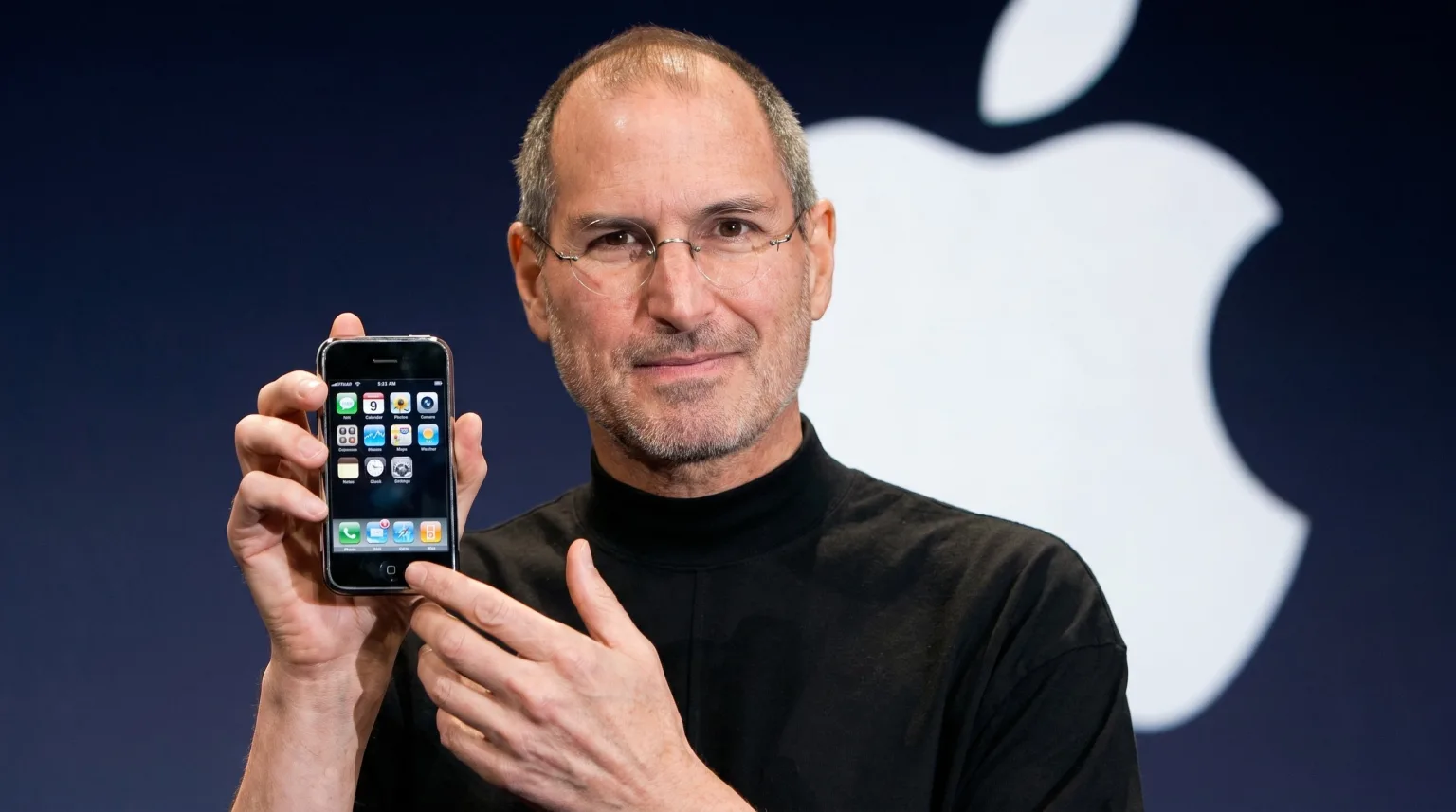
San Francisco, January 9, 2007, a room in the dark
Two thousand people hold their breath. On stage, a man in a black turtleneck walks slowly, a clicker in his hand. He has not shown the object yet. He says nothing about megapixels, processors, or battery life. He drops a single sentence: “Today, Apple is going to reinvent the phone.” (9to5Mac)
Stop on that verb for a second. Reinvent. Not improve. Not upgrade. Steve Jobs had all of those words available, all accurate, all defensible in front of any product committee. He picked the one that moves the frame. And that choice, made before the device even left his pocket, steered how the entire planet would judge what Apple showed that day.
I spent part of my career inside that machine, at Apple after Jobs returned, then at Sony and running R&D at Neopost. I watched excellent products die for lack of the right name, and ordinary products thrive because someone found the right word. The market does not reward value. It rewards perceived value.
Reinvent, a verb that changes the playing field
Take the word “improve.” It installs a comparison at once. Improve against what? Against the BlackBerry, the Nokia, the Treo. Now you are on a comparison table, ticking boxes, physical keyboard versus touchscreen, battery versus thinness. On that ground, the newcomer almost always loses, because it lacks boxes the others have ticked for years.
The word “reinvent” does something else. It steps off the table. It announces that the category itself is about to be redefined, so the old criteria no longer apply. You stop comparing and start discovering. Carmine Gallo, who dissected Jobs’s keynotes, notes that “Apple reinvents the phone” was the only line on the slide, repeated several times during the talk, and already present in the press release sent the day before (Forbes). Nothing was left to chance. The frame was set before the product.
The brain decides before it compares
Here is the part most leaders underestimate. When you hear “reinvent,” your brain does not run a rational analysis first. It reacts. The neuroscientist Antonio Damásio puts it this way: we are not thinking machines that feel, we are feeling machines that think. Emotion comes first, justification follows, and it dresses up a decision that was already leaning one way.
A strong word acts like a switch placed very early on the track. Once the train of your attention has moved onto “transformation,” it becomes costly to return to the “comparison” track. That is why the first word weighs more than the ten technical slides that follow. It does not only describe the product, it installs the lens through which everything else will be judged.
Framing, the bias the best exploit
This mechanism has a name in research: the framing effect. Daniel Kahneman and Amos Tversky demonstrated it experimentally back in 1981. The same information, worded two different ways, produces opposite decisions in the same people (Science). Say “this treatment saves 90% of patients” or “this treatment lets 10% die”: the numbers are identical, the choices are not. Framing shifts preference in predictable ways (The Decision Lab). That work earned Kahneman a Nobel Prize in economics.
You will meet this word, biased, very often as soon as we talk about perception. My Innovational Intelligence™ system rests largely on cognitive biases, because they are the human invariant that technology never changes. Jobs, consciously or by stage instinct, used a positive, category-breaking frame. He did not ask the audience to compare. He asked them to recategorize. And an audience that recategorizes no longer asks “is it better?”, it asks “what did I just see?”. I explore this mechanism in detail in my book, in the chapter on communicating the vision (Book).

What Jobs actually sold: a perception
Look at the numbers, since I always insist on verifying. In 2007, the iPhone was barely 0.5% of Apple’s revenue. Seventeen years later, it brings in more than 200 billion dollars a year, and cumulative sales crossed the 2 trillion dollar mark in early 2025 (MacTech). The product was real, the engineering remarkable. But a remarkable product that is badly framed dies as fast as a mediocre one. Framing turned an excellent device into a civilizational event.
Careful with the easy reading. The word alone did not generate those billions. A lie framed as a revolution collapses at first contact with reality. Jobs could say “reinvent” because he held an object that could prove it three minutes later. Framing does not replace substance, it makes substance visible. When promise and proof line up, perception becomes an accelerator. When they diverge, it becomes a boomerang.
The cost of the lukewarm word
Here is the mistake I see almost every week in brilliant leaders. They build something solid, then describe it with lukewarm words. “An optimized solution.” “An enriched offer.” “An improved version.” These words are honest, cautious, and perfectly forgettable. They place your work on the comparison table from the start, next to better-established rivals, and then you ask the market to make the effort to perceive your value. The market does not make that effort. It keeps the frame you hand it.
Trust plays a decisive role here. A strong word creates a strong expectation. If you announce “reinvent” and deliver “improve,” the penalty is immediate, because the rule is simple: you say what you do, and you do what you say. Good framing is therefore not a seduction exercise, it is a commitment. Choose the strongest word your proof can hold, then hold it.
How to choose the word that moves value
Here is a method you can apply at your next presentation. Take your project and run the exercise out loud, with your team.
First, list the three verbs you would spontaneously use to describe what you are launching. Most of the time, they set up a comparison. Spot them.
Second, for each one, ask: does this word invite comparison or recategorization? If it invites comparison, it puts you on your competitors’ ground.
Third, look for the strongest verb your proof can support in front of a skeptic. Note carefully: that your proof can support. A frame with no proof behind it is an assumption, and assumptions should be killed early through experimentation, before they kill the project.
Fourth, test the sentence on five people who do not know the product. Measure their first reaction. Do they recategorize, or do they compare? You have your answer, and it is verifiable.
This discipline is not Steve Jobs’s innate talent. It can be learned, measured, and repeated. That is exactly what I mean by audacity: you do not have to predict the future of your market, you are going to create it, and the first act of creation is the word you name it with.
The essentials
Remember three things:
- The first word you use sets the lens. “Reinvent” steps off the comparison table, “improve” locks you onto it.
- Perception precedes analysis. The brain feels before it reasons, and the framing effect, demonstrated by Kahneman and Tversky, drives opposite decisions from identical information.
- Framing only has value if it keeps its promise. Choose the strongest word your proof can support, then deliver what you announced.
In business, the way you communicate value is part of the value. Start with a word, and choose it the way Jobs chose his.


References
- (My book) https://philippeboulanger.com/book/
- (9to5Mac) https://9to5mac.com/2022/01/09/steve-jobs-original-iphone-announcement-15-years/
- (Forbes) https://www.forbes.com/sites/carminegallo/2012/10/04/11-presentation-lessons-you-can-still-learn-from-steve-jobs/
- (Science) https://www.science.org/doi/10.1126/science.7455683
- (The Decision Lab) https://thedecisionlab.com/biases/framing-effect
- (MacTech) https://www.mactech.com/2025/02/04/iphone-reaches-historic-milestone-surpassing-2-trillion-in-lifetime-sales/