Lyon, a Tuesday in March, 7:40 a.m. The meeting-room coffee tastes like cardboard. Victor, head of operations at a regional haulage company, projects the new route-planning app in front of twenty team leaders. He has spent six months on this project. He knows every screen by heart.
On the third slide, a loading-dock supervisor raises her hand.
“Your tool ignores Friday afternoon slots. For us, that’s where everything happens.”
Silence. Victor smiles politely, writes down the remark and moves to the next slide. In his head, the box is already ticked: she belongs with the resisters.
Two weeks later, he calls me. “Philippe, the rollout is stalling. The night shifts are dragging their feet, and I don’t know where to start again.”
I ask him one question: “Who, in that room, gave you the most useful information?”
A long silence on the line. Then: “The dock supervisor. She was right about Fridays.”
Victor had filed the person holding the key to his project under the opposing camp.
The person who objects cares about the project
A colleague who challenges your project in public is spending energy on it. They could have kept quiet and waited for the storm to pass. They chose to speak, with all the risk that carries.
That risk is real. Researchers James Detert and Amy Edmondson conducted 190 interviews with employees across all levels and functions. Fear of speaking up, even to offer a suggestion that would help the company, turned out to be widespread, and it rests on implicit beliefs that people bring with them to work (HBS Working Knowledge).
So the person who dares to object has crossed a barrier most of their colleagues never cross. Treating them as an opponent sends the whole room a clear message: around here, silence is safer.
I have watched this mechanism wreck brilliant projects. When a manager belittles the person who brings an idea or a reservation, they lose far more than an idea. They lose the trust of everyone watching, and the team’s psychological safety collapses (My book, chapter 9).

Where the map of allies comes from
This line of thinking has a history. Jean-Christian Fauvet, co-founder of the consulting firm Bossard, developed sociodynamics from the 1970s onward, a way of reading human relationships inside companies. His “strategy of allies” rests on a simple principle: anyone who does not oppose you can become an ally (Consultor).
Olivier d’Herbemont and Bruno César applied this lens to so-called “lateral” projects. These are projects you lead without hierarchical authority over the departments involved, often in a passive environment, sometimes a hostile one (Mollat). Their book La Stratégie du projet latéral, published by Dunod, won the Prix Dauphine Entreprise in 1996 (buecher.de). Its English edition, Managing Sensitive Projects, devotes a full chapter to measuring the players’ sociodynamics, and another to helping allies act (RePEc).
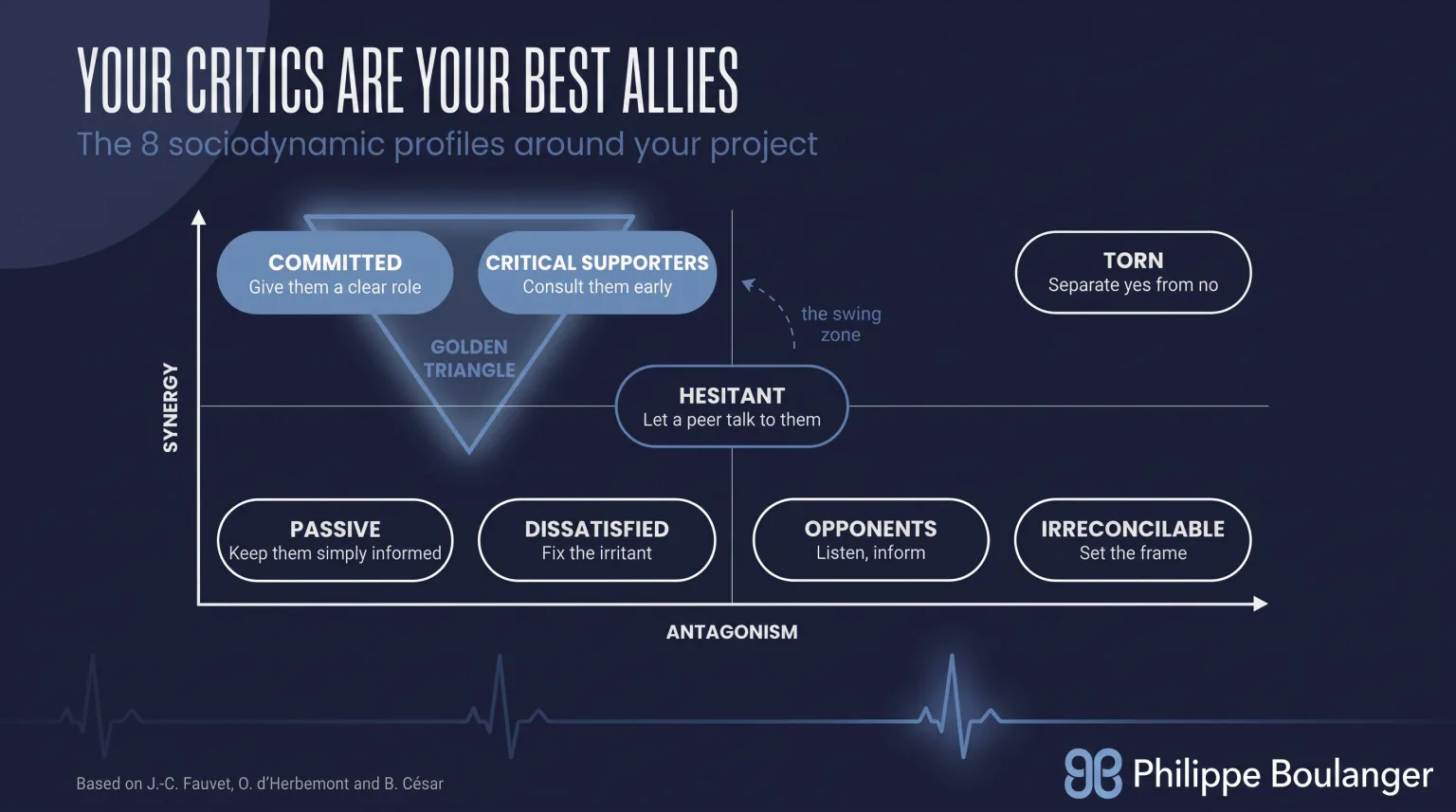
The matrix crosses two axes. The first measures synergy, the energy each person puts into the project. The second measures antagonism, the energy they spend against it. One person can score high on both at once. That is actually the most interesting case.
Eight profiles, eight ways to act
Labels vary from one source to another. I use those from an infographic by Florence Pignot, a leadership trainer and coach. Other versions speak of “grumblers,” “torn” or “rebels” for similar profiles (GRAINE Bourgogne-Franche-Comté).
Critical supporters. High synergy, moderate antagonism. They believe in the project and see its flaws. Show them your work before it is locked: an objection built in early becomes an argument they will carry themselves.
The committed. High synergy, very little antagonism. They are on board without reservation. Give them a precise mission, but avoid making them your only spokespeople. Their enthusiasm reassures the already convinced and rarely moves those who doubt.
The hesitant. A little energy for, a little energy against. According to some sources, they can make up as much as 80% of a group (GRAINE Bourgogne-Franche-Comté). Set up conversations between them and a colleague from the critical supporters.
The passive. Little energy either way. Give them simple, regular information without demanding enthusiasm. They will follow once the hesitant have shifted.
The dissatisfied. Little synergy, and antagonism that mostly shows up as complaining. Listen to what irritates them day to day. Removing one concrete irritant often costs less than a communication campaign.
The torn. Lots of energy for and lots of energy against. Separate with them what they support from what they reject. Treating everything as one block risks pushing them into the opponents’ camp.
Opponents. Strong antagonism, weak synergy. Respect their disagreement and keep them informed, without letting their objections take over every meeting.
The irreconcilable. Maximum opposition. State clearly what remains open for discussion and what is settled. Their disagreement has every right to exist, as long as it does not set the pace for everyone else.
The golden triangle: where to put your energy
In the sociodynamics tradition, critical supporters and the committed form the “golden triangle,” the core of allies to rely on when leading change. The passive, for their part, follow easily once critical supporters and the hesitant are on board (GRAINE Bourgogne-Franche-Comté).
Most managers, like Victor, do the opposite. They spend their meetings answering the irreconcilable and reassuring opponents. Meanwhile, the hesitant watch and wait to see which way the scales tip.
Why do critical supporters carry so much weight? Because they speak the language of the hesitant. They had the same doubts, and they voiced them out loud. When they say “I checked, it holds up,” their word counts for more than your most polished presentation.
I have seen the same thing with “positive deviants,” those employees who get unusual results with the same resources as their peers. Experiments show they are the best placed to explain to colleagues what works (My book, chapter 12). A credible peer succeeds where hierarchy fails.
Why criticism cannot be faked
Some teams try to get around the problem by appointing a “devil’s advocate.” Research by Charlan Nemeth, professor of psychology at Berkeley, shows that authentic dissent broadens thinking and improves decisions. The devil’s advocate role-play, by contrast, does far less to stimulate divergent thought (UC Berkeley).
Your critical supporter therefore has a value you cannot manufacture. Their disagreement is sincere, and that is exactly what makes it useful.
Another trap lies in wait: confusing enthusiasm with contribution. Leadership IQ matched engagement surveys and performance appraisals across 207 organizations. In 42% of them, the lowest performers reported being more engaged than the highest performers (Leadership IQ). This study measures engagement at work, and buy-in for a specific project is a separate measure. It still reminds us that an enthusiastic “yes” and a real contribution have to be measured separately.
Nemawashi, or the art of tending the roots
At Sony, I discovered a Japanese process called Nemawashi. The word comes from agriculture: you prepare a tree’s roots before transplanting it. In practice, before any decision meeting, you meet each decision-maker one-on-one to gather their remarks, and you sometimes build one of their suggestions into the project (My book, chapter 10).
Nemawashi is exactly what critical supporters expect. They want to be consulted before everything is set in stone. Show them a finished project, and their criticism turns into opposition. Ask for it early, and it becomes a contribution.
Back to Victor. After our call, he went back to the dock supervisor and asked for her help configuring the Friday slots. She agreed, on one condition: testing the tool with her night shift before anyone else. Three weeks later, supervisors from the other docks were coming to her with questions.
Start with the right people
How each person feels about your project is beyond your control. The order in which you go and meet people, on the other hand, is entirely up to you.
Take a sheet of paper. Place each key person in your project on the two axes, synergy and antagonism. Then rate yourself from 0 to 5 on this question: how much do you tend to take an objection as a personal attack? If you dislike your score, you are in good company. I have not always been at 5 on that scale myself.
Innovate or agonize: the choice is up to you.
The essentials
Remember three things:
- The person who criticizes your project with arguments is investing energy in it, and often ranks among your best potential allies.
- Focus your efforts on critical supporters and the hesitant, and stop wearing yourself out trying to convince the irreconcilable.
- Consult your critics before the project is locked, so that an objection built in early becomes an argument they will defend themselves.
Nobody climbs this kind of summit alone. Which profile is draining most of your energy right now?



References
- (My book) https://philippeboulanger.com/book/
- (HBS Working Knowledge) https://hbswk.hbs.edu/item/first-look-december-16-2008
- (Consultor) https://www.consultor.fr/articles/une-strategie-qui-marche-cette-preoccupation-des-70-s-tellement-actuelle
- (Mollat) https://www.mollat.com/dossiers/la-gestion-de-projet
- (buecher.de) https://buecher.de/artikel/ebook/managing-sensitive-projects-ebook-pdf/48840186
- (RePEc) https://ideas.repec.org/b/pal/palbok/978-1-349-14842-4.html
- (GRAINE Bourgogne-Franche-Comté) https://www.graine-bourgogne-franche-comte.fr/wp-content/uploads/2021/07/N-A4.pdf
- (UC Berkeley) https://vcresearch.berkeley.edu/node/15171
- (Leadership IQ) https://www.leadershipiq.com/blogs/leadershipiq/35354881-employee-engagement-shocker-low-performers-may-be-more-engaged-than-high-performers