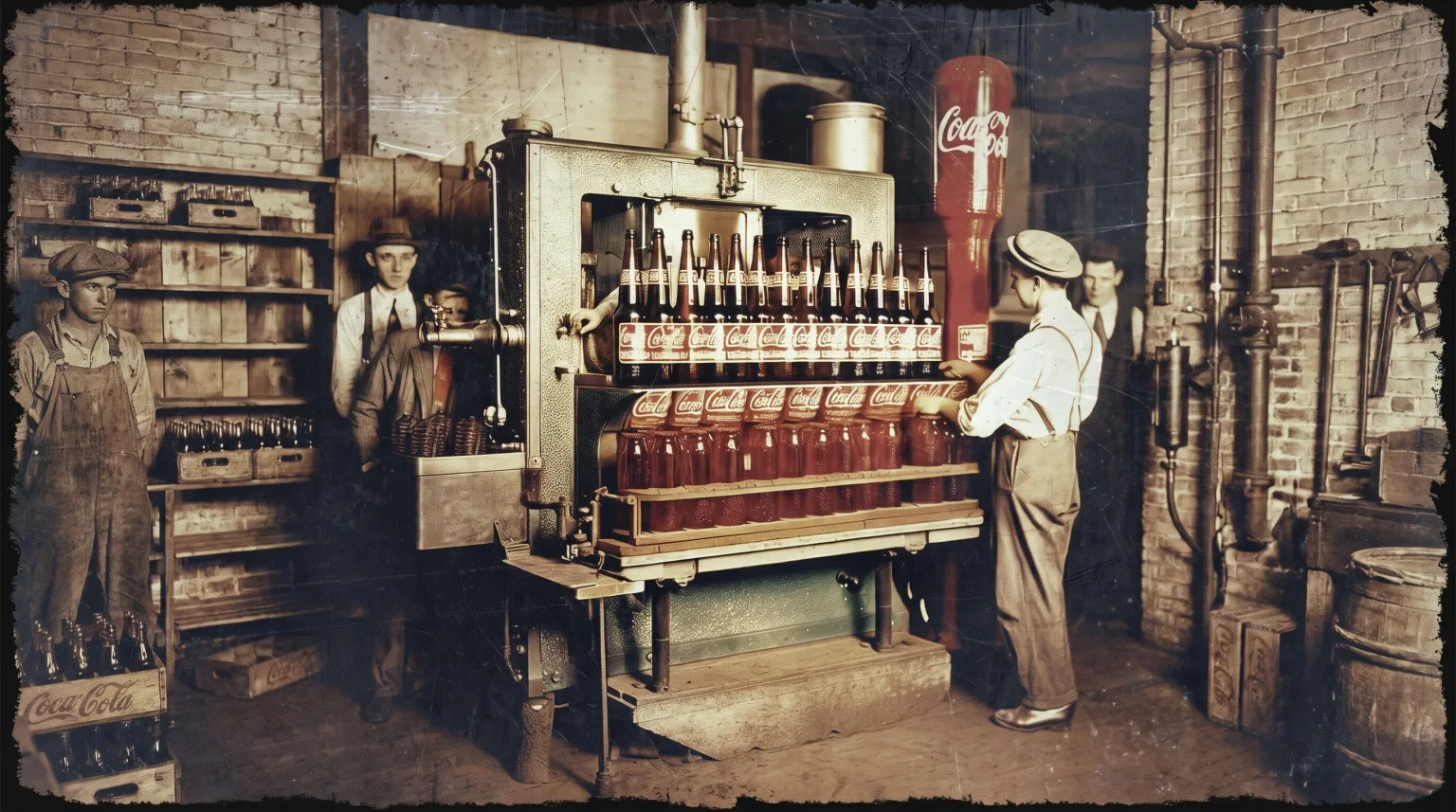
Atlanta, May 8, 1886. At the counter of Jacobs’ Pharmacy, a customer hands over five cents to taste a drink nobody has heard of yet. The syrup was mixed in the laboratory of a local pharmacist, John Stith Pemberton. That day, Coca-Cola is served for the first time. Over its entire first year, it sells an average of nine glasses a day (The Coca-Cola Company).
Two years later, Pemberton is dead. Sick and addicted to morphine, he dies poor after selling off his rights piece by piece (Wikipedia).
In 1919, thirty-three years after that first glass, Asa Candler’s heirs sell the company for $25 million to a group led by Ernest Woodruff (New Georgia Encyclopedia).
Between those two fates lies the whole distance between an invention and an innovation. And I still see that distance today in a great many executive committees.
An inventor who didn’t believe in his own invention
Pemberton was no amateur. Wounded by a saber in April 1865, he became addicted to the morphine he was given for the pain, and spent years looking for remedies that would do without it. His flagship product at the time was French Wine Coca, a coca wine. In 1886, Atlanta and Fulton County passed temperance laws. He urgently needed an alcohol-free version, and that regulatory constraint produced the syrup that would become Coca-Cola (Wikipedia).
Keep that starting point in mind. Coca-Cola was a forced adaptation of an existing product, born from a law. Pemberton showed creativity and arrived at an invention. Then he didn’t know what to do with it.
The most unsettling detail appears in the Lemelson-MIT profile of Pemberton. He apparently saw little potential in his new formula. When Atlanta repealed its prohibition in 1887, he went back to his old coca wine (Lemelson-MIT). The man holding one of the future best-known products on the planet chose to return to the one before it.
Sick and short of money, he sold shares to several partners. In 1888, he sold what he had left for $1,750 and died on August 16 of that same year (Lemelson-MIT).
I want to be fair to him. Reducing his path to an error of judgment would be easy and unfair: illness and addiction weighed heavily. The conclusion stands all the same. The man who created the product could not, or would not, build what needed to surround it.
Without implementation, an invention stays a recipe
I often insist on the confusion between creativity, invention and innovation, because it is expensive. Creativity imagines an original solution. Invention produces something new. Innovation, according to the OECD definition I use, requires implementing a new or significantly improved product, process, marketing method or organizational method. Without implementation, you cannot call it innovation (My book, chapter 3)

Reread the Coca-Cola story through that lens. The product came from Pemberton. The name, the marketing, the distribution and the packaging came from other people. Almost every form of innovation the OECD describes shows up in this story, and none of them is the inventor’s work.
A small wink: in that same chapter, I cite Coca-Cola’s marketing appropriation of the red-and-white Santa Claus as an example of creativity that is neither invention nor innovation (My book). The brand is a textbook case for learning to separate the three notions.
Frank Robinson, the bookkeeper who thought like an ad man
The first act of innovation came from Pemberton’s partner and bookkeeper, Frank M. Robinson. He suggested the name Coca-Cola, explaining that the two Cs would look good in advertising, then wrote out the logo himself in flowing script (The Coca-Cola Company).
Pause on that reasoning. In 1886, a bookkeeper was already thinking about the billboard and about what a passerby would remember. He reasoned like a customer before the product had a single loyal one.
In the organizations I work with, this profile almost always exists. It is rarely on the project team. It sits in finance or customer service, and nobody asks for its opinion on the launch. How many Robinsons do you have on your teams, and who listens to them?
Asa Candler makes the drink unavoidable
Asa Griggs Candler, an Atlanta businessman, bought the business in stages. By 1891, he was its sole owner, at a total cost of $2,300 (The Coca-Cola Company).
Candler believed in advertising, and he proved it. In May 1889, he ran a full-page ad in The Atlanta Journal. He handed out thousands of coupons for a free glass and hammered home slogans urging customers to refuse imitations. By 1892, syrup sales had grown almost tenfold, and he founded a Georgia corporation with $100,000 in capital. In 1895, he told shareholders the drink was consumed in every state and territory of the United States (The Coca-Cola Company).
The free coupon deserves a closer look. Candler removed the first barrier to adoption: the risk, however small, of paying for an unknown taste. He turned a product nobody had asked for into a habit. Today we would call it friction reduction. In OECD vocabulary, it is a marketing innovation (My book).
Candler had his blind spots too. In 1898, he judged the company’s new headquarters sufficient for every future need. A little over ten years later, the building was already too small (The Coca-Cola Company). Keep that detail in mind for what follows.
The one-dollar contract
Here is the episode I tell executives most often.
In 1894, in Vicksburg, Mississippi, a merchant named Joseph Biedenharn installed bottling equipment at the back of his store. He sold cases of Coca-Cola to farms and lumber camps along the river (The Coca-Cola Company). Nobody had asked him to. He was simply the first to bottle the drink.
In 1899, two Chattanooga lawyers, Benjamin Thomas and Joseph Whitehead, came to Atlanta to meet Candler. They wanted the bottling rights. Candler saw bottling as an untested industry and worried about losing control of quality. He granted them the rights for one dollar (Wikipedia), covering practically the entire United States (The Coca-Cola Company).
Twenty years later, the number of bottling plants had grown from two to more than a thousand, 95% of them locally owned (The Coca-Cola Company). The regional bottlers in turn franchised thousands of small independent bottlers (New Georgia Encyclopedia).
To be precise: the company did benefit from this network, since it sold its syrup to the bottlers. But the decision itself reveals a reflex I see everywhere. Candler, so skilled with soda fountains, did not recognize in bottling the distribution innovation that would carry his brand far beyond pharmacies. The success of one model blinds you to the next. Our biases work all the better when we have succeeded (My book, chapter 6).
A bottle to fight off the copycats
Success attracts imitators. Koka-Nola, Toka-Cola, Koke: competitors copied or slightly distorted the logo, consumers got confused, and lawsuits dragged on for years. The bottlers demanded protection (The Coca-Cola Company).
On April 26, 1915, their association voted a budget of up to $500 for a distinctive bottle. The brief required that it be recognizable by touch in the dark, and even in pieces on the ground. The Root Glass Company, in Terre Haute, Indiana, took up the challenge. Its team drew inspiration from an illustration of a cocoa pod found at the local library, and the patent was granted on November 16, 1915 (The Coca-Cola Company). The bottle was adopted in 1916 (New Georgia Encyclopedia).
Notice where this innovation came from: the bottlers, meaning the network Candler had handed over for a dollar. Partners in the field raised the problem and paid for the solution. And that glass shape was first a defensive answer, a way to protect intellectual property that lawsuits could no longer defend. Patent, copyright, trade secret: protecting an invention is part of the road to innovation (My book).
From Atlanta pharmacies to the rest of the world
In 1923, Robert Woodruff, Ernest’s son, became president of the company and led its worldwide expansion. The Coca-Cola Export Corporation was created in 1930. During World War II, the company pledged to sell a bottle for five cents to every American serviceperson, wherever they were stationed. By the end of the war, it had plants and infrastructure abroad that set up its international growth (New Georgia Encyclopedia).
Now put the numbers side by side, in the dollars of the time. Pemberton sold the rest of his rights for $1,750. Candler consolidated full ownership for $2,300. Twenty-eight years later, his heirs sold for $25 million, roughly ten thousand times Candler’s total outlay.
That value was built by a succession of people who each added a layer: a bookkeeper, a businessman, bottlers, a glassmaker, then a president who thought at the scale of the world. Innovation is almost always a team effort. Invention can remain one man’s affair and die with him.
Who is the Pemberton in your company?
Take ten minutes with your executive committee and ask these questions without hedging.
How many inventions are sleeping in your drawers because nobody is carrying them to market? In your company, who thinks about the name, the customer and distribution from the very first prototype? Which proposal from a partner or distributor did you turn down because it didn’t look like your current model?
Then rate, on a scale from 0 to 9, your organization’s ability to turn an invention into an innovation. If you score below 5, you may have a Pemberton on your teams. He doesn’t need more genius. He needs a Robinson and a Candler at his side.
And remember that 100% of ideas that are never communicated will never become innovations (My book). Pemberton did communicate his drink, but he never believed in its future. Others believed in it for him.
The essentials
Remember three things:
- Pemberton invented Coca-Cola and died poor in 1888. The value was created by the people who implemented his invention.
- The decisive innovations came from elsewhere: the name from a bookkeeper, the coupons from a businessman, bottling from two lawyers, the bottle from a glassmaker.
- The success of one model blinds you to the next. Candler gave away bottling for one dollar because it didn’t look like his soda fountains.
Your next big innovation may already exist somewhere in your organization, in the form of an invention its own author underestimates. Go find it. Innovate or agonize, the choice is up to you!



References
- (My book) https://philippeboulanger.com/book/
- (The Coca-Cola Company) https://www.coca-colacompany.com/about-us/history/the-birth-of-a-refreshing-idea
- (The Coca-Cola Company) https://www.coca-colacompany.com/about-us/history/the-asa-candler-era
- (The Coca-Cola Company) https://www.coca-colacompany.com/about-us/history/the-history-of-the-coca-cola-contour-bottle
- (Wikipedia) https://en.wikipedia.org/wiki/John_Stith_Pemberton
- (Wikipedia) https://en.wikipedia.org/wiki/Benjamin_Thomas_(industrialist)
- (Lemelson-MIT) https://lemelson.mit.edu/resources/john-pemberton
- (New Georgia Encyclopedia) https://www.georgiaencyclopedia.org/articles/business-economy/coca-cola-company