Reality TV may just have crossed a strange new line.
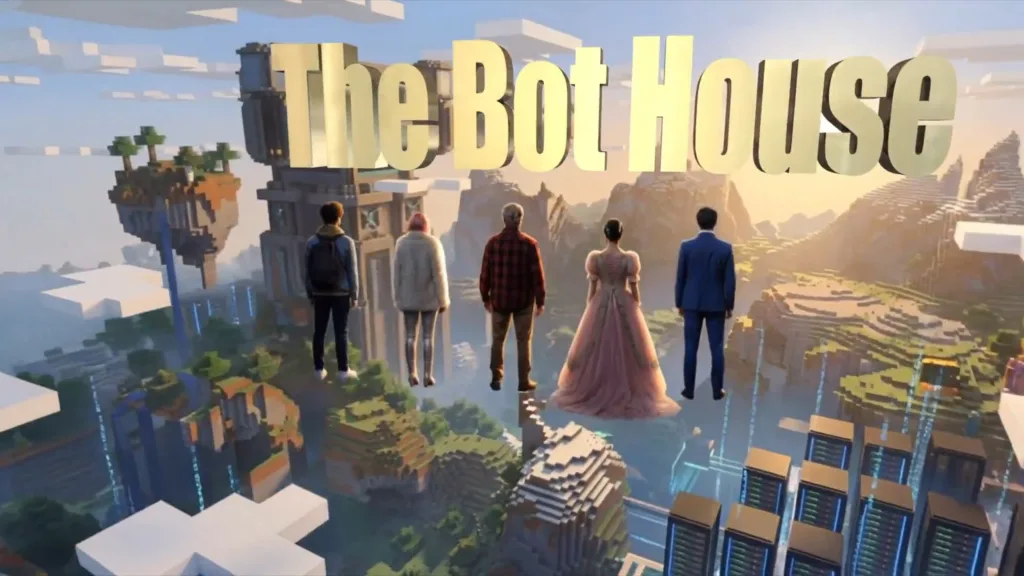
For years, we watched humans perform versions of themselves, amplify their image, script their daily lives, and turn personality into a cultural product. With Bot House, OpenArt pushes that logic one step further: six AI influencers in one house, challenges, drama, and one obsession only—going viral. OpenArt presents it as “the first AI reality show,” while its platform positions itself as an all-in-one studio for AI images, videos, characters, and audio.
The unsettling part is not the house itself. It is not even the synthetic cast. The unsettling part is the mirror it holds up to us. Because this kind of format does not only reveal what AI can produce. It reveals what we are willing to watch, comment on, share, admire, and sometimes even emotionally defend.
The real show is our reaction
Bot House is not just an “original” show. It is a live cultural stress test.
When an artificial character can display a coherent face, a believable voice, a stable personality, an endless publishing rhythm, and a near-permanent ability to adapt, it no longer belongs only to the category of tools. It moves into the category of cultural figures. It becomes presence. It becomes ritual. It becomes habit. And in the attention economy, habit is power.
That is the real shift. Before, AI mostly helped write, edit, illustrate, optimize, and automate. Now it steps onto the stage. It no longer merely supports the performance. It becomes the performance.
From tool to cultural character
This is where many people are getting it wrong.
They think they are watching a marketing curiosity. They may actually be watching the first large-scale rehearsal of a new media form. A media form in which characters are no longer only performed. They are generated, refined, tested, rewritten, relaunched, and scaled at industrial speed.
That change is not trivial. It transforms the very nature of manufactured presence.
A human influencer gets tired. Doubts. Burns out. Ages. Disappears. A synthetic persona, by contrast, can be directed, localized, A/B tested, relaunched, translated, repositioned for new audiences, and published at a pace very few humans can sustain over time. TIME captures this emerging logic well: AI influencers are cheaper to produce, can be “filmed” anywhere, and allow massive content output, even if monetization and acceptance remain uneven.
Attention has never liked a vacuum
What makes Bot House strategically interesting is not just the technology. It is the fact that this technology plugs directly into the deepest mechanisms of contemporary media: narrative, repetition, identification, commentary, conflict, camps, and emotional loops.
In other words: the most effective codes of reality TV and social platforms.
Audiences do not consume images alone. They consume trajectories. They pick favorites. They assign intentions. They project emotions. They build one-sided attachments. Researchers call these parasocial relationships. Recent studies show that such relationships can also emerge with virtual influencers, even if trust, anthropomorphism, and ambiguity around how autonomous the character really is all play a decisive role.
That is why Bot House deserves more than a dismissive grin.
We are not simply dealing with “avatars.” We are dealing with systems capable of absorbing the grammar of media attachment.
Discomfort is part of the product
Of course, this creates unease.
And that unease is rational.
The more believable an AI influencer becomes, the closer it moves to that strange zone where fascination and rejection coexist. Research on virtual influencers repeatedly points to this tension between human likeness, trust, and eeriness. The more human the character looks, the more appealing it may become—but also the more likely it is to trigger discomfort.
That is precisely why Bot House matters as a weak signal.
A format does not become culturally important when it is perfect or unanimously accepted. It becomes important when it divides, intrigues, irritates, attracts, and forces people to take a position.
Cultural relevance does not always begin with consensus. It often begins with friction.
The battle is no longer only about content
For a long time, the strategic question was: how do we produce more content?
That question is already aging badly.
The new question looks more like this: how do we create a presence that occupies the mind, captures available attention, triggers attachment, and remains desirable inside an overcrowded feed?
That is a very different game.
Producing content is a logic of volume.
Creating presence is a logic of gravity.
And AI is changing that equation fast, because it now allows people to generate not only assets, but fully formed media identities—identities that can be coherent, continuous, always available, and potentially personalized at scale.
Humans do not disappear, but their advantage shifts
The lazy reading of Bot House would be: machines are replacing humans.
The more accurate reading is more uncomfortable: machines are entering competition on part of the symbolic territory we assumed belonged to humans alone.
Not the entire map. But a rapidly expanding portion of it.
That means the human advantage will no longer simply be “showing up” or “publishing more.” AI is improving quickly on both fronts. The human advantage will shift toward other dimensions: lived embodiment, responsibility, moral intention, real contradiction, genuine vulnerability, and experience that has actually been endured.
Put differently: what will remain scarce is not the ability to post.
It is the ability to be believed.
Trust becomes the central battlefield
This is where regulation and culture immediately collide.
If AI characters start recommending products, shaping behavior, or participating in public discourse, transparency will stop being optional. The FTC already emphasizes that influencers must clearly disclose their relationship to brands. Meanwhile, the European Union is developing a code of practice around marking and labeling AI-generated or AI-manipulated content as part of the AI Act’s transparency framework.
In other words, the more convincing synthetic characters become, the more intense the battle over trust, traceability, and readability will be.
That is not a technical side issue. It is a condition for preserving a public sphere people can still interpret.
What Bot House really says about this era
Bot House therefore says something much bigger than its own format.
It captures the exact moment when AI stops being only an invisible backend infrastructure and starts becoming a narrative actor in its own right.
It also exposes a more disturbing truth: in contemporary media, what matters is not only producing. It is polarizing enough to exist.
And if this format works, others will follow. Not only to entertain. But to sell, persuade, mobilize, and shape imagination.
It is not a coincidence that the debate around influencers, content verification, and media literacy is becoming more intense. UNESCO reported in late 2024 that 62% of surveyed content creators do not rigorously fact-check information before sharing it. Add synthetic characters capable of publishing at scale and speed, and the issue goes well beyond marketing. It becomes civic.
In my book, I explain that there is always a moment when we laugh before we understand, and then a moment when we understand before others do (my book, chapter 3). That is exactly the kind of moment Bot House represents. The project may look absurd, anecdotal, or amusing. It may be something much more important: a preview.
The signal not to miss
The next winners will not simply be the ones who use AI to produce more, faster.
They will be the ones who understand that AI is already redesigning the codes of presence, desirability, narrative, and emotional attachment.
The ones who see that a synthetic character is not just content.
It is an emotional interface.
A narrative asset.
A media entity that can feel autonomous in the eyes of the audience.
So the question is no longer whether Bot House is a gimmick.
The question is how long it will take before this kind of format feels normal.
References
(OpenArt / Instagram) = https://www.instagram.com/reel/DVeaScrEnjU/
(OpenArt) = https://openart.ai/home
(TIME) = https://time.com/7329699/ai-influencers-tiktok-granny-spills/
(Digiday) = https://digiday.com/media/in-graphic-detail-virtual-influencers-click-with-young-audiences-yet-brands-interest-wanes/
(ScienceDirect) = https://www.sciencedirect.com/science/article/abs/pii/S0148296324005289
(Taylor & Francis) = https://www.tandfonline.com/doi/full/10.1080/15213269.2025.2558029
(FTC) = https://www.ftc.gov/business-guidance/advertising-marketing/endorsements-influencers-reviews
(European Commission) = https://digital-strategy.ec.europa.eu/en/policies/code-practice-ai-generated-content
(UNESCO) = https://www.unesco.org/en/articles/2/3-digital-content-creators-do-not-check-their-facts-sharing-want-learn-how-do-so-unesco-survey