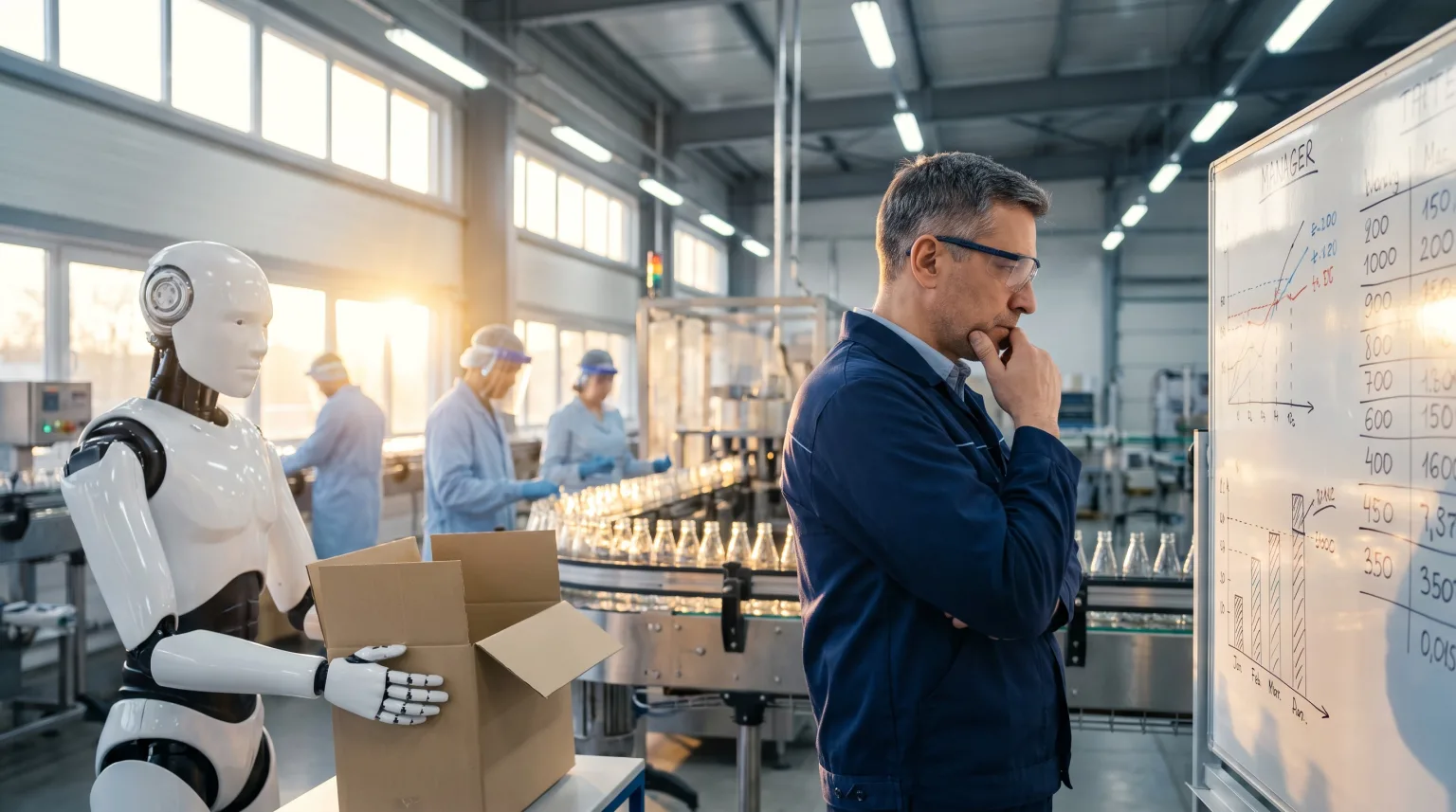
Lyon, a Tuesday in September, 7:40 a.m. The packaging line is already running when Charles hands me his phone. Charles (not his real name) runs the plant of a mid-sized company that makes bottles for the cosmetics industry. On the screen, a humanoid robot picks up flat cardboard, folds it, fills it and stacks the boxes on a pallet. The movement is smooth, almost graceful.
“My chairman saw this demo at a trade show. He wants a replacement plan for line 3 before Christmas. Twelve operators. What do you think?”
I answered with a question: “How much does one hour of an operator’s work cost you, fully loaded?”
“Around 32 euros. I know that number by heart.”
“And one hour of that robot?”
Silence. Charles looks at the video, then at me.
“The sales rep gave me a purchase price. He never mentioned an hourly cost.”
“One more thing: of all the movements on line 3, how many can this robot actually do in your plant? With your boxes, your format changes, your Monday-morning jams?”
Charles put his phone away. We spent the morning in front of a whiteboard. By noon, line 3 had changed status: the replacement project had become a hypothesis to test.
I have lived this scene in different forms for years. A study published at the end of September finally puts numbers on it.
Between the video and the payroll
Two numbers have been making the rounds in the French press for a few days. Robots could handle about a third of the hours worked in the United States, yet they would be profitable on only three tasks out of a thousand (01net).
These figures come from a study published on September 30, 2026 by Anthropic, titled “What work can robots do?”. The authors built a robot exposure index, task by task, based on the occupations listed by the U.S. Department of Labor. Their finding: robots can already perform three quarters of the physical tasks done in the United States, or 34% of working hours, but mostly in very limited settings. And they are cost-competitive for only 0.3% of tasks (Anthropic).
Read those two percentages again. Between 34% and 0.3% lies a factor of one hundred. That gap separates what the machine can do from what it earns.
The trade-show demo showed the first column. Charles’s payroll speaks to the second.
One detail of the study made Charles smile when I sent it to him. Among the rare jobs where robots are already profitable, or close to it, the authors list packers and packagers, along with taxi drivers. In total, about 300,000 American workers hold a job in which a robot could perform 95% of the tasks at a competitive cost (Anthropic). So Charles’s line 3 may well be in the 0.3%. May be. Nobody will know without doing the math.
The hidden cost of the human touch
Another study, published in July by Planera, a construction software company, reaches a similar conclusion by a different road. It compares, job by job, the annual cost of full automation with the actual wage. Replacing a nursing assistant with a humanoid robot would cost about $375,100 a year, nearly nine times the $42,200 annual salary. For a construction laborer, who earns just under $50,000, the bill would approach $300,000 (Forbes).
Planera’s spokesperson sums up the paradox: the lowest-paid workers are often the ones doing the most physical, people-facing work, and that is exactly what machines handle worst (Forbes).
For decades we were told that low-skilled jobs would be the first to be automated. The numbers tell the opposite story. Holding the arm of an elderly person getting up, or fitting a sheet of drywall on a crooked staircase: these movements demand constant adaptation that robots cannot yet deliver at a reasonable price.
The examples in Anthropic’s study point the same way. For welders, the robot can do the work, but the set of robots required costs about five times more than human welders. Cleaning robots can be up to ten times slower. Robotaxis cost only about $7,000 a year more than a driver, but they run into regulatory limits (The Median).
The purchase price shown at the trade show says nothing about any of this. The real cost includes integration, maintenance, energy, downtime, and the wages of the humans you still need to supervise the machine (Forbes).
A movie we have already seen
In January 2024, MIT researchers ran the same exercise for computer vision. Result: automation would have paid off for only 23% of the wages exposed to that technology. Their example was a bakery: visually inspecting ingredients accounts for 6% of a baker’s work, and installing and running the system would cost more than letting a human do it (Euronews).
Two and a half years later, the conclusion has not moved. Technical capability progresses fast, adoption follows slowly, and the gap between the two is measured in euros.
I spent part of my career launching technology products, at Apple and then at Sony, where I took part in launching the Aibo robot in Europe. For a long time I believed technology was the engine of everything. I was wrong. Technology changes constantly; its only constant is the acceleration of its change. The true invariant of innovation is human: our fears and our biases in the face of novelty (My book, chapter 4).

Charles’s chairman did not see an hourly cost. He saw a video. His decision was made before the first number, under the influence of a bias I find in many leaders: the spectacle of technology replaces the analysis of its use.
Be wary of this study too
I owe you a warning, and it concerns the main source of this article.
The study is published by Anthropic, a company that sells artificial intelligence. The tasks were rated by its own model, Claude. And when the model could not find a robot able to perform a task as described, it counted robots that perform related tasks. This method risks overstating what robots can do (The Median).
The 34% figure is therefore probably too high. The 0.3% figure is more solid, because it rests on costs. But it moves too.
Every year, robots become able to perform about 2% of the physical work they could not do before (Anthropic). If their price fell by 20%, the share of tasks where they become profitable would rise from 0.3% to 0.8% (The Median). And at the historical rate of price decline, about 3% a year, it would take forty years to reach 10% (MIXED).
Forty years is a long time for an employee worried about their job. It is very short for a company investing in a plant. Both readings are true at once, and your strategy has to hold them together.
What I proposed to Charles
We set aside the two easy reflexes, replacing line 3 or ignoring it, and turned a conviction into an experiment.
First step: break the operator’s job down into tasks, with the share of time actually spent on each. Charles thought his operators “put bottles into boxes”. The survey showed another reality: settings, format changes, quality control, clearing jams, exchanges with maintenance. Pure packaging took up less than half of the day.
Second step: calculate the full cost of one useful robot hour, in Charles’s plant, on the tasks the robot can actually do. I mean real production hours, measured on the line.
Third step: test on a single cell, for three months, with indicators defined in advance. I repeat it in every talk I give: measure before, during and after, and ask two questions for each activity. Are the expected gains realistic? Are they verifiable? (My book, chapter 14)
Fourth step, the one Charles’s chairman had forgotten: talk to the twelve operators before starting. A strategy announced at the moment of deployment triggers the fear of obsolescence, and sometimes a strike. La Poste learned this with AI in 2024 (My book). A robot dropped without explanation in the middle of a line will produce the same effect.
There is also a demographic reason to look at robots differently. In developed countries, collapsing birth rates will leave jobs open that nobody will come to fill. Robots will have to make up part of that shortfall. The right frame is amplification. Ask yourself how your twelve operators can produce more, and better, with a machine at their side.
The essentials
Remember three things:
- What a robot can do and what it earns are two different measures: 34% of working hours on one side, 0.3% of profitable tasks on the other.
- The math is done task by task, in your own environment, as a full cost per useful hour, human supervision included.
- A study, however serious, remains a hypothesis for your company: kill it or confirm it through experimentation, and talk to your teams before you start.
Charles called me last week. His test cell has been running for six weeks. He does not know yet whether the robot will stay. He already knows what a useful hour costs, and his operators take part in the measurements instead of fearing them. Innovate or agonize: the choice is up to you.



References
- (My book) https://philippeboulanger.com/book/
- (01net) https://www.01net.com/actualites/les-robots-se-heurtent-a-la-realite-trop-chers-pour-remplacer-lhumain.html
- (Anthropic) https://www.anthropic.com/research/what-work-can-robots-do
- (Forbes) https://www.forbes.com/sites/johnkoetsier/2026/07/07/10-jobs-that-are-safe-because-robots-cost-too-much/
- (The Median) https://dcthemedian.substack.com/p/robots-are-cheaper-than-people-for
- (MIXED) https://mixed-news.com/en/anthropic-robots-74-percent-us-physical-work-cost-competitive-0-3-percent/
- (Euronews) https://fr.euronews.com/2024/01/24/l-ia-est-trop-couteuse-pour-prendre-aux-humains-leurs-emplois-actuels-etude-du-mit