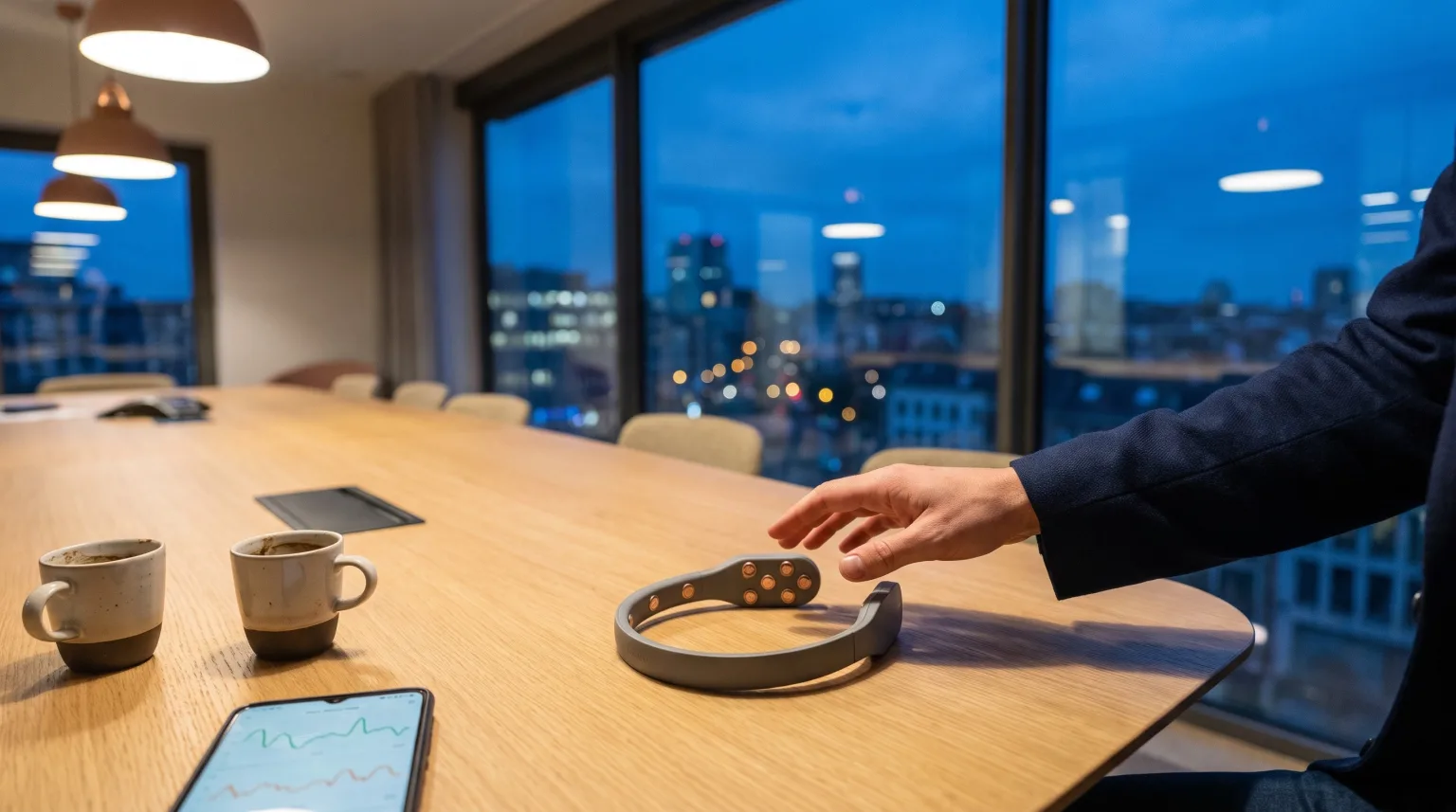
Brussels, a Tuesday evening in November. Hugo places a grey headband on the meeting room table, between two cups of cold coffee.
“It measures my focus. The app tells me when I drift off. I want to equip my fifty sales reps before the end of the quarter.”
Hugo runs a sales team at a services company. He ordered the headband online one Sunday, after watching a three-minute video. He hands me his phone: a green curve, an orange curve, a score out of 100.
“And this score, who was it validated on?”
He searches. He finds a study quoted on the manufacturer’s website. A small sample, in a lab, in a quiet room, with well-rested participants.
“Your reps spend the day on the phone, in an open-plan office, and they’re exhausted by 5 p.m. Do you think your headband sees the same thing in them?”
Silence. Then Hugo laughs, a little sheepishly. “You just saved me from a big mistake. And probably a strike.”
Hugo is a composite character. I have met his situation more than once.
Your brain is already for sale
When people talk about brain-computer interfaces, the media show implants. Paralyzed patients typing with their thoughts, trials to restore speech or control a robotic arm. Meanwhile, another category is moving forward quietly: wearable devices, placed on the head with no surgery. Headbands, headphones packed with sensors, baseball caps. They are sold to you for meditation, attention tracking or cognitive training. Others alter brain activity through electrical current or another form of stimulation: this is neuromodulation. (The Conversation)
Damien Coyle, Director of the Institute for the Augmented Human at the University of Bath, has just delivered an unsparing diagnosis. Researchers can detect aspects of attention, cognitive workload, intent and changes in mental state from brain activity. They can also modulate that activity for therapeutic effect. Yet companies are selling their products on the strength of promising but relatively small studies, while mainstream adoption will demand evidence of an entirely different caliber. (The Conversation)
His forecast fits in one sentence. Meaningful mainstream progress is possible within five to ten years, provided investment shifts away from gadget development and toward large-scale validation, ecosystem building and responsible deployment. (The Conversation)
Read that sentence again. The number comes with its condition. If the condition falls, the number falls with it. And most articles that pick up this “5 to 10 years” will forget the second half.
Beware of forecasts from those who build the product
I’ll be direct, it’s my signature. Damien Coyle is also the founder and CEO of NeuroCONCISE, a company that develops brain-computer interfaces. He sits on the British BSI standards committee for non-medical BCIs. He discloses this himself at the bottom of his article, and that is to his credit. (The Conversation)
He may well be right. An industry player who calls for more investment in validation and standards is also defending his own ground. Both are true at the same time. Your job as a leader is to hold both ideas in the same hand, without dropping one for the other.
Other voices give very different horizons. IE University estimates it will take another 10 to 20 years for brain-computer interfaces to become common in medical settings, and possibly up to 50 years for widespread everyday use. (IE University)
Five years, twenty years, fifty years. When experts diverge this much, the forecast stops being useful to you. What serves you is identifying the hidden assumption behind each number, then testing it in your own organization.
A working gadget does not make an innovation
In my book, I devote an entire chapter to the confusion between creativity, invention and innovation. A headband that displays a focus curve is an invention put up for sale. It will become an innovation the day thousands of people use it in their real lives, with a measured and reproducible benefit. (My book, chapter 3)

The gap between the two is technical and human. Brain signals vary widely from one person to another, depending on age, fatigue, environment and context. They are noisy and very low in amplitude. There is also a shortage of large, standardized datasets to train reliable models across diverse populations. (The Conversation)
Look at that list again. Fatigue, environment, context. That is exactly what separates the lab from Hugo’s open-plan office. A sensor calibrated on a well-rested student, sitting in a silent room, tells a different story on an exhausted sales rep making his fifteenth call.
I have tested sensors myself during my biohacking experiments: a mattress topper that tracks sleep, connected scales. I came away with a conviction I repeat at every keynote. What works is individual, and only measurement tells you what it is. (My book, chapter 17)
Artificial intelligence speeds things up, and that is also the danger
Why is this topic coming back now? Another analysis published in The Conversation offers two reasons. Artificial intelligence makes it possible to extract useful patterns from non-invasive recordings, including cheap sensors, where clinical equipment was once required. And big tech companies are betting on neural interfaces. In 2023, Apple filed a patent application for AirPods fitted with electrodes that would measure brain activity. With hundreds of millions of earbuds already in circulation, the door to mass adoption would be open. (The Conversation)
Meta took a different route. Its Neural Band, sold with the Ray-Ban Display glasses in the United States since September 2025, picks up the electrical activity of the wrist muscles (electromyography) to control the glasses with small finger gestures. Meta says it developed the wristband from research involving nearly 200,000 participants. (Meta)
An important clarification: electromyography measures muscle activity. It reads no brain activity at all. But look at the contrast. A training base of nearly 200,000 people on one side, small studies on the other. My hypothesis, and I state it as a hypothesis to be tested: the first “neural” interface you wear every day may go through your wrist before your skull. The signal there is stronger, and the training data more abundant.
Your brainwaves are sensitive data
The more a device works in the background, the easier it is to adopt. That is also where the risk climbs. Damien Coyle notes that passive monitoring lowers the effort required from users while heightening privacy risks as soon as brain signals are combined with contextual data. That combination can reveal your emotional state, your workload, your preferences or your intentions. (The Conversation)
Lawmakers have started to respond. In April 2024, Colorado became the first U.S. state to explicitly extend privacy rights to neural data. A Neurorights Foundation report released the same day found that nearly every company in a sample of 30 appeared to have access to its customers’ neural data, with no meaningful limits. The CCIA trade association, whose members include Meta and Apple, had opposed the bill. (Bloomberg Law)
California and Montana followed. Colorado and Montana require express consent before any collection, then separate consent or an opt-out before that data is disclosed to a third party. (Route Fifty)
At the global level, UNESCO’s General Conference adopted its Recommendation on the Ethics of Neurotechnology on November 12, 2025, the first worldwide framework on the subject. The text is not legally binding. It still sets clear markers: free and informed consent, strict protection of neural data, and a call to prohibit any direct or indirect pressure on people to use enhancement neurotechnology. (Inside Privacy)
Reread that last point with Hugo’s project in mind. Equipping fifty sales reps with a headband that measures their attention, under their manager’s authority, is exactly the scenario the text describes.
In 2018, on the TEDxULB stage in Brussels, I was already taking the audience into our future and asking what existing and emerging technologies would do to us. (TEDxULB) I have kept saying it on stage ever since: brain-computer interfaces will become a battlefield, and we will soon have to choose between U.S. and Chinese solutions the way we chose between iOS and Android. That choice will involve your most intimate data.
What you can do on Monday morning
You don’t need to wait ten years to decide. You need a method. Assumptions are highly dangerous, and they should be killed with experimentation as early as possible. (My book, chapter 12)
Here is the approach I recommend before buying any neurotechnology for your teams.
- Demand the evidence. How many people was the device validated on? Under what conditions? By whom? If the answer is one internal study on a small group, you know where you stand.
- Experiment in-house. A small group of volunteers, a limited period, measurement before, during and after. Compare against an indicator you already track, such as conversion rate or customer satisfaction.
- Settle the data question before you order. Where is the data stored? Who can access it? Does the vendor resell it? Your data protection officer should read the contract before your purchasing director does.
- Protect voluntary participation. An employee who declines must face no consequence, not even an implicit one. Without psychological safety, your measurements will be skewed, because people will play with the sensor instead of working.
Hugo ended up running a test with six volunteers for one month, with no link to their annual review. The outcome: two found the tool useful for planning their focus blocks, and the other four put it away after a week. The rollout to all fifty can wait. For the price of six headbands, Hugo learned something valuable about his team.
The essentials
Remember four things:
- The five-to-ten-year horizon depends on one condition: funding large-scale evidence rather than the next gadget.
- A forecast is worth what the assumption behind it and the interests of the person making it are worth.
- Neural data is sensitive data. Settle its governance before the purchase, never after.
- Test in-house, with volunteers, measuring before, during and after.
We don’t need to fear this future. You don’t have to predict it, because you are going to create it. Innovate or agonize, the choice is up to you!


References
- (My book) https://philippeboulanger.com/book/
- (The Conversation) https://theconversation.com/how-long-until-wearable-brain-computer-interfaces-become-mainstream-281806
- (The Conversation) https://theconversation.com/brain-reading-wearables-will-soon-be-ordinary-what-will-this-mean-for-the-new-generation-of-neurotechnological-natives-289923
- (IE University) https://ie.edu/the-next-fifty/school-of-science-and-technology/brain-computer-interfaces-the-practical-and-ethical-challenges-facing-a-technology-in-motion
- (Meta) https://about.fb.com/news/2025/09/meta-ray-ban-display/
- (Bloomberg Law) https://news.bloomberglaw.com/privacy-and-data-security/colorado-protects-brain-wave-privacy-with-first-neurodata-law
- (Route Fifty) https://www.route-fifty.com/digital-government/2025/07/states-pass-privacy-laws-protect-brain-data-collected-devices/406920
- (Inside Privacy) https://www.insideprivacy.com/health-privacy/unesco-adopts-first-global-framework-on-neurotechnology-ethics/
- (TEDxULB) https://www.youtube.com/watch?v=8Enay2fMtJc