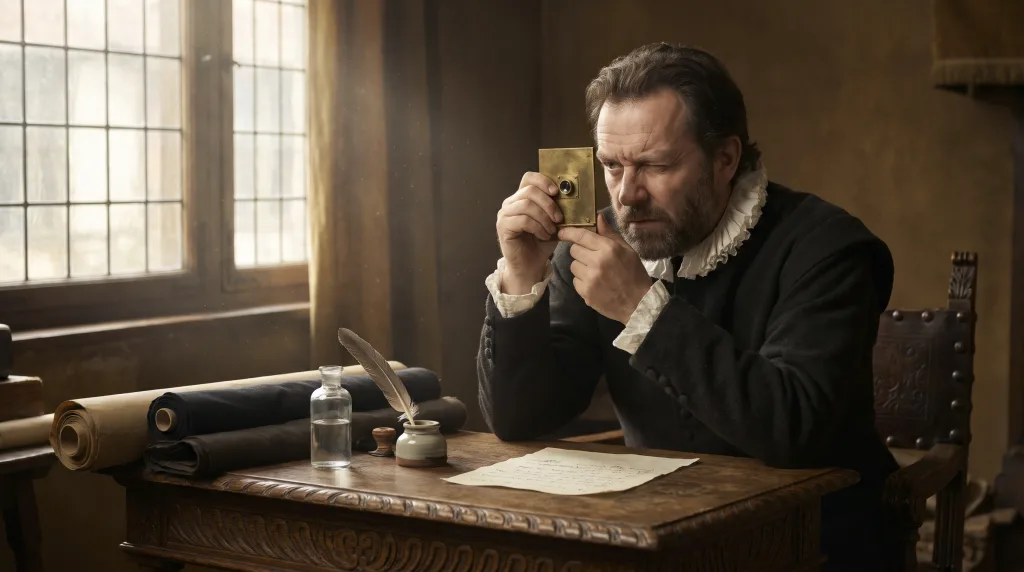
Dayton, Ohio, May 10, 1954. Late afternoon.
At the Institute of Radio Engineers’ National Conference on Airborne Electronics, the session on silicon devices drags on (IEEE Spectrum). Speaker after speaker delivers the same polite, well-documented message. Silicon would make a better transistor than germanium, granted. Still, nobody should expect one for years (PBS).
Gordon Teal steps up to the podium. He runs research at Texas Instruments, a Dallas company many attendees still associate with oil exploration. The firm started life as Geophysical Service Inc., a maker of seismographs for the oil industry (IEEE Spectrum). Teal reads a paper with a sleep-inducing title, “Some Recent Developments in Silicon and Germanium Materials and Devices.” Then, almost in passing, he mentions that he doesn’t share his colleagues’ pessimism, and that he happens to have a few silicon transistors in his pocket.
He pulls them out and explains that Texas Instruments has three types in production (IEEE Spectrum). In production. Not on a lab bench.
Engineers in the room glance at each other. Someone in the front row wonders whether he heard correctly.
A room that had already made up its mind
To grasp the shock, go back to the problem everyone in that room knew by heart. In 1954, commercial transistors are made of germanium. Germanium is easier to purify and crystallize than silicon, and it is the material of the first transistors. Every defense engineer knows its weakness: it fails as the temperature rises. Silicon transistors work at much higher temperatures, and the U.S. military wants them (Transistor Museum).
In a missile nose cone or a jet cockpit, a component that quits in the heat is a useless component.
Silicon’s problem lay elsewhere: it is far harder to purify and crystallize than germanium (National Academies). The Dayton experts had the diagnosis right. They got the timeline wrong.
That morning, the room had drawn its conclusion from what it knew. That is how a human brain normally works: it produces the most probable answer with the information available, then defends it. I describe this mechanism as status quo bias, with its signature phrases: “We’ve always done it this way,” “We already tried that,” “If it were possible, someone else would have done it already” (My book, chapter 6).

A beaker, a record player and a clarinet
Teal knew a claim like that, made in front of skeptical engineers, would not survive the coffee break. So he had prepared something other than a slide.
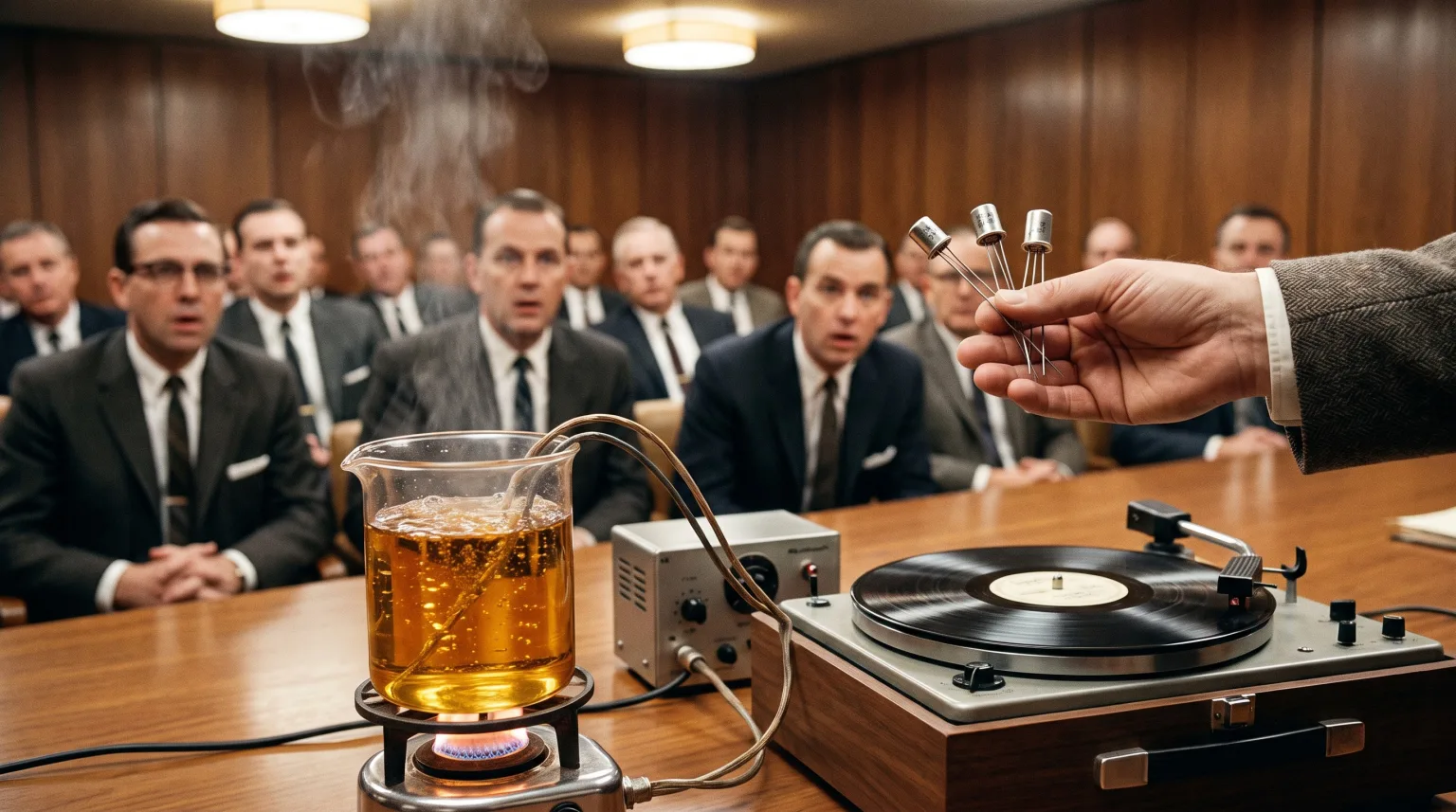
On the table: a record player, an amplifier and a beaker of hot oil. The record is Artie Shaw’s “Summit Ridge Drive.” The clarinet fills the room.
Teal dips an amplifier built with germanium transistors into the oil. The music stops dead. He repeats the test with an amplifier built with the new silicon transistors. The clarinet keeps playing, unbothered (National Academies).
No chart. No leakage-current curve. One jazz tune dies, another survives.
At the end of his talk, Teal mentions that copies of his paper are waiting by the back door. The audience rushes out, leaving the session’s final speaker with no one to talk to. Minutes later, in the lobby, a Raytheon engineer is shouting into a phone that Texas has the silicon transistor (IEEE Spectrum).
Spare a thought for that final speaker. Spending weeks on a talk to address empty chairs is an experience that builds humility.
Bell Labs invented, Texas Instruments innovated
The usual story ends there: the little Texan beat the whole industry. That needs correcting, and the correction is more useful than the myth.
The first working silicon transistor came out of Bell Labs in New Jersey. In January 1954, chemist Morris Tanenbaum built one, using a variant of the grown-junction technique developed by Morgan Sparks and a certain Gordon Teal (Computer History Museum). Tanenbaum, however, felt his device did not look attractive for mass production (IEEE Spectrum).
Bell Labs had the invention. Texas Instruments did the rest: production, market launch, customers. The Dallas team made its first successful silicon transistor on April 14, 1954, using high-purity DuPont silicon and the grown-junction technique (Computer History Museum). Four weeks later, when Teal talked about his pocket in Dayton, production had already started (PBS).
I hammer this distinction home in my keynotes. An invention is a new creation. An innovation requires implementation, a market launch or an operational rollout. Without implementation, you cannot speak of innovation (My book, chapter 3).
The results are measurable. TI’s three-lead device became famous and made the Texas company the sole supplier of silicon transistors for several years (IEEE Spectrum). With little competition, TI dominated that market until silicon became the industry’s preferred material at the end of the decade (Computer History Museum).
A delicious detail: that same year, Texas Instruments designed the Regency TR-1, the first commercial transistor radio. It ran on germanium, because silicon was far too expensive at the time (Wikipedia). TI knew exactly who to sell its breakthrough to: customers who paid for heat tolerance. The company kept silicon for the market where it solved a real problem, and left germanium to the cheap transistors.
The myth of the lone genius
History remembers Gordon Teal, the man with the beaker. It almost always forgets Willis Adcock.
In Dallas, Teal had hired a team of scientists and engineers led by chemist Willis Adcock (Computer History Museum). Adcock grew the first silicon boule that made the transistor possible, and the paper presented in Dayton carried both Adcock’s and Teal’s names (National Academies).
Teal himself did not come out of nowhere. At Bell Labs, with technician Ernie Buehler, he was already growing doped single crystals of silicon in 1951 (IEEE Spectrum). He brought know-how back to Texas and handed it to a team.
Behind the team stood an executive who placed a bet. On April 14, Teal showed a working silicon transistor to Pat Haggerty, TI’s vice president. Haggerty understood that the first company to sell these transistors would win, and TI moved without waiting (PBS).
I insist on this because the myth of the hero-innovator does real damage in companies. It pushes leaders to look for a providential genius instead of building the team. Time to drop it: there is always a team that brings a project home, guided by a leader (My book, chapter 2). History then gives the leader the title of innovator, and the rest of the team vanishes from the photos.
A demo beats any slide deck
Back to the room in Dayton. Teal had the technical content. He had the paper, the measurements, the credibility of his Bell Labs years. What tipped the audience was one minute of clarinet.
Why does it work? Because the audience no longer has anything to believe. It has seen. Faced with anything new, your listeners’ brains first ask a survival question: what does this change for me, am I taking a risk? A demonstration answers that question before the debate even starts. A table of numbers opens the debate.
In my keynotes, the audience experiences each cognitive bias live, as an experiment. I invented nothing: Teal did the same thing with a beaker in 1954. This is the whole subject of the communication, presentations and decision-making pillar of the Innovational Intelligence™ System (My book, chapter 10).
Try the exercise. Think of the last project you defended in front of your executive committee. How many slides? How many demos? On a scale of 0 to 5, how much do your presentations make the proof come alive instead of describing it? Be honest. I’m not always at 5 myself.
What your executive committee calls “impossible”
The Dayton engineers were competent and well informed. They reasoned with the best data of their time, and that is exactly what trapped them. Their expertise covered what had been tried so far. It said nothing about what a team in Dallas had achieved four weeks earlier.
Our past success can be our greatest enemy. Bell Labs had invented the transistor, then built the first silicon transistor. That track record made it unlikely, in everyone’s eyes, that a former oil-instrument maker would get ahead on production. The bias was comfortable. It was also wrong.
What to do on Monday morning? When someone in your organization says something is impossible, ask which experiment that claim rests on. Very often, the answer is the absence of an experiment. Demand demonstrations, even imperfect ones, before the big presentations. And look for who, outside your industry, may already have solved your problem without telling you.
The essentials
Remember four things:
- An invention stays in the lab until someone produces it. Bell Labs had the first silicon transistor, Texas Instruments got the market.
- A demonstration convinces where a presentation opens a debate.
- Expert consensus describes the past. It does not tell you what a determined team may already have achieved.
- Behind every hero of an innovation story, look for the team. Teal had Adcock, Buehler, Haggerty and DuPont’s silicon.
So, what do you have in your pocket that nobody has seen working yet? Innovate or agonize, the choice is up to you!


References
- (My book) https://philippeboulanger.com/book/
- (IEEE Spectrum) https://spectrum.ieee.org/the-lost-history-of-the-transistor
- (National Academies) https://nap.nationalacademies.org/read/12473/chapter/52
- (National Academies) https://www.nationalacademies.org/read/12473/chapter/2
- (Computer History Museum) https://www.computerhistory.org/semiconductor/timeline/1954-Silicon.html
- (Computer History Museum) https://www.computerhistory.org/collections/catalog/102711691
- (PBS) https://www.pbs.org/transistor/science/events/silicont1.html
- (Transistor Museum) https://www.semiconductormuseum.com/PhotoGallery/PhotoGallery_901.htm
- (Wikipedia) https://en.wikipedia.org/wiki/Texas_Instruments