The day a simple pencil beat a tutorial
Some objects can summarize an entire era without looking like they deserve a speech.
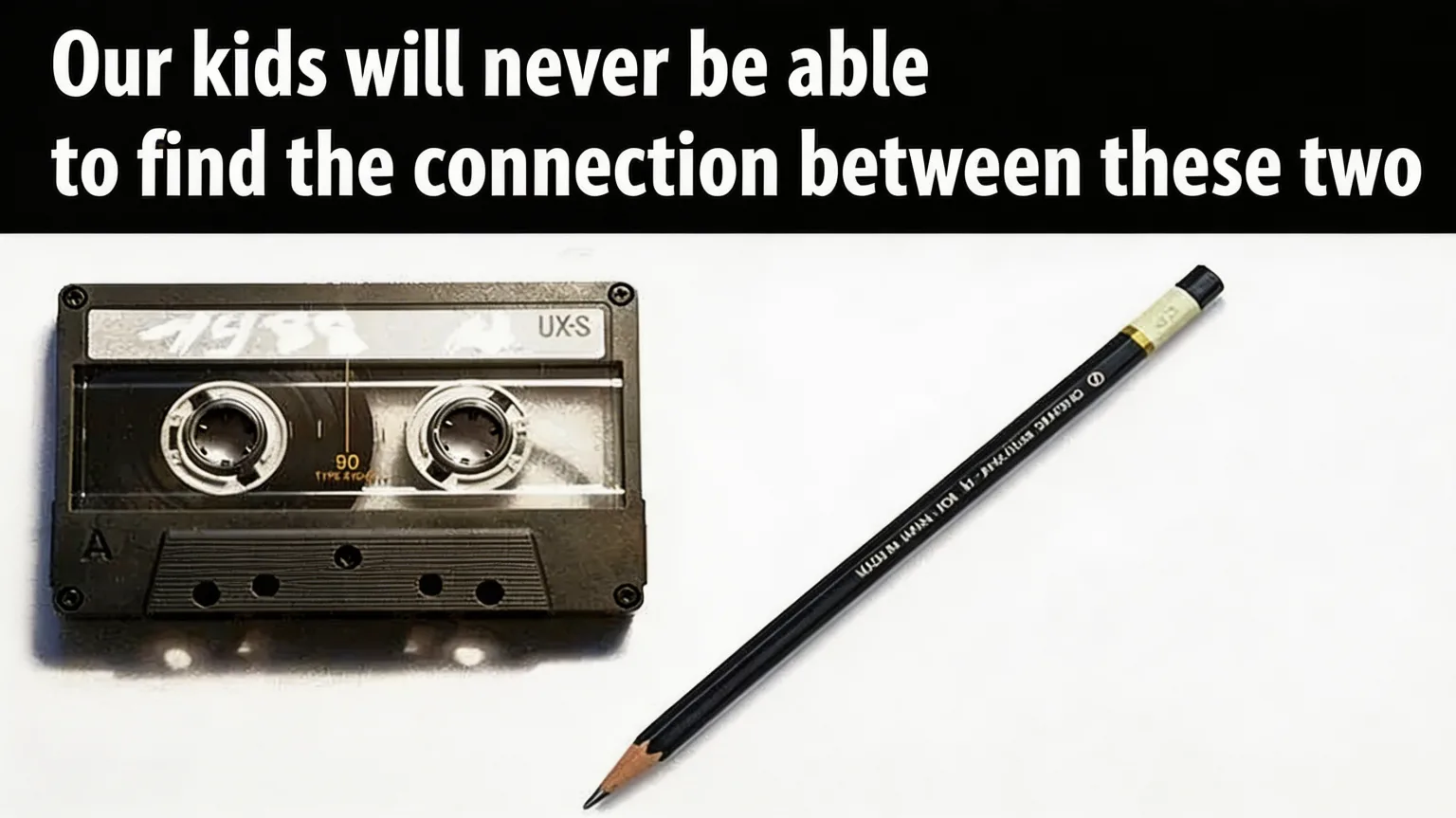
An audio cassette.
A pencil.
And between them, a gesture that millions of people learned without a manual, without an app, without a voice assistant, and without a video tutorial.
Insert the pencil into the reel.
Turn gently.
Tighten the tape.
Save the cassette.
Get the music back.
The first anti-bug system in cassette-player history did not fit inside a lab. It fit inside a pencil case.
The funniest part today is not even the mechanical trick itself. It is the mental gap it reveals. One generation immediately sees the link between the two objects. Another sees a mystery. That is exactly where Saturday of the Absurd begins.
It was never just a trick
The pencil was not a cute accessory next to the cassette. It was part of the system.
It helped rewind without draining the Walkman’s batteries.
It let you retighten a tape that had been eaten.
It sometimes saved an entire album from a temperamental player.
It turned the user into a local technician for their own music.
The compact cassette, developed by Philips and introduced in 1963, made recording and listening far more portable and accessible than open-reel tape. That simplicity helped it spread worldwide (Philips). But that simplicity was never fully passive. The object still demanded a minimum of practical intelligence.
You had to understand the material.
Watch the mechanics.
Feel the tape tension.
Act delicately.
Improvise when the machine became stupid.
In other words, you were not just using technology. You were building a relationship with it.
A time when users still knew how to improvise around the object
The real point is not cheap nostalgia. The real point is the nature of the relationship between humans and technology.
The cassette belonged to an era when technical objects were still partly readable. You could see the reels. You could understand the path of the tape. You could guess the malfunction. You could invent a workaround.
The problem was not abstract.
It was visible.
That made it manageable.
That is exactly why older devices still fascinate people. They are not only retro. They are educational. They show their logic. They give the user a mental grip on reality.
Contemporary digital products often did the opposite. They brought extraordinary power, stunning fluidity, and outrageous convenience. But they also hid the mechanics. When something breaks, the user no longer repairs. They reboot, recharge, reset, or give up.
The pencil inside the cassette told a different story.
A culture of improvisation.
A culture of linking things together.
A culture of “I’ll try.”
In my book, chapter 1, I insist on a central point: experimentation is the key to finding the way, and nothing works perfectly the first time.
The detail that would confuse new generations
The funniest thing about this image is not that it looks old.
It is that it now feels like an absurd riddle to anyone who never lived through that material logic.
Our children may recognize both objects separately.
They may know what a pencil is and what a cassette is.
And still, the functional link between the two might escape them.
Why?
Because our era produces more and more closed, opaque, smooth, seemingly magical objects.
We click.
We swipe.
We stream.
We scroll.
But we understand less and less of what happens underneath.
The cassette generation was sometimes less assisted, but mentally better equipped to deal with everyday micro-breakdowns.
They did not immediately ask an AI what to do.
They tried.
They tested.
They failed.
They corrected.
Then they passed the trick on.
Knowledge moved horizontally, through imitation, observation, and usage culture. Not only through official documentation.
The pencil was a resilience protocol
Put differently, that old gesture carried something strategically modern.
When a technology fails, two paths appear.
The first is total dependence on the system, the manufacturer, the support team, the upper layer.
The second is preserving a margin of autonomy, however small.
The pencil represented that margin.
It was the analog Plan B.
The low-tech workaround.
The elegant patch.
The proof that a popular technology becomes truly powerful when its users also know how to catch it by hand.
In a world saturated with automation, that logic deserves a serious rereading.
The organizations that will move best through the AI era will not just be those piling up tools. They will be the ones that keep humans able to understand failures, detect anomalies, improvise solutions, and retake control when the interface becomes misleading.
The pencil in the cassette is a tiny metaphor for operational resilience.
Yesterday’s absurdity becomes tomorrow’s lesson
The irony is that the old trick now works like a cultural test.
Those who understand it immediately came from a time when technology still demanded participation.
Those who do not understand it grew up in a world where technical performance gradually erased visible usage intelligence.
There is no moral superiority in that.
Every era produces its own reflexes.
Younger generations have developed other skills, sometimes remarkable ones.
They navigate software environments of extraordinary complexity.
They publish, edit, automate, learn fast, and combine tools many adults do not even dare to open.
But one fascinating blind spot remains: the more invisible technology becomes, the more causal links between objects disappear from common culture.
The cassette and the pencil remind us that a technical civilization is also judged by its ability to make its uses understandable.
What this image also says about innovation
Innovation is not always the most sophisticated gadget.
Sometimes useful innovation lives in an unlikely combination of ordinary objects.
An improvised system.
A repurposed use.
A field-born answer.
A solution so simple it becomes invisible afterward.
That is one of the biggest traps inside many organizations: they chase spectacular innovation while dismissing practical intelligence.
They want disruption.
They want the tool.
They want the platform.
They want the impressive vocabulary.
Yet a decisive part of progress often comes from a banal, repeatable gesture that everybody understands and adopts without a steering committee.
The pencil in the cassette was never sold as a revolution.
That was the beauty of it.
It was a solution.
And a solution that people truly adopt is often worth more than a brilliant vision that never becomes real.
What ChatGPT can explain, but can never nostalgize for you
Yes, you can ask ChatGPT about the link between a cassette and a pencil.
And yes, AI can explain it.
It can describe manual rewinding.
It can explain magnetic tape.
It can even note that a recent cassette player manual still included a diagram showing how to wind tape back in with a pencil as a practical fix (WIRED).
But it cannot fully recreate what that gesture meant in the fingers, in habits, in the era itself, in the tiny private victory of saving your music without contacting customer support.
AI explains.
Experience connects.
That may be the most interesting part of this absurd image: it shows that small, embodied, situated forms of knowledge still exist, and they only make full sense inside a lived culture.
The future is not only on the side of the new
The renewed interest in retro technologies, physical music, and older devices also suggests that part of the public, including younger people, is looking for something beyond pure efficiency. There are visible signs of renewed attention toward physical formats and retro objects in popular culture, with similar patterns appearing across several categories of “old” technologies (Billboard, Fast Company, Fast Company).
Why?
Because the old technical world sometimes had a quality that is now rare: it left behind traces, gestures, textures, imperfections, and therefore memory.
The pencil inside the cassette does not return as performance.
It returns as symbol.
A symbol of a time when people still fixed small things.
A symbol of a time when the object was not fully separated from the intelligence of its user.
A symbol of a time when people still understood, at least a little, what they were handling.
The link between the two
So the link between the two is not only mechanical.
The cassette and the pencil together tell a broader truth:
a useful technology is not only one that works.
It is also one that leaves humans with some ability to act when it stops working well.
And that applies just as much to a chewed-up cassette as to a world saturated with AI.
Saturday of the Absurd sometimes comes with excellent strategic instincts.
References
(Philips) = https://www.philips.com/a-w/about/our-history.html
(Philips) = https://www.philips.com/a-w/about/news/media-library/20190101-First-Philips-cassette-recorder-1963.html
(WIRED) = https://www.wired.com/story/ninm-lab-its-ok-cassette-player-review/
(Billboard) = https://www.billboard.com/pro/cassette-tapes-comeback-taylor-swift-artists/
(Fast Company) = https://www.fastcompany.com/90895233/why-gen-z-is-ditching-smartphones-for-dumb-phones
(Fast Company) = https://www.fastcompany.com/90856587/why-are-so-many-gen-zers-drawn-to-old-school-digital-cameras/