Everyone knows the moment.
A bowl of popcorn. Everything feels right. Warm, crunchy, instantly “movie night” before the movie even starts.
Then the irritation arrives.
Those tiny bits of hull — the pericarp — that wedge between your teeth, slip under your gumline, and trigger that universal little “mouth surgery” move with your tongue.
The interesting part isn’t the irritation.
It’s what it reveals about innovation.
Because the popcorn industry did what most organizations do when they want to “improve the product”: they optimized what they assumed was the problem.
Flavor. Recipe. Butter. Packaging. Marketing.
And nothing truly changed.
Until they did what you must do to innovate: go back to reality — through study and experimentation.
When innovation starts with a tiny, specific pain
Popcorn sits at a fascinating boundary between biology, physics, and user experience.
The hull (pericarp) is what makes popping possible: it must be strong enough to hold internal steam pressure until it ruptures. (Purdue University)
In other words: the hull is essential… and annoying.
That’s the kind of trade-off innovation must redesign, not merely accept.
And the friction has a hidden cost: discomfort, irritation, and sometimes gum trouble when a piece gets stuck in the wrong place — dentists regularly warn about that.
The real shift happens when teams stop fantasizing about the “perfect popcorn” and start hunting the actual irritant.
The mental pivot: stop improving, start diagnosing
There is a sharp difference between:
- improving what the team thinks matters,
- removing what the user actually feels.
Your text nails the trigger: hull fragments stuck between teeth.
A simple rule follows:
If you can’t describe the irritant precisely, you’re optimizing a hypothesis.
And a comfortable hypothesis can lead to a perfectly optimized product… solving the wrong problem.
“Virtually hull-less” popcorn: structural innovation, not surface polish
When you attack “hulls in teeth,” you leave marketing and enter material science and process control.
That typically means:
- working on hull behavior and fragmentation,
- adjusting kernel size,
- managing moisture content (popping expansion depends strongly on moisture, with an optimum range).
- targeting the preferred popped shape for the use case.
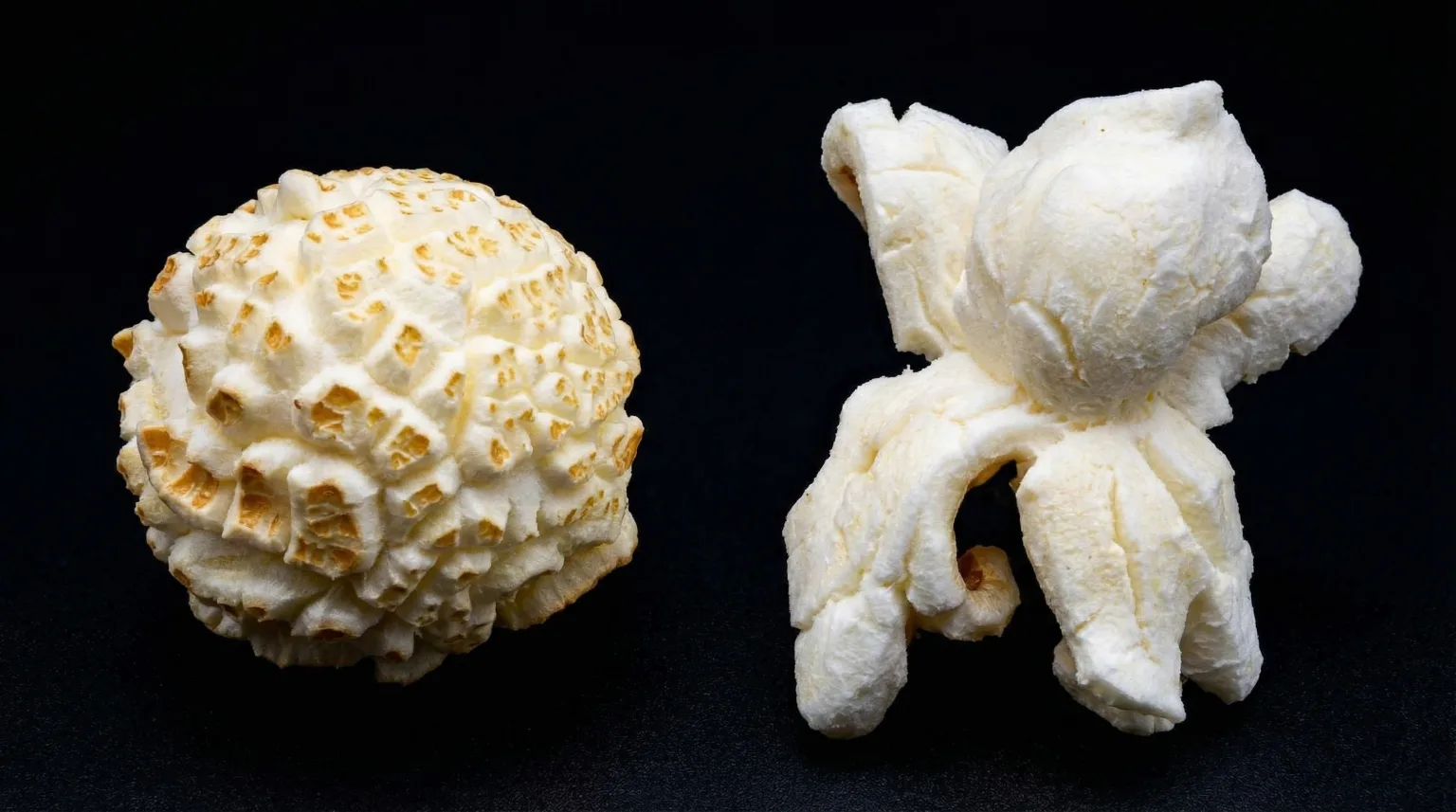
On shape: popcorn commonly expands into two families — butterfly and mushroom — one more airy and irregular, the other rounder and sturdier (useful for coatings). (American Chemical Society)
And popcorn genetics (color, kernel traits, popping characteristics) is a research field of its own. (University of Illinois ACES)
So this wasn’t “just a better recipe.” It was a full-stack shift across biology and physics.
That’s why your line works: innovation didn’t start with a solution. It started with a diagnosis… between your teeth.
The general lesson: innovation often starts where people avoid looking
Most organizations have their own “popcorn hull.”
It doesn’t lodge between teeth. It lodges in:
- a useless form,
- a broken handoff,
- meetings that never decide,
- delays everyone calls “normal,”
- legacy rules no one questions,
- approval processes stacked on top of fear.
Everyone senses it.
Few address it — until it becomes the main pain.
Root cause thinking: innovation that begins with “Why?”
In my approach to intelligence innovationnelle®, you connect this directly to root cause logic: find the cause before pushing solutions (my book, chapter 5). P001-304-9782100876556_ep05 – f…
A classic tool: the “5 Whys,” strongly associated with Toyota-style problem solving — asking “Why?” repeatedly until you reach the root.
Your popcorn story is a perfect, accessible illustration:
- Great taste, still annoying → why?
- Hull fragments → why?
- Hull behavior tied to kernel traits and popping conditions → why?
- Because teams optimized flavor rather than lived experience → why?
- Because observation was replaced by assumptions.
That’s the move from “improve what we control” to “remove what hurts.”
Your final question, made operational
In your projects, what is the “popcorn hull” nobody dares to face?
A simple workshop method:
- List 10 “felt” frictions (time loss, stress, confusion, rework, interruptions, drop-offs).
- Pick the one that repeats most (not the one that sounds smartest).
- Define a friction metric (time, errors, rework rate, abandonment).
- Run 5 Whys on a real case.
- Prototype a fix within 7 days.
- Measure and iterate.
The goal isn’t a “big idea.”
The goal is to remove a “normal” friction.
And when you remove a “normal” friction, you often make an innovation that seems obvious… in hindsight.

References
(Purdue University) = https://ag.purdue.edu/news/2020/02/whats-under-the-shell-of-this-popular-snack.html
(American Chemical Society) = https://www.acs.org/education/whatischemistry/adventures-in-chemistry/secret-science-stuff/popcorn.html
(University of Illinois ACES) = https://aces.illinois.edu/news/illinois-study-reveals-genetic-secrets-americas-favorite-snack
(ScienceDaily) = https://www.sciencedaily.com/releases/2005/04/050415112829.htm
(Iowa State University) = https://www.cad.iastate.edu/popcorn/breeding-populations
(Atlassian) = https://www.atlassian.com/incident-management/postmortem/5-whys