For the past two years, a lazy equation has been circulating in executive committees, tech conferences, and consultant slide decks: AI = automation = cost reduction.
It is seductive. It is simple. It fits into three words. It reassures CFOs, excites CEOs, and gives vendors an easy commercial promise.
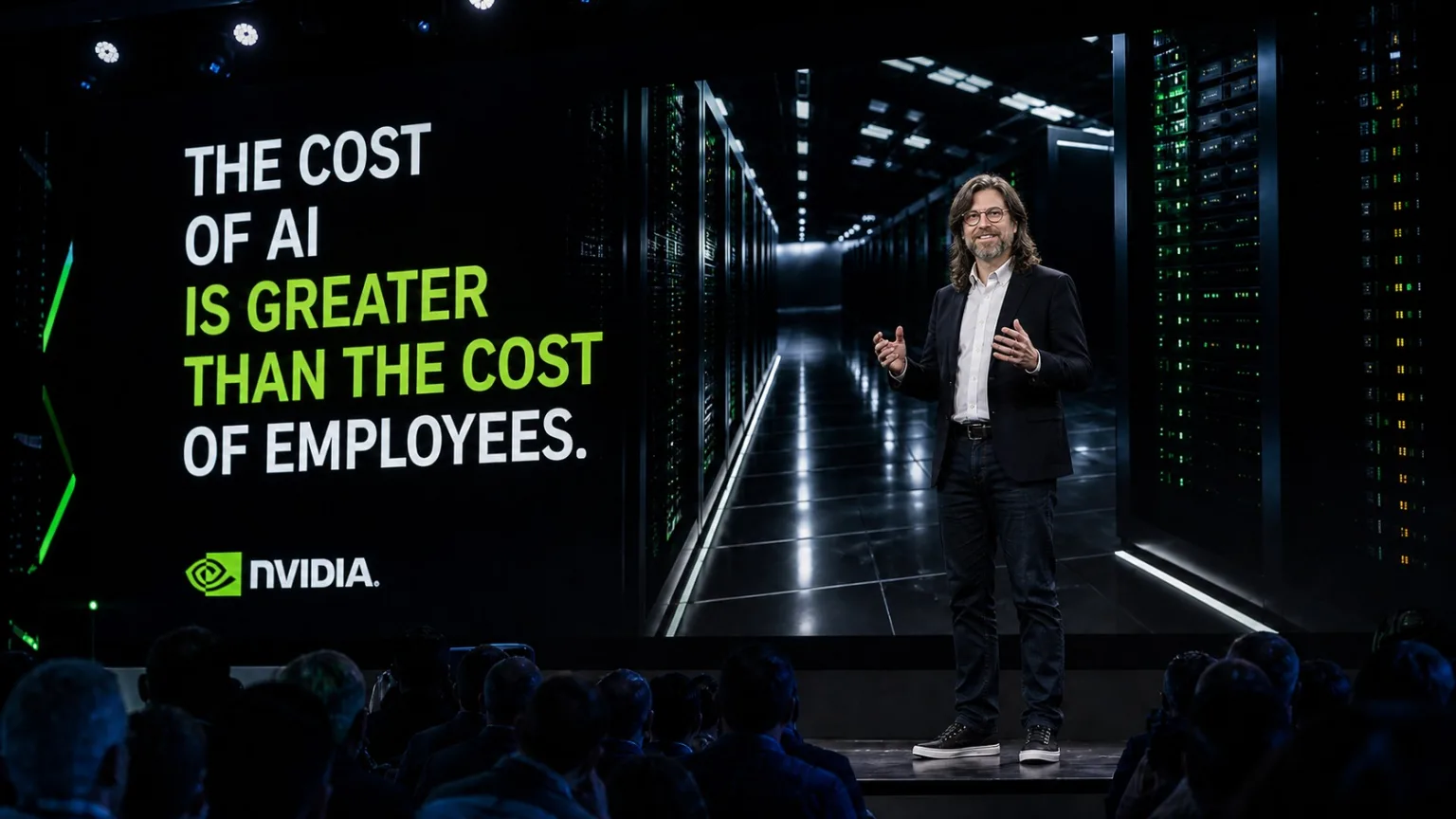
Then Bryan Catanzaro, Vice President of Applied Deep Learning at NVIDIA, summarized in one sentence what many companies are discovering late: “For my team, the cost of compute is far beyond the costs of the employees.” (Fortune)
There it is.
The robot was supposed to replace the employee. In some cases, it starts by costing more than the employee.
The Hidden AI Bill
The original fantasy was comfortable: replace human tasks with automated systems, reduce payroll, accelerate operations, increase margins.
On paper, it sounded logical.
In real operations, the equation becomes less elegant.
Compute is expensive.
Tokens are expensive.
Agents running in loops are expensive.
Human supervision is expensive.
Errors are expensive.
Security is expensive.
Integration is expensive.
Governance is expensive.
Training is expensive.
Poor data is expensive.
And the consultants explaining why everything is expensive are also very expensive.
NVIDIA’s point does not mean AI is useless. It means AI does not automatically produce savings. It becomes an economic advantage only when connected to measurable value creation, redesigned processes, a learning organization, and governance able to arbitrate between experimentation, scaling, and stopping.
Gartner predicts that more than 40% of agentic AI projects will be canceled by the end of 2027 because of escalating costs, unclear business value, or inadequate risk controls. (Gartner)
That number should be displayed next to every AI roadmap. Not to stop projects. To prevent decorative projects.
The Myth of Immediate Replacement
The dominant narrative has been built around a simple image: humans are expensive, machines are cheaper, so machines win.
That narrative forgets a fundamental detail: AI does not replace an employee. It may replace part of certain tasks, in a specific context, under technical, economic, legal, and human constraints.
A MIT FutureTech study on computer vision tasks showed that technical feasibility is not enough. The economic question remains decisive: some automatable tasks are not economically attractive to automate. (MIT FutureTech)
This is where many companies fight the wrong battle.
They ask: “How many people can we replace?”
They should ask: “Where can we create more value with the same people, better equipped, better trained, and better organized?”
Replacement is an accounting logic.
Augmentation is a strategic logic.
Transformation is an organizational logic.
The Real Cost Is Not in the Tool
Most companies miscalculate the cost of AI because they look at subscription prices, token prices, or the cloud bill.
That is too narrow.
The real cost of an AI project includes at least:
- use-case selection;
- data preparation;
- data quality;
- cybersecurity;
- regulatory compliance;
- integration with existing systems;
- user training;
- change management;
- human supervision;
- production errors;
- hallucinations;
- testing;
- governance arbitration;
- maintenance;
- continuous improvement;
- energy impact;
- impact on jobs;
- impact on internal trust.
Poorly integrated AI does not reduce costs. It moves costs. Sometimes it hides them in other budget lines.
A chatbot that answers poorly does not only cost its subscription. It costs customer trust.
A poorly controlled autonomous agent does not only cost API calls. It costs the human hours needed to check, correct, and secure its output.
A code generation tool without guardrails does not only cost tokens. It costs reviews, regressions, technical debt, and possible vulnerabilities.
Stanford HAI notes in its 2026 AI Index that AI company revenue is growing fast, while compute spend and infrastructure spending are also reaching record levels. (Stanford HAI)
The bill has not disappeared. It has changed shape.
The Agent Trap
AI agents are attractive because they promise to chain actions without human intervention: search, decide, write, code, book, summarize, send, follow up.
In a demo, it is impressive.
Inside a company, it is more complicated.
An agent does not make one request. It can make ten, twenty, fifty. It can make a mistake, restart, call an external tool, read documents, produce a plan, correct it, retry a step, then ask for validation.
Every loop consumes compute.
Every loop can create value or waste.
The issue is not only token price. The issue is how many tokens are consumed per useful result.
A mature organization does not measure AI usage by the number of prompts sent. It measures cost per improved decision, cost per avoided error, cost per accelerated sale, cost per truly freed hour, cost per better-served customer.
Without that discipline, AI becomes a budget firework: impressive, noisy, and quickly followed by the smell of smoke.
AI Reveals Organizational Maturity
In my Innovational Intelligence® system, AI is not a magical substitute for humans. It is a revealer.
It shows organizational weaknesses at high speed: unclear goals, absurd processes, unusable data, anxious managers, slow decisions, turf wars, weak communication, defensive culture, and lack of psychological safety. I address this application to artificial intelligence in my book, chapter 14.
A structured company will use AI to amplify its strengths.
A confused company will use AI to amplify its confusion.
A slow company will use AI to produce slow decisions faster.
A political company will use AI to create new power territories.
A company without measurement culture will use AI to produce new illusions.
AI will not save a poorly structured company. It will help it fail faster, with a more elegant invoice.
Process Innovation, Not a Magic Wand
Treating AI as a magical tool is a classic mistake.
AI must be treated as process innovation: a deep change in how we produce, decide, learn, sell, code, recruit, manage, communicate, and serve customers.
Process innovation cannot be created with a software subscription.
It requires an intelligent organization:
Vision.
Culture.
Methods.
Talent.
Communication.
Decision.
Governance.
Measurement.
Without these pillars, AI becomes another layer of complexity. With these pillars, it becomes a value accelerator.
McKinsey observes that organizations capturing more value from AI are more often driven by engaged leaders who take ownership of AI initiatives and drive adoption. (McKinsey)
Technology matters. Management quality matters more.
The CFO Enters the Room
Until now, many AI projects have benefited from fascination. Budgets were approved because AI was strategic, because competitors were moving, because the board was asking questions, because no one wanted to miss the wave.
That period is reaching its limit.
The CFO enters the room.
The question is not whether the demo is brilliant.
The question is how much it costs.
The question is how much it returns.
The question is when return on investment becomes visible.
The question is what risk the company carries.
The question is which savings are real.
The question is which savings are merely shifted elsewhere.
The question is which teams are truly augmented.
The question is which indicators prove value.
This stage is healthy.
It forces companies to leave technological religion and enter economic discipline.
Better Questions Before Automating
Before launching an AI project, a company should answer simple questions.
What precise problem do we want to solve?
What measurable value do we want to create?
Which process are we going to change?
Which data is required?
Who supervises?
Who decides?
Who corrects?
Who carries the risk?
What is the total cost?
What is the cost per useful result?
At what threshold do we stop the project?
At what threshold do we scale it?
Which human capability do we want to augment?
Which human capability might we weaken?
The last question is often forgotten.
AI that automates a task can free time. It can also weaken a critical capability if the organization does not know how to redistribute learning.
Augmenting humans does not mean removing all cognitive effort. It means moving human effort toward better decisions, better arbitration, better interactions, and better learning.
The New KPI: Value per Token
For years, companies measured digital adoption with usage metrics: number of users, number of logins, number of licenses, activation rate.
With AI, these metrics are insufficient.
High usage can hide high waste.
The right indicator is not: “How many employees use AI?”
The right indicator becomes: “What measurable value do we produce per euro of compute, per token consumed, per human hour mobilized?”
Value per token.
Value per workflow.
Value per decision.
Value per customer.
Value per team.
A company that does not measure this value risks confusing activity with performance.
The Augmented Employee Often Beats the Isolated Robot
The augmented employee has what AI does not yet reliably possess in enterprise contexts: implicit context, relational memory, political perception, responsibility, business intuition, ethical judgment, field experience, and the ability to sense that something is wrong.
AI can accelerate.
Humans can arbitrate.
AI can propose.
Humans can decide.
AI can generate.
Humans can carry responsibility.
The high-performing future is not only about robots replacing employees. It will be built around teams capable of combining humans, AI, data, methods, and governance.
The strategic issue is not whether AI will replace humans. It is which organizations will create more value through augmented humans.
The New Luxury Will Be Organizational
In the coming years, every company will have access to powerful models. Every company will be able to buy licenses. Every company will be able to launch agents. Every company will be able to organize AI hackathons. Every company will be able to communicate about its transformation.
The difference will not only come from access to the tool.
It will come from organizational quality.
Winning companies will know how to:
- choose the right use cases;
- measure value;
- stop bad projects;
- train teams;
- secure data;
- clarify responsibilities;
- accept experimentation;
- protect human decision-making;
- maintain trust;
- evolve processes;
- align strategy, culture, and technology.
AI will not magically make organizations intelligent. It will make intelligent organizations faster.
For the others, it will make dysfunctions more visible.
Conclusion: The Bill Has Arrived
The robot was supposed to replace the employee. Sometimes, it now costs more than the employee.
This sentence should not be read as a condemnation of AI. It should be read as an invitation to maturity.
AI is a powerful technology.
It can create value.
It can transform jobs.
It can augment teams.
It can accelerate innovation.
It can improve decision quality.
But it does not forgive organizational improvisation.
Without vision, it becomes spending.
Without culture, it becomes a threat.
Without method, it becomes a toy.
Without measurement, it becomes an illusion.
Without talent, it becomes a cost line.
Without communication, it becomes a source of anxiety.
Without governance, it becomes a risk.
In your company, is AI already a measurable value lever, or just a new cost line with a pretty logo?


References
(Fortune) = https://fortune.com/2026/04/28/nvidia-executive-cost-of-ai-is-greater-than-cost-of-employees/
(Gartner) = https://www.gartner.com/en/newsroom/press-releases/2025-06-25-gartner-predicts-over-40-percent-of-agentic-ai-projects-will-be-canceled-by-end-of-2027
(MIT FutureTech) = https://futuretech.mit.edu/publication/beyond-ai-exposure-which-tasks-are-cost-effective-to-automate-with-computer-vision
(McKinsey) = https://www.mckinsey.com/capabilities/quantumblack/our-insights/the-state-of-ai
(Stanford HAI) = https://hai.stanford.edu/ai-index/2026-ai-index-report/economy
(Reuters) = https://www.reuters.com/technology/openai-sees-compute-spend-around-600-billion-by-2030-cnbc-reports-2026-02-20/