We think we already live in the future
By 2050, your children may laugh at your smartphone the way you laugh today at the fax machine.
We think we already live in the future.
We talk to artificial intelligence.
We wear watches that monitor our sleep.
We order a taxi, a meal, a bank transaction and sometimes a social life from a pocket screen.
We work in collaborative tools that our grandparents might have mistaken for organized telepathy.
And yet, we still reason too often as if tomorrow were merely a software update of today.
A little faster.
A little more connected.
A little more automated.
Still familiar.
Wrong.
The future does not simply improve the present. Sometimes it makes it unrecognizable.
That is why 2050.earth is fascinating. The project, launched by Kaspersky, offers an interactive map of future predictions, with contributions from futurists, scientists, experts and internet users. It should not be read as an oracle. It should be read as a mirror. A mirror that deliberately distorts the present to reveal what we still refuse to look at. (Kaspersky)
2050 is not about gadgets
The usual trap when talking about the future is to reduce it to objects.
A flying car.
A butler robot.
Immersive glasses.
A home that orders oat milk before you even know you want it.
Fun. Spectacular. Perfect for a promotional video.
But the real issue is not the gadget. The real issue is the recomposition of our behaviors.
What happens to family life when immersive presence becomes almost credible?
What happens to work when an avatar can represent us in some digital spaces?
What happens to the city when it becomes an interface driven by data?
What happens to companies when AI no longer merely assists, but starts deciding, negotiating, filtering, recommending and acting?
What happens to education when a child no longer understands why learning should look like it did for their great-grandparents?
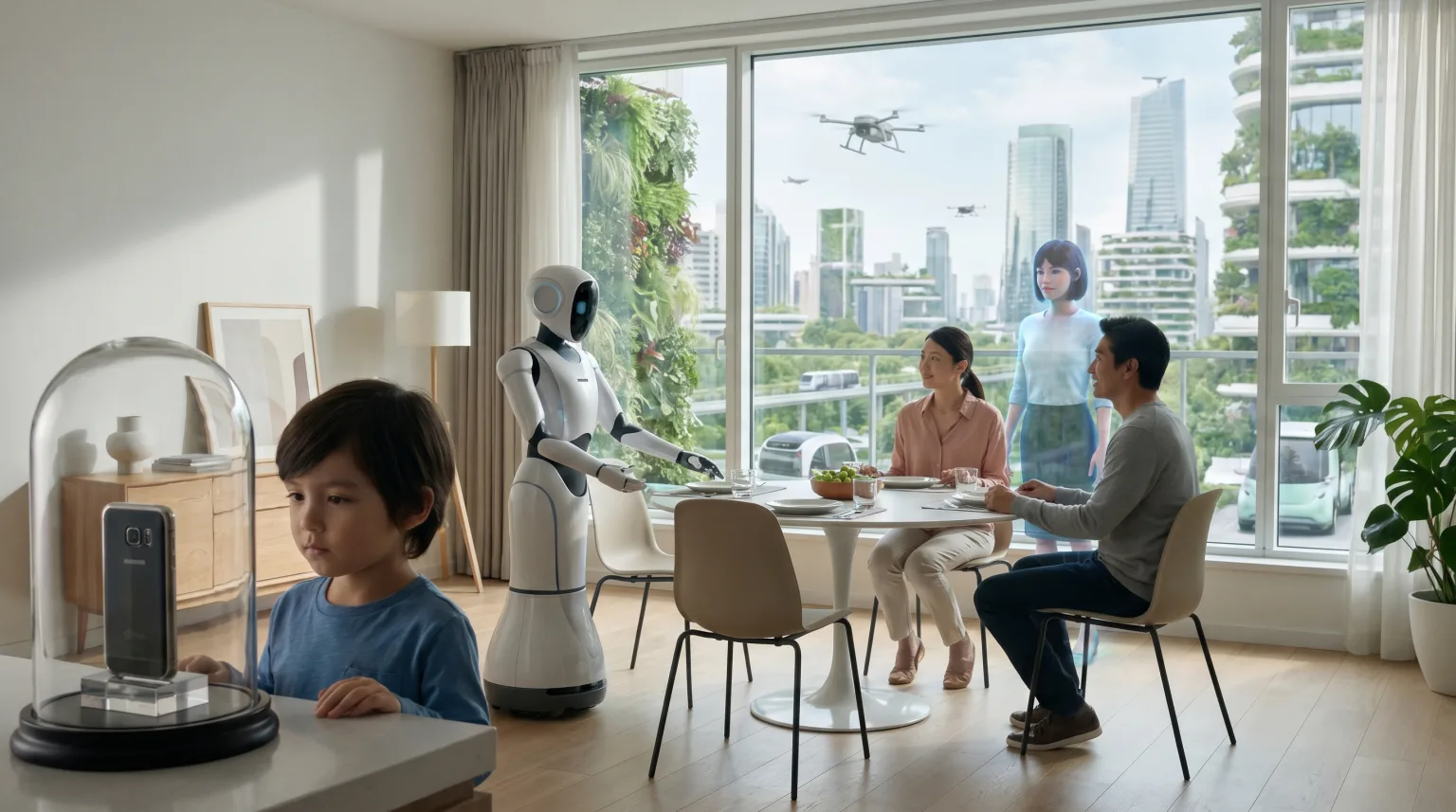
2050.earth shows augmented cities, domestic robots, families reunited in immersive reality, deeply technological urban environments and human relationships reshaped by digital life.
We can smile.
We can roll our eyes.
We can say: “More science fiction.”
That is exactly what organizations do before being overtaken.
The future rarely arrives with a warning label
The most important ruptures almost never introduce themselves as ruptures.
The smartphone did not arrive saying: “Hello, I am going to devour the camera, the GPS, the alarm clock, the press, the radio, the bank, the travel agency, the MP3 player, the address book, the wallet and part of your attention.”
It arrived as a smarter phone.
Then it swallowed daily life.
Artificial intelligence is following the same path. First a writing assistant. Then a copilot. Then an agent. Then an invisible layer inside processes. Then a decision infrastructure.
The World Economic Forum estimates that current major trends could create 170 million new jobs and displace 92 million by 2030, resulting in a net gain of 78 million jobs. The number matters less than the message: work does not simply disappear, it mutates. (World Economic Forum)
And when work mutates, skills, organizations, management models, power structures and performance criteria mutate with it.
Most companies do not miss the future because they lack technology.
They miss it because they are too familiar with their own past.
The cities of 2050 will be living systems
A major part of the future will unfold in cities.
According to the United Nations, 68% of the world’s population is projected to live in urban areas by 2050. This gives a sense of the pressure that will affect transport, energy, health, water, housing, security, infrastructure and public services. (United Nations)
Cities will no longer only be built. They will have to be orchestrated.
The OECD notes that smart cities aim to improve citizens’ well-being, optimize public service delivery and support more sustainable environments through digital technologies. Artificial intelligence is already being considered for mobility, safety, energy efficiency and urban planning. (OECD)
The city of 2050 will not simply be a futuristic setting. It will be a complex organism.
It will listen.
It will measure.
It will predict.
It will arbitrate.
It will recommend.
It will adjust.
And we will have to decide how far we accept that organism intervening in our lives.
A smart city can become more fluid, safer and more efficient. It can also become more intrusive, more normative and more opaque.
The future is never only a technology issue. It is a governance issue.
The real shock will be cultural
Many leaders still look at the future through a technological lens.
How much does it cost?
Which tool should we choose?
Which vendor should we select?
What is the return on investment?
What is the use case?
What is the benchmark?
All of these questions are useful.
But they often come too late if the organization has not first worked on its ability to absorb change.
In my book, I discuss the status quo bias: the invisible force that pushes us to prefer what already exists, even when the world around us has changed (my book, chapter 6).
This bias is not a moral weakness. It is mental economy.
Our brain likes what is known.
Our teams like what is mastered.
Our processes like what is repeatable.
Our committees like what is reassuring.
Our budgets like what is predictable.
The future loves making the predictable look ridiculous.
That is why the most interesting predictions are not necessarily the ones that seem most likely. They are the ones that create discomfort.
A family reunited in immersive reality?
A domestic robot becoming a functional member of the household?
A professional avatar joining certain meetings?
A city adapting its public services in real time?
An AI advising a leader better than an executive committee on some decisions?
These scenarios disturb us because they attack our reference points.
That is exactly why they deserve to be explored.
Slow companies confuse caution with sleepwalking
The problem with the future is not that it arrives too fast.
It is that we arrive too slowly.
Too attached to our habits.
Too in love with our certainties.
Too reassured by what worked yesterday.
Too busy optimizing models approaching their expiration date.
In some organizations, this is called caution.
In others, it is called governance.
In the worst cases, it is called strategy.
But when caution becomes an excuse for immobility, it stops being a virtue. It becomes anesthesia.
The history of innovation is full of companies that had the means, the talent, the data, the customers, the patents and the brand. They lacked one thing: the ability to betray themselves in time.
For an organization, betraying itself means accepting the need to challenge what made it successful.
Its business model.
Its distribution.
Its dominant skills.
Its indicators.
Its routines.
Its internal beliefs.
Its power reflexes.
That is difficult because a high-performing company often has very good reasons not to change.
Until those good reasons become its trap.
AI will only be part of the shock
The Stanford AI Index 2025 describes artificial intelligence as increasingly present in the economy, research, public policy and professional uses. AI is no longer a laboratory topic or an IT department topic. It is becoming a general layer of cognitive infrastructure. (Stanford HAI)
But reducing 2050 to AI would be a mistake.
The future will be a combination.
AI.
Robotics.
Biotechnology.
Smart cities.
Energy.
Immersive reality.
Connected objects.
Cybersecurity.
Digital identity.
Demographic aging.
Reinvention of work.
New social expectations.
Each trend taken separately already matters. Their combination creates systemic acceleration.
That combination is what makes 2050 scenarios interesting.
A domestic robot is not just a robot. It is an autonomy device for older people, an employment issue for home services, a security question, a personal data challenge, a new family interface and perhaps a future social marker.
An augmented city is not just a more connected city. It is a new distribution of power between citizens, elected officials, platforms, technology providers, insurers, mobility operators and public services.
A professional avatar is not just a digital image. It is a question of responsibility, presence, representation, trust and contract.
The future is rarely an object. It is a system.
The children of 2050 will judge our resistance
The most interesting part of this projection is not what we will think of 2050.
It is what the children of 2050 will think of us.
They may not understand why we spent so much time typing on keyboards.
They may find it strange that we drove ourselves through traffic jams.
They may be stunned that healthcare was so reactive.
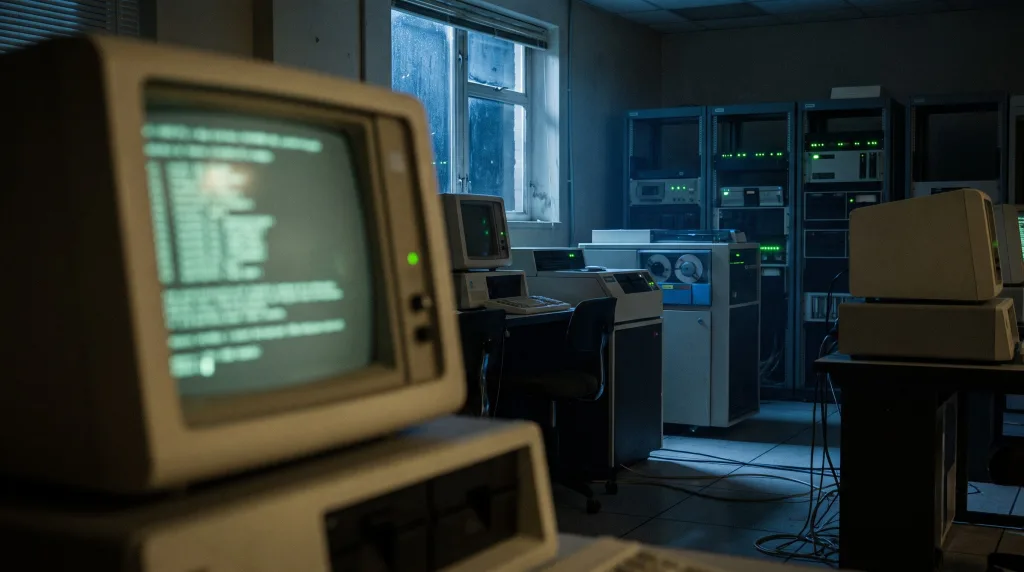
They may laugh at our smartphones the way we laugh today at the fax machine.
They may not understand why we resisted certain obvious shifts for so long.
Every generation finds the technological obviousness of the previous generation archaic.
But the point is not to be right about 2050. The point is to train our organizations to look at weak signals without ridiculing them too quickly.
The future will not ask for permission.
It will enter through the door, through the window, through the algorithm, through the robot, through the child who will not understand why we stayed attached for so long to ways of working that had become absurd.
The decisive skill: looking at what disturbs us
The decisive skill will not be predicting 2050 accurately.
No one knows how to do that.
The decisive skill will be detecting, today, what we still refuse to look at.
In the keynotes, workshops and advisory programs I design around innovational intelligence, this topic comes back constantly: an organization does not progress only because of the ideas it accepts. It progresses mainly because of the discomforts it agrees to explore.
A disturbing prediction is not necessarily true.
But it can be useful.
It forces an assumption to be tested.
It pushes us out of routine.
It invites us to look at a blind spot.
It breaks intellectual comfort.
Pew Research has surveyed experts on the future of digital life and notes that expected benefits will depend heavily on cooperation, security, basic rights and economic fairness. A technological future will not automatically be a human future. It will have to be designed, discussed, governed and corrected. (Pew Research Center)
That is why 2050.earth is interesting.
Not because all its predictions will happen.
Because it forces us to ask which ones we refuse to consider.
And inside that refusal often lies the real strategic work.
👉 Which prediction for 2050 feels the most disturbing to you, and therefore probably the most useful to explore?

References
(Kaspersky) = https://2050.earth/
(Kaspersky Blog) = https://www.kaspersky.com/blog/earth-2050-launch/14150/
(United Nations) = https://www.un.org/uk/desa/68-world-population-projected-live-urban-areas-2050-says-un
(OECD) = https://www.oecd.org/en/about/programmes/the-oecd-programme-on-smart-cities-and-inclusive-growth0.html
(World Economic Forum) = https://www.weforum.org/publications/the-future-of-jobs-report-2025/
(Stanford HAI) = https://hai.stanford.edu/ai-index/2025-ai-index-report
(Pew Research Center) = https://www.pewresearch.org/internet/2019/10/28/experts-optimistic-about-the-next-50-years-of-digital-life/