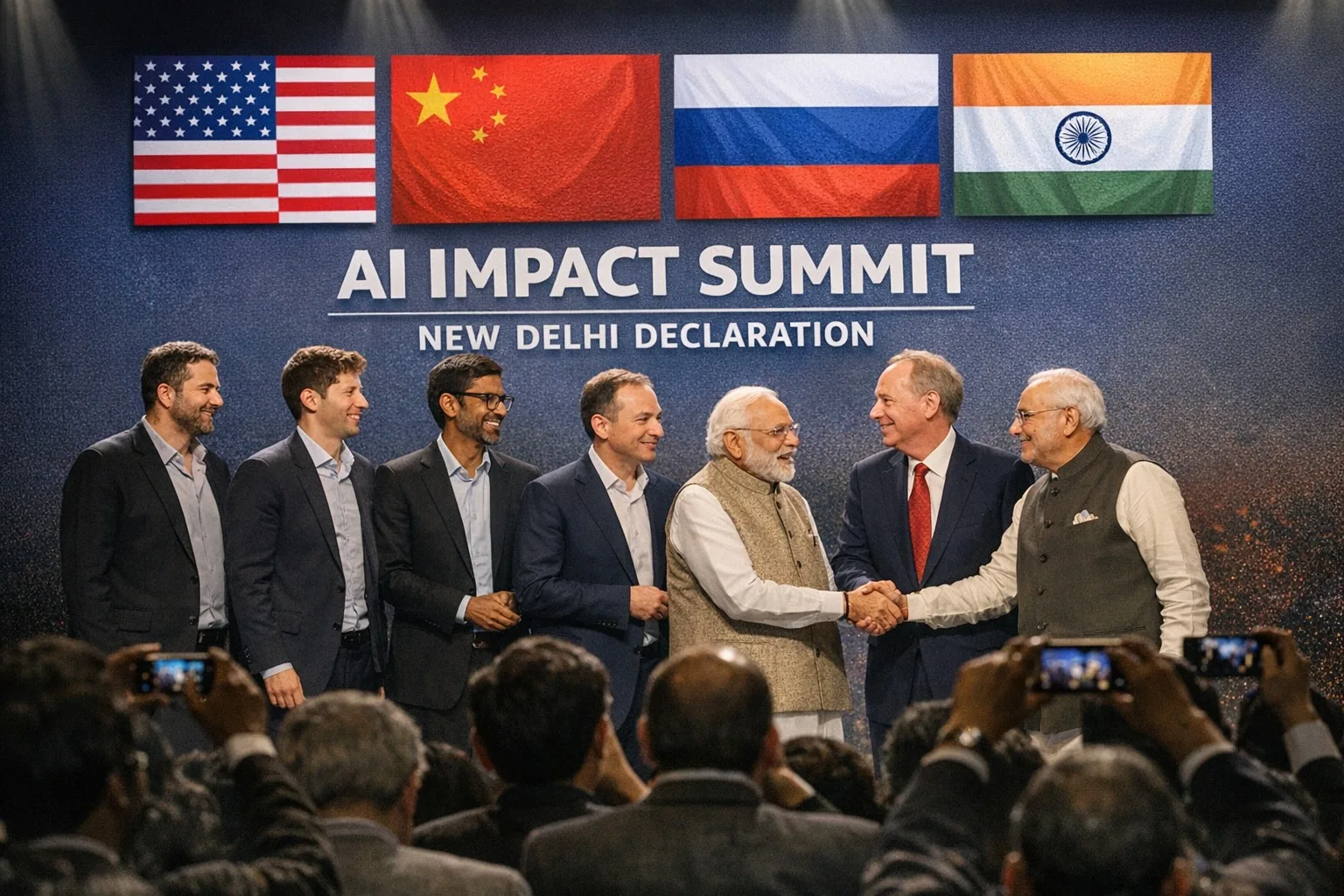
The “global peace deal on AI” wasn’t signed at the UN. It played out in a room in New Delhi, during the AI Impact Summit 2026.
The strongest signal is not technical. It’s geopolitical: a shared text validated in the same movement by countries that, on other issues, barely sign anything together anymore.
1) The hard fact: a declaration adopted—and rival blocs on the same list
The summit (Feb 18–19, 2026) concluded with the adoption of the New Delhi Declaration on AI Impact. (Ministry of External Affairs)
On the exact endorsement count, official communications show multiple figures:
- 91 countries and organisations (MEA)
- 91 (PIB initial release)
- 92 (PIB later communication)
- and in media coverage at announcement time, 88 is also cited (Times of India).
This matters: it reflects a standard “summit-text” dynamic—coalitions expand after the event as capitals finalise and join.
2) The content: voluntary, human-centric, and explicitly non-binding
The declaration emphasises inclusive, human-centric AI and international cooperation under a voluntary / non-binding framing. (MEA)
And its publication as an official diplomatic document makes it reusable as a reference point for other states. (MEA – “AI Impact Summit Declaration”)
The “voluntary” choice is politically rational: it’s often the only overlap zone when strategic interests diverge.
3) The real engine: infrastructure, not models
While diplomacy produces a framework, industry puts numbers on the table.
Reuters reports Reliance and Adani announcing a combined $210B in AI and data infrastructure investments (with Adani focused on “AI-ready” data centers powered by renewables).
And Reuters describes an ecosystem that could catalyse $250B through spillovers.
This is where many people bet on the wrong battlefield. The AI race is no longer just:
- who has the best model,
but: - who controls compute access,
- who industrialises data centers,
- who pulls real usage,
- who sets the rules of acceptability.
That is exactly the shift I detail in my book (chapter 14): once AI becomes a system, advantage migrates toward rules and structures, not just demos.
4) Why India can play this arbiter role
[Inference] A venue like India can function as a space where rival blocs coexist without losing face: the text stays broad enough to be acceptable, and everyone leaves with an ecosystem narrative (investment, partnerships, standardisation).
The summit also presents itself as a long-term platform (official site), reinforcing the ambition to institutionalise the process. (IndiaAI Impact Summit)
5) The question that matters: models or standards?
If you want to bet, bet on the right theatre.
- The model battle remains visible (announcements, benchmarks, frontier narratives).
- The standards battle is quieter—and more decisive: it defines who can deploy, under what constraints, with what obligations, and who gets access to critical infrastructure.
This summit and declaration look less like a “tech event” and more like a stress test: can the world still produce minimal shared governance on a strategic domain? (MEA, PIB)
And next—yes—comes the real test: what “human-centric” means when AI is used in conflict environments.


References
(Reuters) = https://www.reuters.com/world/india/ambanis-reliance-will-invest-110-billion-ai-2026-02-19/
(Reuters) = https://www.reuters.com/business/energy/indias-adani-invest-100-billion-ai-data-centres-by-2035-2026-02-17/
(Reuters) = https://www.reuters.com/world/india/tech-majors-commit-billions-dollars-india-ai-summit-2026-02-19/
(Ministry of External Affairs, India) = https://www.mea.gov.in/press-releases.htm?dtl%2F40810%2FAI_Impact_Summit_2026_Concludes_with_Adoption_of_New_Delhi_Declaration=
(Press Information Bureau, India) = https://www.pib.gov.in/PressReleasePage.aspx?PRID=2231208
(IndiaAI Impact Summit) = https://impact.indiaai.gov.in/
(Times of India) = https://timesofindia.indiatimes.com/technology/tech-news/ai-summit-2026-us-china-eu-and-a-total-of-88-countries-sign-new-delhi-declaration-on-global-ai-impact-whats-in-it-and-why-it-matters/articleshow/128648923.cms