Apple’s early days were nothing like a fairy tale. They looked far more like an innovation lab under tension, where electronics tinkering, hacker culture, commercial instinct, and relentless execution collided.
People keep reducing Apple to a garage. That version is tidy. It is easy to remember. It also hides what the company’s origin really says: a major company can emerge from discomfort, peripheral illegality, permanent experimentation, and a market reading that is faster than everyone else’s. (Mac4Ever)
The garage hides the real story
The garage became a mythological set. It helps tell Apple as a clean American startup legend. But the garage is not the point. The point is what happened before and around it.
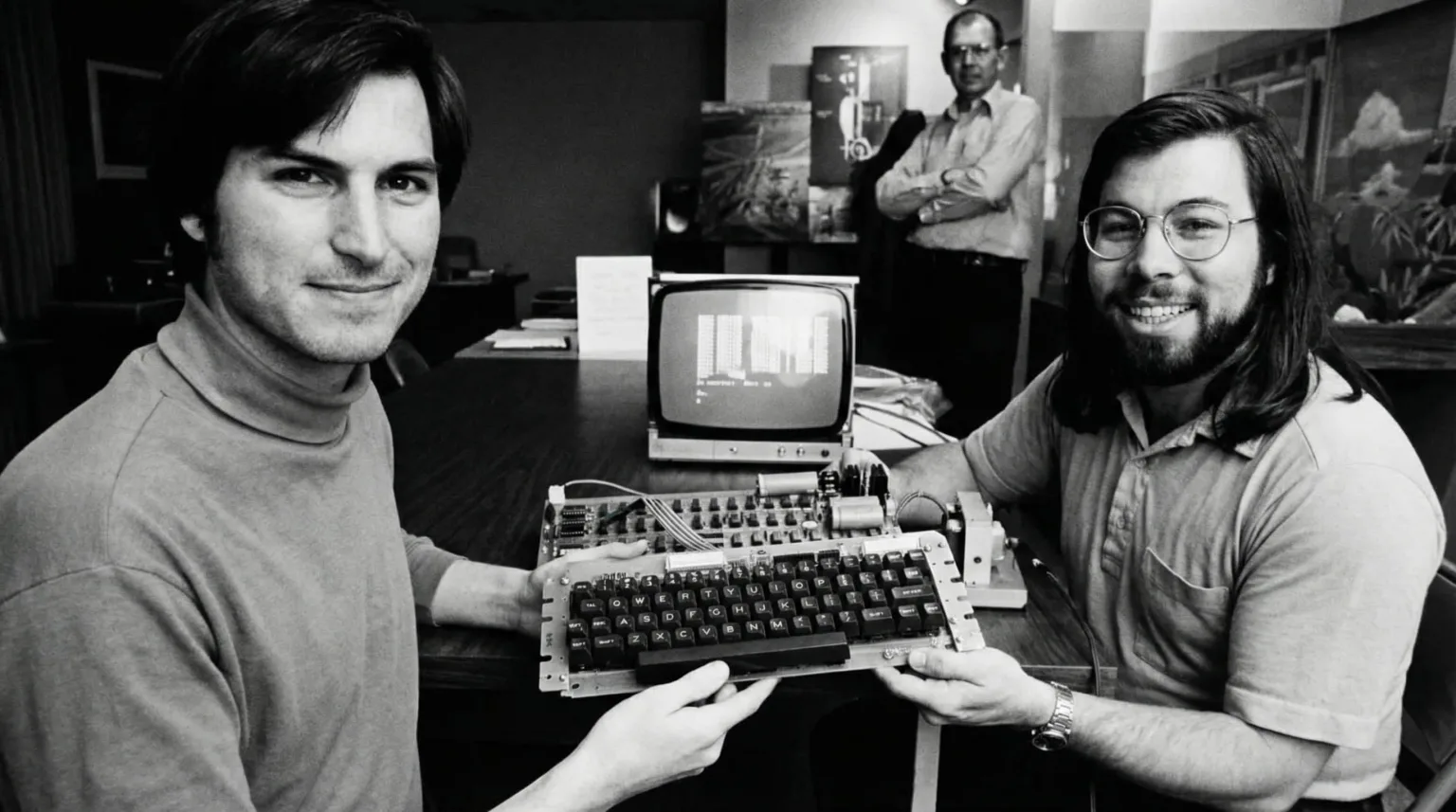
Before Apple, there was already a strategic engine at work. Wozniak mastered electronics at a rare level. Jobs spotted value early. Woz pushed technical logic to the edge. Jobs sensed the moment when a technical feat could become a marketable product. That complementarity was not a secondary detail. It was the structural foundation of Apple’s future. The Computer History Museum notes that Wozniak designed the Apple-1 and first showed it off at the Homebrew Computer Club, while Jobs saw how to sell it. (Computer History Museum, Computer History Museum)
In other words, one proved it could be built, the other made sure it could exist in a market.
A large number of organizations still fail right there. They have brilliant people. They even have strong ideas. Yet they fail to innovate because technical value is left untranslated into commercial reality.
The Blue Box was not a side anecdote
One of the most revealing episodes in Apple’s beginnings remains the Blue Box. Wozniak and Jobs built and sold devices that allowed free long-distance calls by exploiting the phone system. Yes, it was illegal. Yes, it was already business. And yes, it also worked as a mental prototype for what Apple would later become. The Computer History Museum clearly places that episode before Apple and ties it to the path of both Steves. (Computer History Museum, Computer History Museum)
Why does that matter so much?
Because it proved four things.
First, a locked system can be understood deeply enough to be bypassed. Second, even a fringe technical solution can trigger immediate demand. Third, a technical-commercial duo can already work with a natural division of labor. Fourth, Jobs had already understood that invention has little value if it does not circulate.
The Blue Box was not just a shady anecdote. It was a rehearsal.
Breakout confirmed the pattern
The Atari episode around Breakout adds another layer. Atari states that Steve Jobs and Steve Wozniak worked on Breakout, and the company notes that Wozniak created a prototype later redesigned for mass production. (Atari, Atari)
That detail deserves nuance.
In simplified narratives, Breakout becomes proof of pure genius. In reality, the episode shows something else: make it better, make it smaller, fit more into less, learn fast under constraints, then discover that a technical exploit is not automatically industrializable as-is.
That is a truth many companies still refuse to face. A feat is not a product. An engineering performance is not yet innovation. An internal demo that impresses everyone proves nothing about market adoption.
That is exactly what I emphasize in my book: without implementation, adoption, and real-world deployment, you are still dealing with an idea, a possible invention, or raw talent, not innovation (my book, chapter 3).
The Apple I marks the real turning point
The decisive moment comes when Wozniak shows the Apple-1 at the Homebrew Computer Club. Once again, two readings of the same object coexist. For many, it is just a beautiful circuit board. For Wozniak, it is an elegant technical accomplishment. For Jobs, it is already an offer. The Computer History Museum notes that the Apple-1 prototype was shown at Homebrew and later sold as a single-board computer for hobbyists. (Computer History Museum, Computer History Museum)
This is where many people misunderstand Apple.
Apple did not simply begin with a good product. Apple began with an ability to spot faster than others the transition from promising tinkering to sellable object.
The difference between a company that shapes history and a team that remains admirable but marginal is often right there: who can already see the product while everyone else is still admiring the prototype?
Apple’s strange beginnings tell the truth about innovation
Apple’s beginnings are unsettling because they contradict the polished story so many organizations like to tell about themselves.
There is a comforting belief that leaders emerge from clean, legal, structured environments fully aligned with future processes. Reality is rougher. Market-shifting trajectories often begin in tension zones: diverted use, regulatory blind spots, unorthodox experiments, or a sharper reading of a latent need.
That does not mean illegality should be glorified. It means something else: markets are often transformed by people who see in a technical detail, a marginal behavior, or a locked system the outline of a future product, while others see only risk, curiosity, or wasted time.
Apple did not win because it was pure.
Apple won because it aligned rare ingredients: technical talent, commercial instinct, learning speed, and execution.
Most companies prefer ideas over implementation
That is the useful shock this story should deliver to leaders.
In established organizations, interesting ideas are everywhere. Intelligence is rarely the missing piece. What is missing is movement. Permission to test. The right to turn an intuition into something real. The ability to accept an imperfect first version as long as it creates faster learning than the market.
Apple’s beginnings remind us of something many overly compliant structures avoid: markets do not reward theoretical purity. They reward the transformation of intuition into adopted solutions.
And that is where years get lost. Teams comment, frame, compare, align, and wait for the perfect timing. Meanwhile, somebody else moves with something less perfect but already real.
What Apple’s beginnings should make you re-evaluate
Look at your current projects honestly.
Which one is still a great internal idea that never got pushed far enough to become an offer?
Which one is trapped at the “interesting” stage because no internal Jobs stepped in to turn it into a product, service, use case, or adoption dynamic?
The biggest risk is not always launching too early.
The biggest risk is often letting an intuition die for lack of execution.
That is exactly the kind of issue I unpack in my keynotes, workshops, and advisory work, because innovation is never measured by the charm of an idea. It is measured by its ability to enter reality, find adoption, and move a market.



References
(Mac4Ever) = https://www.mac4ever.com/culture/195395-jeu-video-vente-illegale-d-electronique-les-origines-obscures-d-apple
(Computer History Museum – Steve Jobs) = https://computerhistory.org/blog/steve-jobs/
(Computer History Museum – Homebrew Computer Club) = https://www.computerhistory.org/revolution/personal-computers/17/312
(Computer History Museum – Apple II / Blue Boxes) = https://www.computerhistory.org/revolution/personal-computers/17/300
(Computer History Museum – Internet History of 1970s) = https://www.computerhistory.org/internethistory/1970s/
(Atari – History) = https://atari.com/pages/history
(Atari – Breakout origins) = https://atari.com/blogs/atari/new-insight-into-breakout-s-origins
(Computer History Museum – Apple timeline) = https://computerhistory.org/apple-timeline/
(Computer History Museum – Timeline of Computer History) = https://www.computerhistory.org/timeline/computers/