The museum was never the real issue
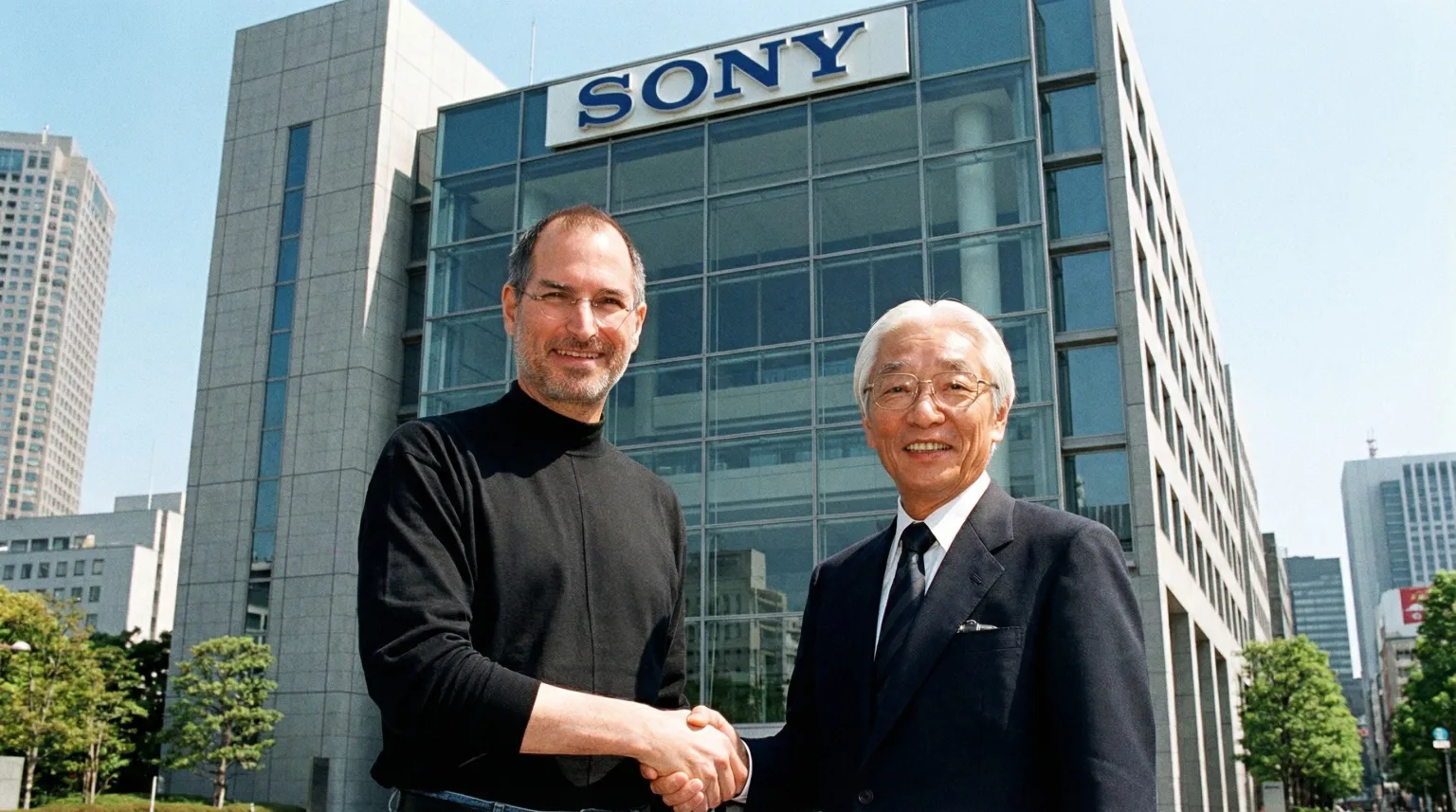
Steve Jobs went to Sony. He looked at objects, discipline, and a way of turning technology into desire. In my book, chapter 3, I explicitly connect those visits to the birth of the iPod and to the logic of serendipity: feeding your mind elsewhere so you can create better here.
That is why this story matters.
On one side, Sony understood early that a company can put its history on display. Its archive in Shinagawa long showcased pioneering products and key documents from its journey. The place does not merely display devices. It displays a culture. (Japan Experience)
On the other side, Apple stayed away from that path for years. Apple did preserve archives. The company had even gathered materials for an internal museum. Then Steve Jobs, back in 1997 to save a company in deep trouble, made the opposite choice: he dropped the in-house museum idea and donated the collection to Stanford. (AppleInsider, Phys.org)
So was he afraid of giving competitors ideas?
I cannot verify that.
That motive is tempting because it sounds psychologically neat. The available facts point elsewhere. They point to a leader obsessed with recovery, motion, and the next product, not with building an internal shrine. In 1997, Apple did not need a mausoleum. Apple needed oxygen. (Phys.org, AppleInsider)
Sony fed Jobs’s imagination
The most interesting part of this story is the apparent paradox.
Jobs openly learned from elsewhere. The Steve Jobs Archive recalls his desire to expose himself to “the best things that humans have done” and notes his trip to Japan, his meeting with Akio Morita, and the first-generation Walkman he received there. (Steve Jobs Archive)
In other words, Steve Jobs did not protect his mind from the outside world. He did the opposite. He opened it wide.
This is where many companies fail. They imagine innovation means guarding ideas, prototypes, buildings, and internal language so tightly that nothing outside can get in. They close doors, control access, filter viewpoints, and end up walking in circles inside their own hallway.
Jobs went to Sony. And at Sony, he was not hunting for a copy. He was looking for intensity, rigor, and coherence between product, design, use, and narrative.
In my book, chapter 3, I write that he was a regular Sony visitor, that he found inspiration there, and that this dynamic fed the iPod. So the central issue is not fear of giving ideas away. The central issue is the ability to receive ideas and recombine them faster than everyone else.
The trap of companies that admire themselves
The danger is not having a memory.
The danger is starting to live inside it.
A company begins to drift when its past stops being raw material and becomes shelter. It displays trophies, old innovations, legendary founders, historic slogans, and still believes it is alive while mostly archiving its own energy.
Sony illustrates this tension perfectly. The company invented, industrialized, diffused, and scaled formats, devices, and habits. Its history is enormous. History alone, however, is not enough. Even a company that strong can lose momentum when internal interests diverge, strategy blurs, and customer experience gets sacrificed to defensive logic. That is exactly what I describe in my book regarding the digital Walkman. Sony had immense assets. Apple did a better job of turning the whole system into desire, simplicity, and ecosystem.
That is why this topic goes far beyond Apple.
Many organizations want to honor their heritage. Fine.
The decline begins when a display case replaces a vision.
Useful legacy and toxic legacy
There are two ways to look at the past.
The first is to treat it like a laboratory. You revisit founding decisions, strong intuitions, mistakes, turning points, and products that shifted a market. You search for principles. You dissect moves. You understand why one product resonated and why another collapsed.
The second is to turn the past into religion. You repeat legends. You freeze heroes. You frame slogans. You protect relics. You sanctify past victories until you forget that their greatness came from breaking with what existed before.
Jobs seemed to accept the first approach and distrust the second.
That is consistent with his broader mindset. He could admire Sony, receive a Walkman from Morita, learn from Japan, and then return to Apple and refuse any mental installation in nostalgia. (Steve Jobs Archive)
There is a powerful leadership doctrine here: draw from the past, yes; administer the past as emotional rent, never.
Apple has opened the door a little
The most interesting twist is that Apple itself now seems slightly more relaxed about this posture.
For its 50th anniversary, Apple opened part of its archives to The Wall Street Journal and showed historical prototypes, while a temporary exhibition appeared at Apple Park. The company is not becoming a museum. It is testing another way of telling its story: limited, controlled, and temporary, without moving into it. (Numerama)
That detail matters.
It shows that a company can value its history without inhabiting it. It can show prototypes without turning the whole house into a commemorative hall. It can tell fifty years of Apple without replacing hunger with memory.
That is likely the healthiest path for many businesses: archives, yes; historical awareness, yes; permanent self-celebration that dulls execution, no.
What many leaders still fail to grasp
Most leaders do not lack history. They lack strategic use of history.
They have founding stories.
They have old products.
They have heritage slides.
They sometimes even have a room full of artifacts.
Yet they extract nothing from them.
They do not ask:
what in our past proves we can begin again?
what in our past successes already contained the seeds of today’s rigidity?
what do our old bets reveal about our current relationship to risk?
what are we still protecting even though it no longer has a future?
The past matters only if it re-arms the present.
Otherwise, it becomes decoration.
Memory only matters if it puts you back in motion
So the Jobs paradox is not a contradiction. It is a doctrine.
Yes, he looked at Sony.
Yes, he learned from Sony.
Yes, Sony fed his product imagination.
And no, that does not prove he rejected an Apple museum because he feared “giving others ideas.”
What it suggests much more solidly is that he refused to let Apple spend energy contemplating its own reflection at the very moment it needed reinvention. (Phys.org, AppleInsider)
Companies that refuse to look at their past often end up having it stolen.
Companies that settle inside their past often end up getting lost there.
The best ones do something else.
They revisit.
They learn.
They sort.
They discard.
They move again.
The future belongs neither to the amnesiac nor to the nostalgic.
It belongs to those who know how to turn memory into momentum.


References
(Obsolete Sony’s Newsletter) = https://obsoletesony.substack.com/p/sony-first-product
(Japan Experience) = https://www.japan-experience.com/all-about-japan/tokyo/museums-galleries/sony-archives
(Numerama) = https://www.numerama.com/tech/2226905-pour-ses-50-ans-apple-montre-des-prototypes-diphone-et-dipod.html
(Steve Jobs Archive) = https://stevejobsarchive.com/stories/objects-of-our-life
(AppleInsider) = https://appleinsider.com/articles/11/12/30/hidden_stanford_archive_houses_largest_collection_of_apple_historical_materials
(Phys.org) = https://phys.org/news/2011-12-stanford-archives-window-apple.html
(Sony Group Portal) = https://www.sony.com/en/SonyInfo/CorporateInfo/History/SonyHistory/2-05.html