The innovation that first sounds like a joke
Michelin has just invented a tree that does not grow.
It inflates.
On paper, the idea sounds almost provocative. An inflatable tree to fight urban heat? You can already imagine the smirks, the vegetation purists, the self-appointed experts in ecological common sense, the lovers of century-old plane trees.
And yet, the topic is serious.
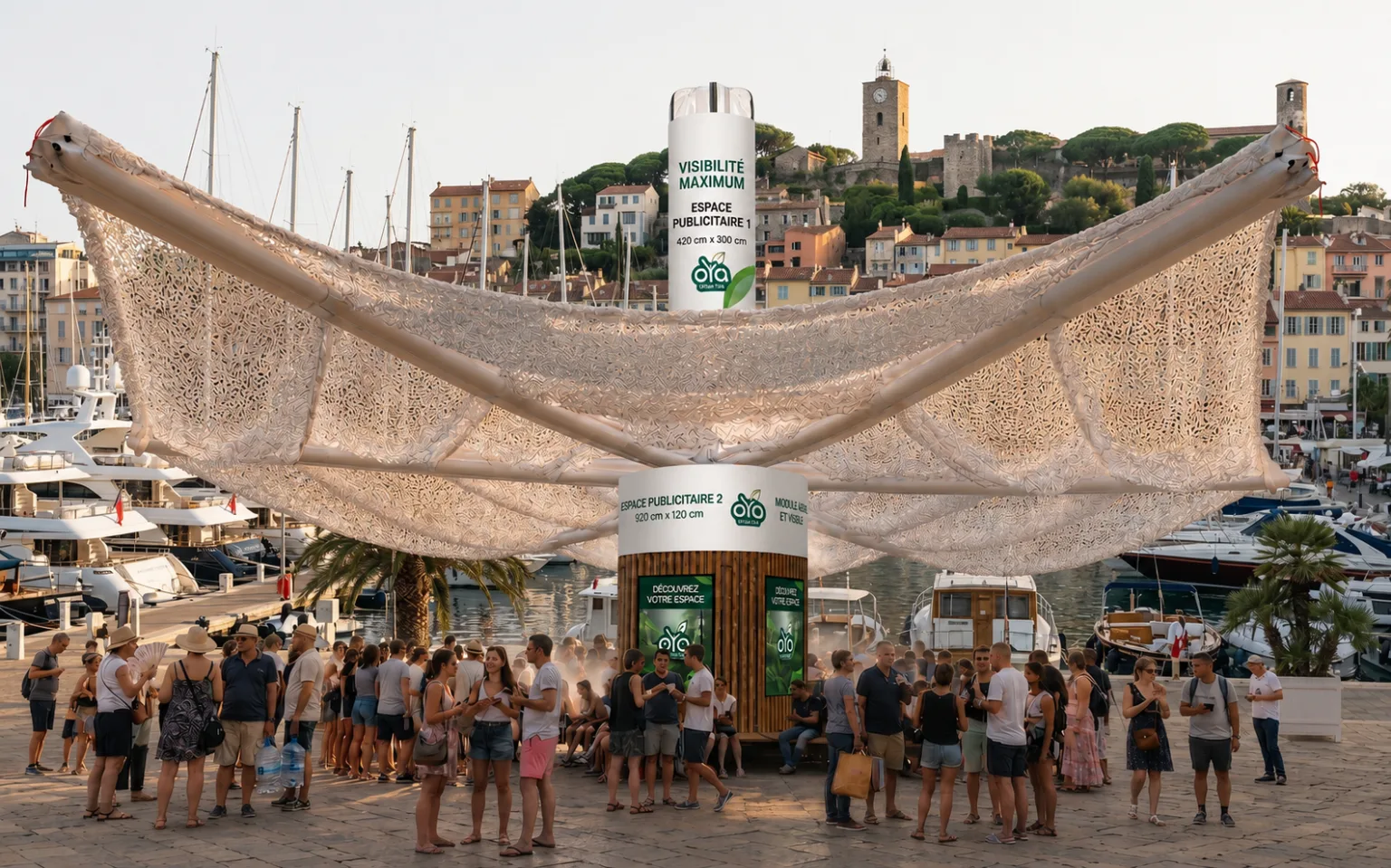
OYA Urban Tree promises 260 m² of shaded surface, capacity for up to 200 people, a mobile structure, installation announced in 1 hour and 30 minutes, without foundations, with a micro-diffused and adaptive misting system according to OYA Urban Tree’s official website. (OYA Urban Tree)
Michelin presents this solution as derived from the Sombrero prototype, developed within the Michelin Innovation Lab, tested in Toulouse, then structured under the name OYA Urban Tree for deployment from summer 2026. (Michelin)
Le Parisien describes it as a huge inflatable canopy capable of creating a cool island in the heart of a city, without construction work or permanent installation. (Le Parisien)
That is exactly why this project interests me.
Because it forces us to leave the comfort of posture.
Two truths can coexist
We need to plant trees.
We need to green cities.
We need to depave soils, make room for water, create natural shade, bring living systems back into urban spaces.
ADEME states that urban greening is an effective solution to cool cities and fight urban heat islands, with benefits for biodiversity, health and citizens’ well-being. (ADEME)
Cerema also explains that urban heat islands are linked to heat storage by concrete, asphalt and bitumen, lack of vegetation, certain urban forms and heat produced by human activities. (Cerema)
So yes, we need real trees.
But there is another truth.
A tree planted today does not immediately protect a crowd on a mineral square, a festival, a market, a railway station forecourt, a fan zone, a temporary courtyard or a place where planting a real tree is wishful thinking.
Between the sustainable ideal and immediate urgency, there is an uncomfortable zone.
Innovation often becomes interesting there.
Shade as infrastructure
What Michelin is proposing with OYA Urban Tree is not merely a strange object.
It is a temporary infrastructure for climate resilience.
A mobile object.
A deployable object.
A visible object.
An object that can be moved according to uses, events, heat peaks and human flows.
In 2024, Michelin had already deployed in Toulouse a 260 m² inflatable shade sail equipped with misters, announced as able to lower the temperature by 2 to 4 °C, as part of the Toulouse + fraîche plan. (Michelin)
This detail matters: OYA did not come out of a PowerPoint deck.
It comes from an experiment.
It has already faced the sun, installation constraints, public space, reactions from passers-by and real use.
In my book, chapter 3, I remind readers that creativity, invention and innovation are related but distinct: innovation happens through implementation or production of a new or significantly improved product, service or process.
An idea that remains in a laboratory can be brilliant.
An idea that goes down into the street starts becoming interesting.
The problem is not the inflatable tree
What fascinates me here is not only the technology.
What fascinates me is the reaction it may trigger.
“An inflatable tree? What an absurd idea.”
Really?
In many organizations, people still prefer producing climate charters, transformation plans, CSR roadmaps, steering committees and immaculate slides.
Meanwhile, people wait for a bus in full sun.
Children stand on a mineral square.
Participants gather in an overheated queue.
Elderly people cross a city that has become hostile.
Cerema points out that trees play a positive cooling role at pedestrian scale, especially through shade and evapotranspiration. (Cerema)
But when the tree is not there?
When it is not there yet?
When it cannot be there?
Useful innovation often starts with an uncomfortable sentence: “Fine, the ideal solution exists, but what do we do now?”
Heatwaves change the tempo of innovation
Heatwaves are no longer a minor seasonal topic.
Météo-France counts 52 heatwaves in France since 1947, with two thirds of them occurring since the beginning of the 21st century, and indicates that the latest recorded one took place in June 2026. (Météo-France)
Santé publique France indicates that, over the summers from 2017 to 2025, 11,700 deaths are attributable to heat exposure during heatwaves, and nearly 40,000 over the entire summer monitoring period. (Santé publique France)
These figures change the nature of the debate.
We are no longer only talking about comfort.
We are talking about public health.
We are talking about urban planning.
We are talking about adaptation.
We are talking about operational management of the city during extreme heat.
Facing this type of constraint, innovation must change speed.
Some answers must be slow, sustainable, rooted and biological.
Others must be fast, mobile, reversible, testable and improvable.
The two logics do not cancel each other.
They complement each other.
Michelin is not only selling shade
In my view, the strongest topic is not “Michelin makes an inflatable tree.”
The strongest topic is: Michelin is moving its know-how.
The company starts from its industrial heritage: materials, inflatable structures, mobility, resistance, industrialization, engineering.
Then it applies that know-how to a problem that is not historically its core market: urban adaptation to extreme heat.
Michelin explains that OYA Urban Tree relies on its expertise in innovative materials, structures, sustainable design and industrial performance. (Michelin)
This is a very interesting innovation mechanism.
Innovation does not always consist in inventing an entirely new technology.
Sometimes it consists in moving an existing competence toward a more urgent, more visible and more collective problem.
In companies, this logic is often underused.
Teams know how to do a lot of things.
They only apply them to their historical perimeter.
Then, one day, an external constraint forces another question:
“Could our know-how solve a problem somewhere else?”
That is when the company starts reinventing itself.
The purists are right, but not fast enough
I fully understand the objection.
A real tree captures carbon, produces shade, contributes to biodiversity, participates in the water cycle, improves quality of life and sustainably transforms urban space.
OYA Urban Tree does not do all that.
It does not replace a tree.
It does not repair mineral urban planning.
It does not single-handedly transform a suffocating city into a living city.
But innovation does not need to solve everything to be useful.
It must solve a precise problem, in a precise context, with a precise constraint.
Here, the constraint is clear: rapidly create shade and a cool island in an exposed space, without heavy construction work, without permanent installation, with a mobile solution.
It is a use case.
Not a doctrine.
Not a religion.
Not an excuse to stop planting.
The ridiculous is sometimes a weak signal
I like innovations that first look ridiculous.
Because they reveal our mental automatisms.
“A phone without a keyboard?”
“A premium electric car?”
“People sleeping in strangers’ homes?”
“Serious meetings on video calls?”
“AI systems that write, code, translate and reason?”
Part of innovation consists in detecting the moment when the ridiculous starts becoming plausible.
OYA Urban Tree creates this kind of cognitive friction.
Our brain says: “A tree must grow.”
The object replies: “I can protect now.”
Our imagination says: “The city must become green.”
Reality replies: “It is still mineral, full of asphalt, concrete, overheated squares and outdoor events under the sun.”
Innovation enters between the two.
It does not ask permission from mental habits.
It tests.
It learns.
It deploys.
It improves.
The company that goes down into the street
Many innovation ideas remain stuck in abstract environments.
A laboratory.
A committee.
A hackathon.
A strategy note.
A very clean slide.
A prototype nobody touches.
OYA Urban Tree has at least one rare quality: the idea becomes physically visible.
You can walk underneath it.
You can sit down.
You can feel the difference.
You can measure use.
You can observe whether people stop, stay, come back, take photos, gather.
Innovation leaves discourse.
It becomes experience.
That is essential.
In my keynotes, workshops and advisory work, I often insist on this point: an idea that never leaves the laboratory remains an intellectual decoration.
An idea that meets reality starts producing learning.
And learning is often more valuable than the initial idea.
The urban future will be hybrid
Tomorrow’s cities will not only be green.
They will be hybrid.
They will need trees, depaved soils, fountains, lighter materials, better-designed buildings, rethought transport, adapted uses, data, sensors, temporary systems and mobile solutions.
ADEME recommends integrating more nature into cities and villages to create shaded areas, habitats for local ecosystems and more breathable urban spaces. (ADEME)
But climate adaptation cannot be limited to a single family of answers.
We will need permanent and temporary solutions.
Natural and technical solutions.
Invisible and spectacular solutions.
Public, private, industrial and citizen-led solutions.
That is why Michelin’s inflatable tree deserves more than a mocking smile.
It deserves to be observed as a weak signal.
Not because it is the complete answer.
Because it shows a direction: adapt the city faster, test faster, protect faster.
The power of imperfect innovation
A perfect innovation often arrives too late.
An imperfect innovation, tested quickly, improvable and confronted with reality, can open a path.
OYA Urban Tree will probably not fit every city, every budget, every site, every wind condition, every event, every use.
Very well.
That is exactly what experiments must reveal.
The important point is to get out of the sterile opposition between “real tree” and “inflatable tree.”
A natural tree is a living infrastructure.
An inflatable tree is a temporary infrastructure.
The first belongs to long time.
The second belongs to emergency time.
Innovational intelligence consists in knowing how to articulate both.
Conclusion: shade should no longer wait
Michelin’s inflatable tree seems absurd only if we remain trapped in a poetic definition of the tree.
But if we look at the problem differently, it becomes much more serious.
It does not promise a forest.
It promises shade.
It does not promise to save the city.
It proposes to protect human bodies, in a precise place, at a precise moment.
It does not replace urban greening.
It reminds us that climate adaptation must also learn to deploy fast.
And that is where this innovation becomes interesting.
Because in a warming world, well-dressed inaction becomes far more ridiculous than a tree that inflates.
👉 Which urban innovation seems ridiculous to you today, but could become obvious in ten years?
Of course, I discuss this type of topic in my keynotes, workshops and advisory work, especially when it is necessary to remind people that an idea that never leaves the laboratory remains an intellectual decoration.


References
(Le Parisien) = https://www.leparisien.fr/puy-de-dome-63/une-reponse-concrete-aux-episodes-de-chaleur-extreme-michelin-invente-larbre-gonflable-28-06-2026-QGP6YJQHQRH3JDBTU7IAHGUDNQ.php
(OYA Urban Tree) = https://www.oya-urbantree.com/
(Michelin) = https://www.michelin.com/publications/produits-et-services/michelin-et-scale-up-booster-s-associent-developpement-oya-urban-tree
(Michelin) = https://www.michelin.com/en/publications/products-and-services/inflatable-shade-sail-michelin
(ADEME) = https://agirpourlatransition.ademe.fr/collectivites/conseils/adaptation/vegetalisation
(ADEME) = https://agirpourlatransition.ademe.fr/collectivites/conseils/adaptation/rafraichissement-urbain
(Cerema) = https://www.cerema.fr/fr/actualites/faites-fondre-ilots-chaleur-cerema-presente-leviers-action
(Météo-France) = https://meteofrance.com/le-changement-climatique/quel-climat-futur/changement-climatique-quel-impact-sur-les-vagues-de
(Santé publique France) = https://www.santepubliquefrance.fr/fortes-chaleurs-canicule/donnees