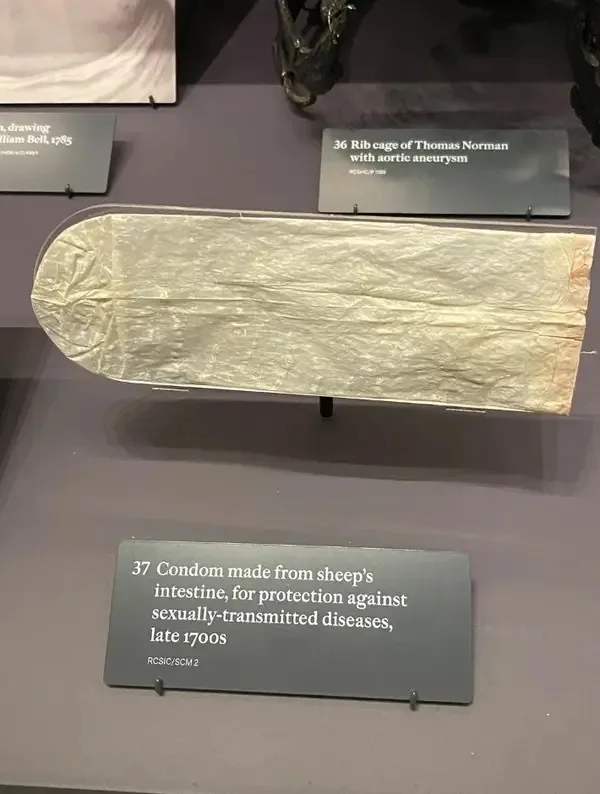
England, the 1980s. At Dudley Castle, near Birmingham, a team of archaeologists is digging through what is left of the old latrines. Not the most glamorous dig site. Among the rubble, they uncover thin membranes of animal origin. Some had been used, others were still new. They date from the mid-1640s, when Charles I’s royalist troops held the castle under siege during the English Civil War. To this day, they are the oldest condoms physically recovered in Europe (BMJ).
Soldiers shut inside a fortress, thinking about protection between two assaults: that is the first solid fact. Yet when you ask who invented the condom, the answer you usually get goes back fifteen centuries earlier, to Crete, with a cursed king and a goat’s bladder. And as soon as you ask the English and the French what they call the thing, each one points at the other.
Let’s untangle all of this. You will see that the history of the condom says a lot about how we handle the ideas that embarrass us.
A cursed king and a goat’s bladder
The oldest account we know of appears in the Metamorphoses of Antoninus Liberalis, a Greek author of the 2nd century AD (European Journal of Contraception). He tells a legend about Minos, king of Crete, whom you probably know from the Minotaur and the labyrinth.
Minos keeps cheating. His wife Pasiphaë, daughter of the sun god Helios, casts a spell on him: from now on, his semen will contain serpents and scorpions. His mistresses die from it (Wikipedia). In some versions, Pasiphaë survives thanks to her immortality, but the couple cannot produce an heir.
The solution comes from Procris, daughter of King Erechtheus of Athens. She is said to have used a goat’s bladder placed inside the woman’s body to trap the creatures, with the help of an herb from the sorceress Circe. The accounts disagree on who cured whom, and even on who wore the bladder (University of Washington).
Stop for a moment on two details.
First detail: the oldest “condom” in literature is internal. It protects the woman. It would take a very long time before a female device showed up again.
Second detail, and a tastier one: the whole point of the operation was to give Minos an heir (Indian Journal of Urology). The first condom known to history was therefore used to make babies. Hard to imagine a bigger misunderstanding for an object we now associate with contraception.
Keep in mind what kind of document this is. It is a myth. It tells us what a Greek author could imagine. It proves no actual use in ancient Crete.
Beware of tidy timelines
All over the internet you will find claims such as “the Egyptians were already using linen condoms 3,000 years ago” or “Roman legionaries wore them into battle.” These sentences are appealing. They are also very poorly supported.
A review published in the European Journal of Contraception points out that the literature on the history of the condom is full of errors. Its authors chose to keep only facts established from primary sources (European Journal of Contraception). A recent BMJ article agrees: ancient texts describe potions and techniques to avoid pregnancy, yet none of them mentions a penile sheath (BMJ).
I say it often on stage: assumptions are highly dangerous and should be killed with experimentation as early as possible. In history, experimentation is called a primary source. Without a source, you do not have a fact, you have a nice story.
From a Persian physician to an anatomist in Padua
The first serious written trace of a male sheath comes from Persia. In the 10th century, the physician Al-Akhawayni recommended a sheath made from an animal gallbladder (European Journal of Contraception).
The real accelerator arrived at the end of the 15th century. The first well-documented syphilis outbreak in Europe broke out in 1494, among French troops (Wikipedia). The disease spread fast and it killed. Fear changed everything.
In 1564, De Morbo Gallico, “The French Disease,” was published, a treatise by the Italian anatomist Gabriele Falloppio, two years after his death. It contains the earliest uncontested description of condom use (Wikipedia). Falloppio, also known for describing the tubes that bear his name, presents a small linen sheath soaked in a preparation, dried, placed over the glans and tied with a ribbon (Indian Journal of Urology).
He claimed to have had it tested by 1,100 men, none of whom caught the disease (Wikipedia).
My reflex when facing such a perfect result comes down to two questions: is it realistic, and is it verifiable? Zero infections among 1,100 men, with no control group, no documented follow-up, on the inventor’s word alone. The number is impressive. It proves nothing. You have probably sat through executive committee presentations built on exactly this model.
Sheaths you blew up to check
In the 17th and 18th centuries, linen gave way to animal gut. These “skin” condoms were thin and comfortable, but they tore easily (BMJ).
The accounts from that era are worth the detour. People were advised to rehydrate them by dipping them in milk before use. The Scottish writer James Boswell used a lake instead. Casanova checked them for leaks by blowing into them (BMJ). In his Memoirs, he calls them “English riding coats.” Remember that detail, it will come in handy.
Then chemistry stepped in. Rubber condoms appeared in 1855, and latex took over from 1930 onwards (European Journal of Contraception).
Do the math. The idea of a barrier appears in a 2nd-century myth. The male sheath is recommended in the 10th century, described medically in 1564, used by soldiers in the 1640s, then industrialized in the 19th century. The material changed several times. The principle barely moved in eighteen centuries.
Capote anglaise, French letter: Europe’s hot potato
Now for the funniest part.
The French say “capote anglaise,” the English overcoat. The English say “French letter,” an expression first recorded in the years 1855 to 1860 (Dictionary.com). The word “capote” originally referred to a long hooded coat. So the object gets dressed in a foreign garment, just like Casanova’s riding coat.
The English did not stop at France. Farmer and Henley’s slang dictionary, published between 1890 and 1904, also lists “Spanish letter,” “Italian letter” and even “American letter” (Linguist List).
Germans say “Pariser,” the Parisian. In Franco-Provençal, people spoke of a “gant de Paris,” a Paris glove. The Walloons, loyal to French usage, say “capote inglesse” (Wiktionnaire). Readers in Brussels will appreciate it.
The Portuguese stay out of the nationality game. They say “camisa de vênus,” Venus’s shirt (Wiktionnaire). They picked a goddess over a neighbor, which in a way brings us back to the mythology of Minos.
Even the word “condom” keeps its mystery. The most plausible hypotheses derive it from the Latin condere, “to put away, to store,” or from the Venetian gondon, a variant of the Italian guantone, a glove (European Journal of Contraception). The glove again.
The disease got the same treatment as the object. Falloppio, an Italian, titled his treatise “The French Disease.”
The pattern is obvious: whatever touches on shame always comes from somewhere else.
So who invented the condom?
Nobody, and a lot of people at once.
In my book, I separate three notions that people often confuse. Creativity is finding an original solution to a problem. Invention produces something new, without necessarily being put into practice. Innovation requires implementation, and it is most often the result of teamwork (My book, chapter 3).

Apply that grid. The Minos tale belongs to creativity, an idea imagined by a storyteller. Falloppio proposes an invention and documents it. The Dudley soldiers and the 18th-century libertines turn the object into real-world use. The rubber and then latex manufacturers turn it into a mass innovation. Each of them has a share. None can claim sole paternity.
Paternity of an invention is far more political than people think. When I worked at Apple in Cupertino, I found out that the director was routinely listed among the co-inventors on every patent application. I removed my name from the three filings put in front of me, because I had not contributed to them (My book). The names that stay in history rarely belong to everyone who did the work.
What shame costs innovation
Back to our national labels. They reveal a reflex I find in almost every organization I work with: when a subject is uncomfortable, it gets attributed to someone else.
You know the “not invented here” syndrome, which pushes a team to reject a good idea because it comes from outside. There is an inverted version, less studied, the “invented elsewhere” reflex. A failure or a taboo topic suddenly becomes the business of another department or a former executive. Nobody claims paternity, so nobody learns anything from it.
That reflex has a cost. For centuries, the shame attached to the condom slowed its spread, even though the object protected people from deadly diseases. In a company, shame slows the escalation of bad news in the same way. That is why culture and psychological safety form one of the pillars of the Innovational Intelligence™ System (My book, chapter 9). Without psychological safety, nobody dares say the project is taking on water.
I often say it with a smile: innovation is like sex, nothing works perfectly the first time. Falloppio’s linen sheath, tied with a ribbon, is the historical proof. It took centuries of trials and abandoned materials to get to latex.
A quick exercise. On a scale from 0 to 5, how openly does your organization talk about its embarrassing topics, failures included? And the last time a project went wrong, who claimed paternity?
The essentials
Remember three things:
- The oldest known story of a condom is a 2nd-century Greek myth, and the device was used to conceive an heir.
- The earliest uncontested medical description dates from 1564 and the oldest condoms found in Europe go back to the 1640s: everything else is hypothesis.
- Every language pinned the object on its neighbor. When a topic is embarrassing, we export it, and that reflex blocks learning in your teams.
An invention does not need a single father to change the world. It needs people who dare to talk about it. Innovate or agonize, the choice is up to you!



References
- (My book) https://philippeboulanger.com/book/
- (BMJ) https://sti.bmj.com/content/101/7/427
- (European Journal of Contraception) https://doi.org/10.3109/13625187.2015.1050716
- (Wikipedia) https://en.wikipedia.org/wiki/History_of_condoms
- (University of Washington) https://uw.manifoldapp.org/read/minos-and-condoms
- (Indian Journal of Urology) https://pmc.ncbi.nlm.nih.gov/articles/PMC3649591/
- (Dictionary.com) https://dictionary.com/browse/french-letter
- (Linguist List) https://listserv.linguistlist.org/pipermail/ads-l/2013-April/126492.html
- (Wiktionnaire) https://fr.wiktionary.org/wiki/capote_anglaise