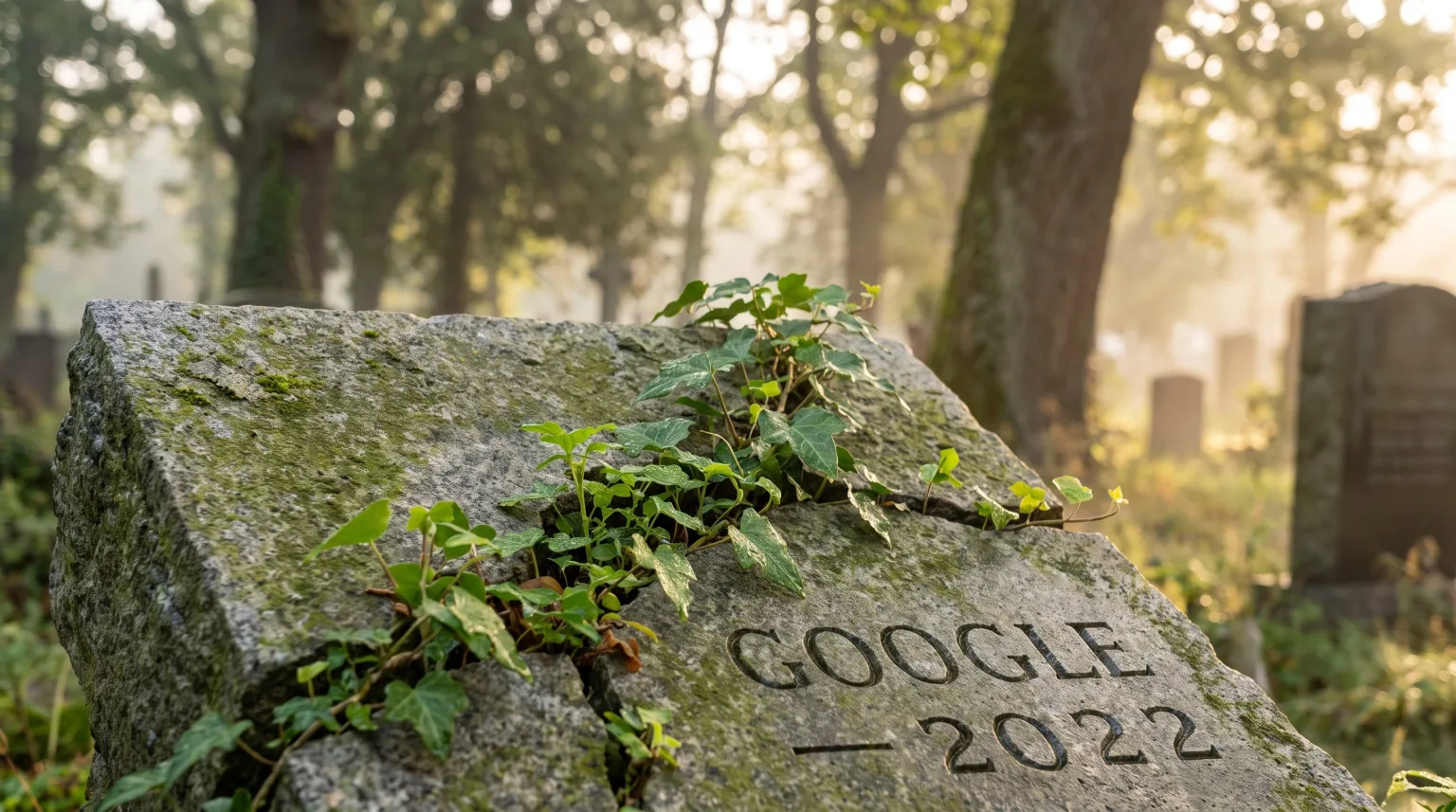
Late 2022, a meeting room somewhere between San Francisco and Paris, it hardly matters. An analyst sets down his coffee, swivels his laptop toward the table and drops the line everyone was waiting for: “Google is done.” ChatGPT had just arrived at the party. Within weeks, the search engine, that cash machine that had held for twenty years, looked like a relic. People pulled out the word that chills the blood in tech: Nokia. The next Nokia. The giant that saw nothing coming and was about to collapse in front of us.
Three years have passed. So let’s take a closer look at the corpse. It is doing remarkably well.
The Corpse Is Worth $4.3 Trillion
Let’s start with the number that should end the debate. Alphabet, Google’s parent company, is worth roughly $4.3 trillion today. That is two and a half times its value three years ago, back when people were digging its grave. In January 2026 it joined the very exclusive club of $4 trillion companies, alongside Apple, Microsoft and Nvidia (CNBC).
A corpse that gains $2.5 trillion in three years is a corpse worth re-examining.
The most recent quarter tells the same story. Revenue up 24% year over year, at $119.8 billion for the second quarter of 2026 alone. Twelfth straight quarter of double-digit growth (9to5Google). That reads like the balance sheet of a company accelerating, a long way from the end of its life.
What Was Supposed to Kill It Fed It
Here is the paradox I love, the one that should give pause to any executive convinced a new technology will finish them off. AI, the supposedly fatal weapon, became the fuel.
Gemini, Google’s answer to ChatGPT, now has close to 900 million people using it every month, up from 400 million a year earlier (PPC Land). And that is only the app. Inside search, AI Overviews reach more than 2 billion people a month. Search did not die of AI, it swallowed AI.
Google Cloud, for its part, is growing at more than 80% a year, driven by demand for AI infrastructure and enterprise AI services (9to5Google). A division many saw as a permanent challenger now sits at the center of the reactor.
Let’s replay the 2022 reasoning. The thesis was simple: a conversational agent answers directly, so nobody clicks, so ad revenue collapses, so Google dies. The logic held together. It had only forgotten one thing: Google was not going to sit and watch its own disappearance.
Google Was Never “Just” Search
The most common analytical mistake was to reduce Google to its search bar. Look at what sits behind it.
YouTube, on its own, generates more revenue than Netflix. More than $60 billion for 2025, against roughly $45 billion for Netflix (Variety). Last quarter, YouTube advertising passed $11 billion in a single three-month period for the first time. We are talking about a platform many still filed under “cat videos.”
Waymo, the self-driving subsidiary, is running about 500,000 driverless rides a week across the United States, ten times fewer two years earlier (InsideEVs). While the world debated whether generative AI would kill Google, another Google AI was driving cars through the streets of San Francisco, Phoenix and Los Angeles.
Search, cloud, video, autonomous mobility. The “corpse” operates on four fronts at once, and it is gaining ground on each.
Why the Prophets Got It Wrong
So how did so many smart observers get it this wrong? The answer has nothing to do with technology. It is human, as always.
First, a massive confirmation bias. ChatGPT was spectacular, new, counterintuitive. It fit tech’s favorite story perfectly: the little one toppling the giant. That story is so seductive that we hunt for the facts that confirm it and ignore the ones that contradict it. Yet the contradicting facts were already there: Google’s financial firepower, its data, its talent, its lead in fundamental AI research. DeepMind and the Transformer, the building block that made ChatGPT possible, were born at Google.
Second, a confusion between “being threatened” and “being doomed.” The two are not synonyms. A threatened company that reacts becomes stronger. A threatened company that freezes becomes Nokia. The difference is not the size of the shock, it is the response.
I stress this point in my book, in the chapter on past success as your first enemy. Our greatest danger is never the competitor walking in, it is the comfort that makes us drop our guard. Google had every reason to fall asleep on its advertising annuity. The credit, if there is any, was in not doing so. In turning panic into direction, then direction into execution (Book).

Because the panic was real. Internally, the arrival of ChatGPT triggered what the press called a “code red.” And that is where the whole subject is decided. Panic is directly linked to the survival instinct. It can paralyze an organization or set it back in motion. What makes the difference is a clear vision followed by clear communication, then measured execution. Google panicked, like everyone. The rest came down to what it did with that panic.
What Your Company Should Take From This
You are not Alphabet, and you do not have $100 billion in cash to absorb a shock. Precisely. The moral of this story is not financial, it is behavioral, and it is within your reach.
When a technology lands and someone announces your coming death, ask three questions before you react. Is the threat real, or is the dominant narrative speaking for you? What can you do, now, with this technology that you could not do before? And above all: does your leadership team have the humility to admit it may not yet have the skills to adapt its vision?
That last question separates the companies that bounce back from the ones that collapse. Google had that humility. It embedded AI everywhere, in search, in cloud, in daily use, instead of treating it as a bolt-on. It treated the threat as raw material, not as a sentence.
You cannot predict which technology will shake your market next year. You do not need to. You do not have to predict the future, because you are going to create it. That is exactly what Google did while people were writing its obituary.
The funny thing in this whole affair is right here: what was supposed to kill Google made it bigger than it has ever been. The engine behind that rebound comes down to three words: refusing the status quo.
The essentials
Remember three things from this failed autopsy:
- Being threatened is not being doomed. The threat destroys the companies that freeze and strengthens the ones that react. The size of the shock matters less than the quality of the response.
- The invariant is never the technology, it is the human being. Google had the data and the talent back in 2022. What made the difference was the humility to question itself and the will to execute.
- Your past success is your first enemy. Comfort drops the guard. Discipline means measuring, killing assumptions through experimentation, and absorbing change instead of enduring it.
Google was not dead. Nobody had simply bothered to check before signing the death certificate. Before you bury your market, your job or your company, do the same: go look at the body up close. You might find it in perfect health, provided you decide, right now, to keep it alive. Innovate or agonize, the choice is up to you.



References
- (My book) philippeboulanger.com/book
- (9to5Google) 9to5google.com/2026/07/22/alphabet-q2-2026-earnings
- (CNBC) cnbc.com/2026/01/12/alphabet-4-trillion-market-cap.html
- (PPC Land) ppc.land/gemini-hits-900-million-users-closing-gap-with-chatgpt-fast
- (Variety) variety.com/2026/digital/news/youtube-2025-total-revenue-ads-subscriptions-alphabet-earnings-1236652260
- (InsideEVs) insideevs.com/news/791245/waymo-rides-per-week-2026-doubled