Monday, 8:40 a.m., third floor
“Look.”
Lucas, head of operations at a mid-sized industrial company, leans toward the screen his financial controller is holding out. An AI agent has just compiled the weekly report for the group’s four plants. Thirty-two consolidated tabs, variances explained, anomalies flagged in red. This work usually takes a day and a half.
“Ten minutes,” the controller says. “I built it over the weekend.”
Lucas smiles. He is genuinely impressed. Then he says the sentence I hear in almost every company I work with:
“Great. Let’s talk about it after the quarter closes. Until then, we keep the current process. I don’t want any surprises in front of the board.”
The controller closes his laptop. The following Monday, he builds the report by hand. The Monday after that, too. By the third Monday, he stops showing anything to anyone.
Lucas doesn’t exist under that name. He is a composite of dozens of executives I have met, and I bet at least one of them sits on your leadership team. Maybe even in your mirror.
What Microsoft measured, and what it left out
On May 5, 2026, Microsoft released its annual Work Trend Index. The company had Edelman Data x Intelligence survey 20,000 knowledge workers who use AI, across ten countries including France, between February and April 2026. It cross-referenced those answers with trillions of anonymized Microsoft 365 signals (Microsoft WorkLab).
The core message fits in one sentence: people are ready, the systems around them much less so. In other words, the brake on AI sits less in your employees’ heads than in your processes, your metrics and your management habits.
Before applauding, let’s put a few limits on the table.
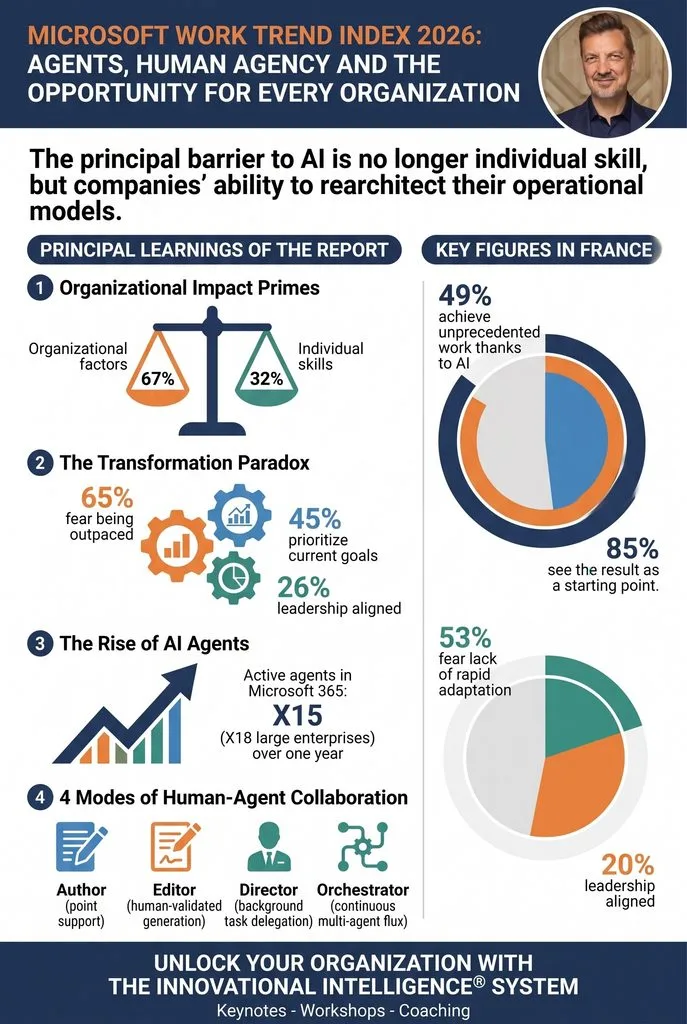
Microsoft sells the agents whose growth it measures. The number of active agents in Microsoft 365 grew 15-fold in a year, and 18-fold in large enterprises (Microsoft WorkLab). A vendor that concludes its customers should reorganize around its products deserves a careful reading.
The sample only includes AI users. Anyone who answered “never” was screened out at the start. So you will find nothing here about the part of your workforce that ignores the tool or refuses it.
Everything is self-reported. Respondents describe their own practice, their manager, their company culture and the impact they perceive. Microsoft says so in its methodology: the relationships shown are statistical associations, with no demonstration of cause and effect (Microsoft WorkLab).
These limits don’t make the study useless. They simply require you to read it with method.
67 versus 32: reading the number without telling yourself a story
The report’s headline figure: organizational factors (culture, manager support, talent practices) account for 67% of AI’s reported impact, compared with 32% for individual factors such as mindset or behavior (Microsoft WorkLab).
Beware the quick read. That 67% doesn’t mean two-thirds of the problem comes from the organization. It is a share of relative importance in a statistical model, a random forest tested on 29 factors and nearly 20,000 responses. The most predictive factor, the organization’s AI culture, carries about two and a half times the weight of the top individual factor.
What should you take from it? When an employee says AI really helps them, their work environment predicts that perception better than their own enthusiasm does. The result tells you where to look first, without proving that changing the culture will produce the expected impact.
This reading matches something I have argued for years. The invariant of innovation has never been technology. It is the human being, with their fears, their biases and their emotions, from the intern to the CEO. An organization that buys licenses without touching its culture is buying a tool it cannot absorb (My book, chapter 4).

The Transformation Paradox, French edition
Microsoft has a name for what Lucas’s controller goes through every Monday: the Transformation Paradox. 65% of AI users fear falling behind if they don’t adapt quickly. At the same time, 45% say it feels safer to focus on current goals than to redesign work with AI. And only 13% say they are rewarded for reinventing their work even when the results don’t follow (Microsoft WorkLab).
Read the first two numbers side by side. Your teams are afraid of standing still, and even more afraid of moving. They choose the safety your metrics offer them.
In France, the top of the company looks even less aligned. 53% of French AI users fear not adapting fast enough, 43% prefer to stick to their operational goals, 12% say they are rewarded for reinvention, and only 20% consider their leadership clearly aligned on AI, compared with 26% globally (Microsoft Source).
One employee in five. The other four watch a leadership team sending mixed signals: “innovate” in the speeches, “hit your numbers” in the annual reviews. Caught between the two, they pick the numbers. In their shoes, I would do the same.
Panic about AI is directly linked to the survival instinct. When leadership doesn’t say clearly what AI will be used for, the vacuum fills with worst-case scenarios: have I become obsolete, is my job at risk? The rule of trust stays simple: I say what I do, and I do what I say. La Poste, the French postal service, learned this the hard way. Its leadership defined an AI strategy for organizing mail carriers’ routes in July 2023, and only presented it to staff as a done deal at rollout in January 2024. The immediate result: a strike (My book, chapter 14).
Author, editor, director, orchestrator: which role do you allow your teams?
The report describes several ways of working with an agent. In its French edition, Microsoft names four (Microsoft Source):
- the author produces the work and asks AI for occasional help;
- the editor sets the intent, lets AI produce, then reviews and validates;
- the director writes a brief and delegates entire tasks, which run in the background;
- the orchestrator designs a system in which several agents work in sequence and only escalate exceptions.
Microsoft itself states that this framework is illustrative: it rests on no direct measurement (Microsoft WorkLab). It remains useful for one simple reason. Moving from author to orchestrator requires a permission individuals cannot grant themselves. Lucas’s controller was ready to become a director. His organization sent him back to the author role, and even below it.
Moving up a level also demands more judgment. The users surveyed rank quality control of AI output (50%) and critical thinking (46%) as the top human skills. In France, those scores drop to 43% and 37%. And 85% of French respondents say they treat AI output as a first draft they remain responsible for (Microsoft Source).
Keep in mind the study Harvard Business School ran with BCG on 758 consultants. On tasks inside AI’s competence frontier, consultants using AI completed 12.2% more tasks, 25.1% faster. On a task deliberately chosen outside that frontier, they were 19% less likely to reach the correct solution (HBS). An orchestrator without critical thinking industrializes their mistakes.
The manager, the forgotten link
Between the leadership team and the controller, there is Lucas. He is the one who turns a strategy into a Monday morning.
A Microsoft study of 1,800 employees, cited in the report, measures what changes when a manager uses AI in front of the team: 17 points more on perceived AI value, 22 points more on critical thinking, 30 points more on trust in agents. When that manager creates psychological safety around experimentation, employees are 1.4 times more likely to be frequent users of agents (Microsoft WorkLab).
Among “Frontier Professionals,” the most advanced users, 85% say their manager openly uses AI, compared with 64% of the others. And 26% say they are rewarded for reinventing their work regardless of outcome, compared with 11% (Microsoft WorkLab).
Nothing new under the sun. In 1999, Amy Edmondson studied 51 teams in a manufacturing company. Psychological safety, the shared belief that the team is safe for interpersonal risk-taking, predicted the team’s learning behavior, and that behavior explained part of its performance (Administrative Science Quarterly). Without that safety, nobody dares tell the CEO the project is on fire. And nobody dares show the agent they built over the weekend (My book, chapter 9).
Twenty dollars and an expense report
Hugues, an employee whose testimony I share, needed a twenty-dollar ChatGPT subscription. Purchasing told him not to expect anything for three months. With his manager’s approval, he used his company credit card. His first expense report caused a scandal in HR. The manager had to justify the decision. The leadership team experienced the episode as a wake-up call, and the purchasing procedure was changed within 24 hours (My book).
When an organization can’t remove a twenty-dollar obstacle, it won’t remove a strategic one.
The macroeconomic data points the same way. In Denmark, Anders Humlum and Emilie Vestergaard linked AI adoption surveys to administrative labor market records. Two years after ChatGPT’s launch, they find no measurable effect on earnings or hours worked, and rule out effects larger than 2% (NBER). The tool has spread. Organizations have not yet turned that usage into results.
What I would do on Monday morning in Lucas’s place
If Lucas called me, I wouldn’t ask him which tool to buy. I would suggest the five steps I use for AI adoption:
- clarify the vision: does AI change what the company does, or only how it does it?
- communicate that vision by answering survival questions first, after measuring the teams’ baseline sentiment;
- hand exploration to a small team of enthusiasts, which obviously includes the financial controller;
- deploy what has been validated, measuring before, during and after;
- measure sentiment again, then restart the loop.
In practice, the controller’s agent would run in parallel with the current process for four weeks. We would count the time saved and the accuracy gaps. At the board meeting, Lucas would present both reports side by side. The surprise he feared would become an experiment he leads.
And I would ask him to change one metric in his teams’ annual reviews: the documented attempt, including when it fails. As long as your evaluation criteria reward only the quarter’s results, your most capable people will take their talent elsewhere.
The essentials
Remember four things:
- The 2026 Work Trend Index links AI’s reported impact more to the work environment (67%) than to individual qualities (32%). This is a correlation drawn from a self-reported survey, and it demonstrates no causality.
- In France, only 20% of AI users consider their leadership clearly aligned. Silence at the top feeds fear, and fear freezes teams.
- The frontline manager is the most concrete lever: a manager who uses AI in front of the team and protects experimentation changes behavior.
- Test your organization on a twenty-dollar obstacle. If it fails, it will fail on strategic issues too.
Your employees have already covered part of the distance. It is up to you to decide whether your organization follows them or holds them back. Innovate or agonize: the choice is yours.


References
- (My book) https://philippeboulanger.com/book/
- (Microsoft WorkLab) https://www.microsoft.com/en-us/worklab/work-trend-index/agents-human-agency-and-the-opportunity-for-every-organization
- (Microsoft Source) https://news.microsoft.com/source/emea/features/barometre-work-trend-index-2026-les-modeles-operationnels-des-entreprises-reinventes-a-lere-de-lia/
- (HBS) https://www.hbs.edu/faculty/Pages/item.aspx?num=64700
- (NBER) https://www.nber.org/papers/w33777
- (Administrative Science Quarterly) https://journals.sagepub.com/doi/10.2307/2666999