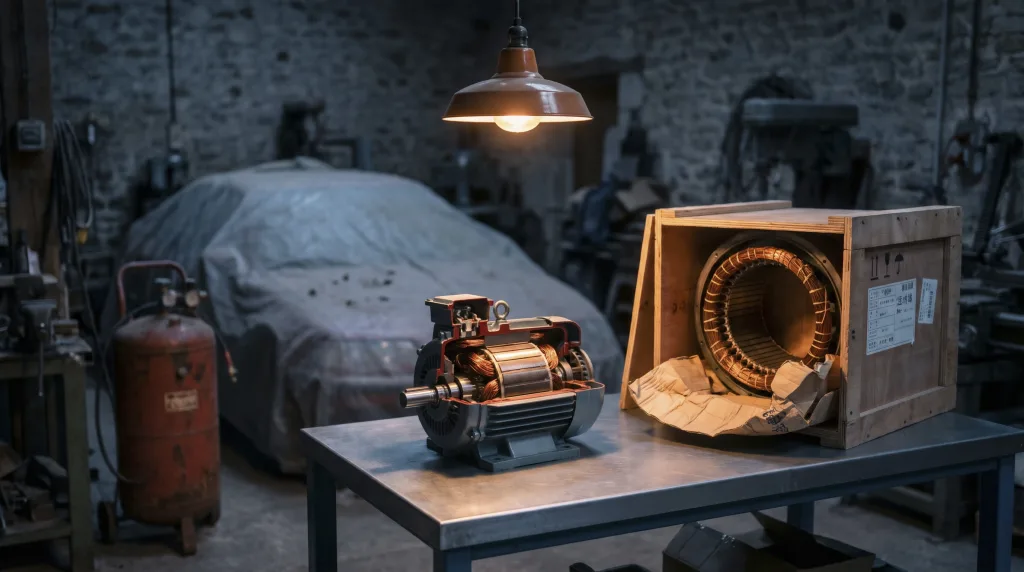
Orem, Utah, fall 2006.
George Wright has just been hired as marketing director at Blendtec. The company makes blenders. It has an engineering culture, spends its money on the product rather than on awareness, and has a limited retail presence (Dynamic Business).
One day, Wright walks through the workshop. Sawdust and wood shavings cover the floor. Tom Dickson, the founder, is shoving a wooden board into one of his blenders to test a modification (Inc.).
For Dickson, this is a routine check. For his teams too. Nobody sees anything in it beyond a test procedure.
Wright sees a show.
$50, a white lab coat and a rake
The starting budget fits in one number: $50. Wright buys a lab coat, a domain name and the items to blend (Inc.). In the version he later gave on stage, the shopping list included a six-pack of Coke, a rake, a rotisserie chicken and marbles (Search Engine Roundtable).
The format is disarmingly simple. Dickson, in a white coat and with a perfectly straight face, asks the camera one question: “Will It Blend?” Then he presses the button.
The series launches on YouTube on October 30, 2006 (Wikipedia). The first videos grind up a rake, a rotisserie chicken, a full Big Mac meal and a Rubik’s Cube (Inc.). Within days, views are counted in millions, without a single dollar spent on media.
Then come the iPods, and later the iPhones. Ten years after launch, Blendtec claims more than 150 videos, more than 50 million views and nearly one million subscribers (GlobeNewswire).
In the press release published for that anniversary, Tom Dickson says it plainly: he started Will It Blend? with a $50 budget (GlobeNewswire).
What your company no longer sees
Go back to the workshop. For years, dozens of people walked over that sawdust and did nothing with it. They were simply used to it.
The brain loves habit. What it sees every day, it stops treating as information and files under “background.” That is cheap for the brain and expensive for you.
I have watched this happen from the inside, in groups of several thousand people. Engineers find their test benches boring. Customer service stops noticing the strange questions it gets every week. And that is often where the company’s strongest story is sleeping.
It takes an outside eye, or a fresh one, for the background to become a subject again. Wright had just arrived. He was not used to the sawdust yet. In my view, that advantage weighed more than his $50.
My rule is simple: the more ordinary a practice looks to you, the more it deserves to be examined by someone who doesn’t know it.
Marketing can be innovated too
Many executives file Will It Blend? under “publicity stunt.” That is a filing error, and it has consequences.
The OECD explicitly recognizes marketing innovation: implementing a new method that changes a product’s design, placement, promotion or pricing. I insist on this because too many companies reserve the word “innovation” for R&D and let marketing repeat last year’s recipes (My book, chapter 3).
To launch the series, Blendtec kept its motor and its blades. The company changed the way it proved how tough its product was. A spec sheet claims, a video demonstrates. Blendtec still promotes blades that are thicker and stronger than the competition’s (GlobeNewswire). In 2006, that argument was invisible to the general public. A phone reduced to dust makes it obvious in a few seconds.
Remember the mechanism: the proof already existed in the workshop. It only had to be brought out.
The numbers change depending on who tells them
Now I will do what I do with every beautiful story: check the numbers.
Launch views? Six million in five days, according to Inc. in 2008 (Inc.). Five million in three days, according to what Wright told audiences on stage (Search Engine Roundtable). Six million in six days, according to Blendtec’s official press release in 2016 (GlobeNewswire). Even the origin varies: Wikipedia places the spark in an experiment with a box of matches (Wikipedia).
Sales? Dickson speaks of 700 percent growth in home products (Inc.). Wright mentions 700 percent on blenders and more than 500 percent on overall sales (Search Engine Roundtable). Another article reports more than 800 percent on retail sales (Dynamic Business).
All of these figures come from the company itself. I found no independent audit that confirms them. And Dickson was honest enough to admit it: it is hard to attribute sales to the videos alone, because the Will It Blend? audience looks little like the people who actually buy the blenders (Dynamic Business).
Should you throw the story away? No. The series made an engineering brand known to tens of millions of viewers. But caution changes what you can take from it. If you present “$50 equals +700%” to your executive committee, you are selling an assumption. And assumptions are highly dangerous: they should be killed with experimentation as early as possible.
The graveyard of $50 videos
There is a bias that marketing case studies rarely mention: survivorship bias.
You know Blendtec because it worked. You don’t know the thousands of companies that filmed their workshop or their founder in 2006 or in 2024 and collected 200 views. Their budget was $50 too. Nobody tells their story.
Concluding from Blendtec that an original campaign can do without a big budget is like studying lottery winners to learn how to invest. The example proves that a test can cost very little. It says nothing about your odds of success.
Coca-Cola approaches the subject with method. Its marketing budget allocation rule puts 70 percent into proven programs, 20 percent into promising trends and 10 percent into completely new ideas (My book, chapter 11). The “Share a Coke” campaign, with first names on the bottles, started as an experiment in Australia in 2011, with 150 names, before its global rollout (The Coca-Cola Company).
So read Blendtec as a low-cost test that succeeded, and keep room in your budget for the tests that will fail.
Find your wooden board
Let’s move to action. Here is a simple exercise.
Rate yourself from 0 to 5 on this statement: “I know which internal practices of my company would fascinate an outsider.” Be honest. I am not always at 5 myself.
Then ask your teams these questions, starting with your newest hires:
- What test, check or ritual do we perform that nobody else performs?
- What do visitors look at with surprise when they walk through our premises?
- What odd question do our customers ask regularly?
- What obsession of our founder or our engineers makes people smile internally?
Next, set a tiny budget and a short time frame. Decide in advance what you will measure: views, inbound requests, sales or awareness. Measure before, during and after. And accept that most of these attempts will not take off.
One last point matters. Dickson played himself. Wright listed among his ingredients the authenticity of a manufacturer talking about its own product, and real people staying true to themselves (Search Engine Roundtable). If you hire an actor to mimic a ritual your company doesn’t practice, you lose exactly what made the idea credible.
The essentials
Remember four things:
- Your company’s best story often hides in a practice your teams consider too ordinary to show.
- It takes a fresh eye to spot it: new hires or customers.
- Blendtec’s figures (views, +700%) come from the company and vary from one source to another; treat them as an assumption.
- A small budget lowers the cost of a test without guaranteeing success, and survivorship bias hides the failures from you.
Innovate or agonize, the choice is up to you! So, what wooden board is lying around in your workshop?

References
- (My book) https://philippeboulanger.com/book/
- (Inc.) https://www.inc.com/articles/2008/06/blendtec.html
- (Search Engine Roundtable) https://www.seroundtable.com/archives/018700.html
- (GlobeNewswire) https://www.globenewswire.com/en/news-release/2016/11/07/887174/38354/en/Blendtec-Celebrates-10-Years-of-Viral-Marketing-Success.html
- (Dynamic Business) https://dynamicbusiness.com/leadership-2/entrepreneur-profile/how-tom-dickson-went-viral-with-50-and-a-blender-210912.html
- (Wikipedia) https://en.wikipedia.org/wiki/Will_It_Blend%3F
- (The Coca-Cola Company) https://www.coca-colacompany.com/about-us/history/how-a-campaign-got-its-start-down-under