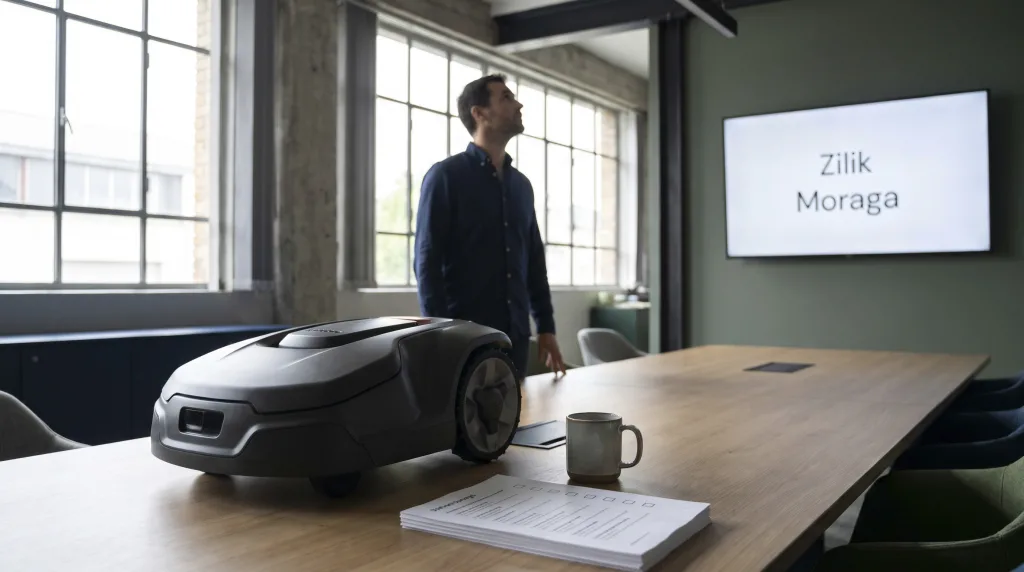
Monday, 8:30 a.m., executive committee room. Hugo, CEO of a six-hundred-person industrial company, puts up his first slide: “Innovation: strategic priority for 2027.” He expects nods. He gets polite silence.
The head of operations eventually raises her hand. “We all agree on the principle, Hugo. I just need to know when.”
“What do you mean, when?” Hugo replies.
“My teams spend their days putting out fires. They don’t have one hour a week to think. If I ask them to innovate, they’ll do it in the evening, or not at all.”
Hugo looks around the table. The CFO stares at his screen. The sales director nods without a word. Hugo realizes he has just opened a door nobody dared to push.
Hugo is a composite character. He resembles many of the leaders I work with, and his scene plays out every week in dozens of executive committees. The misunderstanding is always the same: the leadership team believes its people lack ideas, when what they mostly lack is time and clear decision criteria.
The exec team sees the strategy, the teams live the day-to-day
What leadership communicates and what employees feel often form two very distant realities. The results of a perception survey then trigger a healthy wake-up call. I designed sentiment surveys that calculate an innovational intelligence quotient precisely to measure that gap, with a baseline survey followed by a follow-up survey once an action plan is in place (My book, chapter 13).

International figures confirm the gap. In its 2024 report on the most innovative companies, BCG states that 83% of companies rank innovation among their top three priorities, and that only 3% are truly ready to innovate (BCG). Eighty points separate intention from capability.
The problem rarely sits in the strategy itself. It hides in what happens between the executive committee’s slide and the employee’s desk: the weekly trade-offs, the meetings that run over, the proposed idea that never gets an answer.
Why measure before you act
When a machine breaks down, no engineer replaces parts at random. They start with a diagnosis. Yet when innovation stalls, many organizations launch a hackathon, buy an idea platform or appoint a head of innovation without having identified the root cause.
Assumptions are dangerous. Kill them with experimentation and measurement, as early as possible. An organizational assessment does exactly that: it replaces the executive committee’s convictions with the teams’ actual perception, department by department and level by level.
Research confirms the weight of culture. MIT Sloan Management Review points out that a study of 759 companies across 17 markets identified corporate culture as a stronger driver of radical innovation than labor, capital, government or national culture (MIT Sloan Management Review). The same publication describes a 360-degree assessment of innovation culture and makes an observation I see in the field: companies manage what is easy to count, such as resources and processes, and neglect the human dimensions, such as values and climate (MIT Sloan Management Review).
Google reached a similar conclusion with Project Aristotle. After studying 180 teams, including 115 engineering teams and 65 sales teams, the researchers ranked psychological safety first among the five dynamics of effective teams. What mattered most had less to do with who was on the team and more to do with how the team worked together (Google re:Work).
Measuring has another virtue that is often forgotten. Without a baseline, you cannot prove six months later that an action plan had any effect. You end up defending an impression in front of your board.
Lever 1: the exec team, first accelerator or first brake
Innovation follows management energy. Gallup’s State of the Global Workplace report puts global employee engagement at 20% in 2025, its lowest level since 2020, and manager engagement at 22%. Gallup estimates the cost of disengagement at about $10 trillion in lost productivity, close to 9% of global GDP (Gallup). When managers check out, teams stop proposing.
Leadership behavior weighs directly on risk-taking. According to McKinsey, only 26% of leaders create psychological safety for their teams (McKinsey). Its survey shows that consultative behaviors, such as asking the team for input and seeking consensus, foster psychological safety, while authoritative behaviors erode it. Challenging your teams only works once a positive climate is in place. Yet only 43% of respondents describe a positive climate in their team (McKinsey).
The QIIO, the Organizational Innovational Intelligence® Quotient, sheds an uncomfortable light here. In a recent assessment, which I present in anonymized form, the executive committee rated itself 2.59 out of 5 on methods and execution discipline, and 2.63 out of 5 on measurement, learning and decision criteria. The leadership team was the first to admit it had no shared grid to keep or drop an idea. In the open comments, one obstacle came up again and again: ideas rejected without a reasoned explanation.
An unexplained rejection costs more than it seems. The employee concerned will not come back with the next idea. Neither will the colleagues who watched it happen.
Lever 2: culture, measured by those who live it
An innovation culture is installed, built and maintained through everyday actions. It depends on trust, which makes it fragile: it can take years to establish and vanish in an instant after an unexpected management decision (My book, chapter 9).
The QIIO asks employees about leadership alignment, psychological safety, strategic clarity, decision-making, governance, experimentation, methods, time allocation, resources and the collective dynamics of innovation. Each dimension receives a score per team, complemented by an analysis of verbatim comments.
In the anonymized assessment mentioned above, the “Time and prioritization” dimension had the lowest average of the whole questionnaire, 2.94 out of 5. Employees spoke of a “tyranny of urgency.” Last-minute requests absorbed all the mental space available for reflection and monitoring.
The teams also came with concrete solutions: a protected weekly slot for innovation, small-group “innovation cafés” with management, a single platform to submit ideas, and a clear framework for the authorized artificial intelligence tools. A well-run assessment surfaces exactly these proposals, the ones nobody dares to bring up in a meeting.
Lever 3: trust, necessary and insufficient
The rule of trust with employees fits in one sentence: I say what I do, and I do what I say. Every gap between what leadership says and what it decides day to day erodes that capital. The QIIO comments confirmed it, describing a perceived gap between the company’s discourse and its operational trade-offs.
The most widely accepted definition of psychological safety today comes from Amy Edmondson: the belief that you will not be punished or humiliated for speaking up with ideas, questions, concerns or mistakes. In her hospital research, the best-performing teams reported more errors than the others, because they dared to talk about them (My book).
Here is the most instructive paradox in the assessment. Psychological safety was the organization’s strongest point, with scores of 4 out of 5 or higher in nine teams, up to 4.46. One of those teams nevertheless scored 2.33 out of 5 on time and prioritization. People felt safe to speak up, and found no moment to do so.
Trust opens the door. It provides neither the time nor the decision criteria needed to turn an idea into a demonstrator. Without those conditions, it wears thin: after proposing again and again with no follow-up, employees conclude that innovation belongs to internal communications.
From assessment to first actions
An assessment left in a drawer is useless. The QIIO leads to a precise action plan, team by team, up to top management. The deliverable includes a quantitative analysis of the answers, a qualitative analysis of comments per team and overall, the identification of strengths, obstacles and perception gaps, an innovation readiness map, leadership hypotheses to explore, and inputs for individual coaching and collective reflection.
In the anonymized case, the 90-day plan unfolded in three stages. The first month restored dialogue: launching informal rituals, clarifying the framework for AI use, appointing innovation ambassadors and repeating the vision in simple terms. The second month protected resources, with innovation time officially written into schedules, a platform to collect ideas and an “immunity totem” protecting risky missions. The third month moved to experimentation: one small idea tested each month, the first demonstrators, cross-department presentations and a collective lessons-learned review.
The twelve-month target was explicit: bring every indicator to 4.4 out of 5. Six months to a year after the initial assessment, a second QIIO measures the actual impact of the action plan. The loop closes: measure, act, measure again.
Take five minutes before reading on. On a scale from 0 to 5, how would you rate your organization on time devoted to innovation? Then ask three frontline employees for the same score. The gap between your answers will already tell you a lot.
Join me in a private meeting “Executive team, culture, trust: three levers to (re)ignite innovation”
Here are the key topics I will cover with you:
- An assessment to measure your innovation culture and know where to act first.
- Evaluating trust in your teams, then building a concrete action plan.
- From assessment to first actions: creating the conditions to dare to innovate.
Date: you chose here
Hugo eventually asked his executive committee the right question: “What are our teams living through that we don’t see?” Come and find the answer for your own organization.
The essentials
Remember three things:
- The gap between the intention to innovate and the actual capability can be measured, and what the frontline feels almost always differs from what the executive committee believes.
- Strong psychological safety is not enough: without protected time or shared decision criteria, trust wears thin.
- An organizational assessment such as the QIIO provides a baseline, a targeted action plan and, six to twelve months later, proof of impact.
A company that doesn’t innovate is already dead, it just doesn’t know it yet. The good news is that you can find out today where to act first. Innovate or agonize, the choice is up to you!


References
- (My book) https://philippeboulanger.com/book/
- (BCG) https://www.bcg.com/news/7june2024-global-innovation-readiness-gap
- (MIT Sloan Management Review) https://sloanreview.mit.edu/article/how-innovative-is-your-companys-culture/
- (Google re:Work) https://rework.withgoogle.com/intl/en/guides/understand-team-effectiveness
- (Gallup) https://www.gallup.com/workplace/349484/state-of-the-global-workplace.aspx
- (McKinsey) https://www.mckinsey.com/featured-insights/charts/just-26-percent-of-leaders-create-psychological-safety-for-their-teams
- (McKinsey) https://www.mckinsey.com/business-functions/organization/our-insights/psychological-safety-and-the-critical-role-of-leadership-development