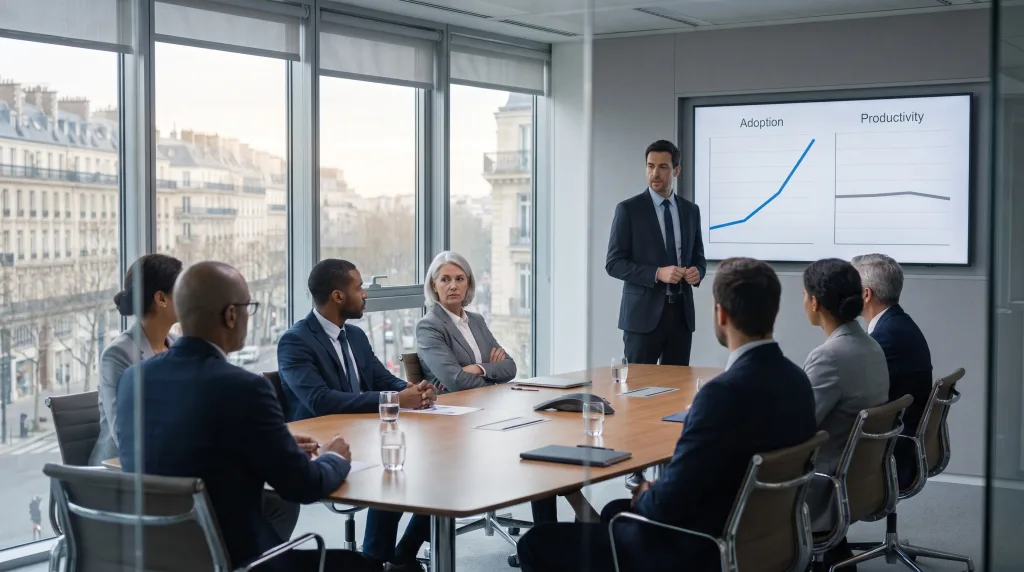
Paris, a Tuesday morning in September 2026. Martin, chief operating officer of a mid-sized industrial group, opens his HR dashboard before he even reaches for coffee. The algorithm has already scheduled the week’s teams, scored every frontline manager’s performance, and flagged three roles as “attrition risk.” Martin approves. He has been approving for six months. He can no longer remember the last time he talked to a team leader before signing off on an HR decision.
“Are you delegating, or are you abdicating?” his CFO asks him, catching his eye in the corridor. Martin shrugs. The dashboard is right nine times out of ten, he says. The problem is never the ninth decision. It is the tenth.
An unexpected mirror: from the state to the company
Historian Jill Lepore has just published The Rise and Fall of the Artificial State, and the Guardian delivered a pointed review on 19 August 2026: an ominous warning about how governments let algorithms, robocalls, and social media campaigns replace political debate itself (The Guardian). Lepore calls this the “Artificial State,” a digital communications infrastructure through which governments and private corporations organize and automate public discourse, reducing citizenship to minutely message-tested online engagement (Yale).
I do not write book reviews. But when a Harvard historian documents how collective judgment dissolved into automation, an innovation consultant who spent thirty years watching executive committees hand their discernment over to spreadsheets has reason to pause. The mechanism Lepore describes at the scale of a nation is one I have watched play out for fifteen years at the scale of an executive committee.
The same mechanism, at the scale of your organization
Lepore’s founding essay on the topic, published in the New Yorker in November 2024, already asked the question: as American civic life becomes increasingly shaped by algorithms, trust in government has plummeted (Harvard Law School). Replace “government” with “executive committee” and “citizens” with “teams.” The sentence still holds.
An article in the California Management Review, published in January 2026, tracks exactly this shift inside companies. At Amazon, McDonald’s, Uber, and Walmart, algorithms now schedule shifts, assign tasks, evaluate performance, and sometimes end employment, without a human manager weighing in on the decision. The article asks a simple question: if the algorithm decides, what exactly is the manager managing (California Management Review)?
What this article documents is a hollowing out. The manager becomes a checker of algorithmic output, stripped of the very exercise that builds strategic judgment. Organizations end up training validators, more rarely leaders.
Why leaders love handing off judgment
I have watched this reflex hundreds of times, at Apple, at Sony, running 1,100 engineers at Neopost. Delegating to the algorithm is almost never framed as a retreat. It gets framed as rigor. “We no longer decide by gut feel, we decide by data.” That sentence calms an anxious executive committee, and anxiety, as I have said for years, is directly linked to the survival instinct.
The problem is not the data. The problem is what happens once the data stops being enough. A dashboard cannot say “I don’t know.” It can say “the score is 0.74.” Faced with an unprecedented situation, a human manager hesitates, doubts, consults, and takes the risk of being visibly wrong. An algorithm never doubts. It extrapolates, with the same confidence whether the underlying data is relevant or stale.
Martin, back in his corridor, is right about one thing: the dashboard is right nine times out of ten. But an organization never dies from its nine easy decisions. It dies from the tenth, the one nobody saw coming because nobody was still trained to see it coming.
The invariant no algorithm will ever replace
It took me years to accept this, as a self-declared technologist: technology is not the invariant of innovation. It keeps evolving, it creates fads, it accelerates. The real invariant is the human being: fears, biases, emotions, from the newest hire to the CEO. As Damasio put it, we are not thinking machines that feel, we are feeling machines that think.
That is precisely the blind spot Lepore documents at the political scale and the California Management Review documents at the managerial scale: a system optimized for available data ends up teaching its human operators to unlearn judgment under uncertainty. This is a question of decision architecture.
The AI-adoption chapter in (My book, chapter 14) lays out a five-stage cycle, from vision to measuring team sentiment, precisely because none of those five moves can be handed to a machine without loss.

What the data says about trust in workplace AI
The numbers confirm this is not a nostalgic consultant’s whim. A Fox News poll published in April 2026 shows concern about artificial intelligence rising steadily: 66% of registered voters say they are concerned, up from 63% in December and 56% when the question was first asked back in 2023 (Fox News). The sharpest increases show up among women, voters without a four-year degree, and voters generally most cautious about change.
These numbers are not just about politics. They describe the climate your own teams move through every morning. A company that rolls out algorithmic management without communicating clearly about its purpose does not earn buy-in. It earns silent panic, the kind that never reaches an executive committee because it lives in the corridors, not in the dashboards.
How to kill the assumption that “the algorithm knows better than we do”
Here is what I recommend, concretely, to every executive committee asking me how to avoid becoming a miniature “Artificial State.”
First, separate what should be measured from what should be decided. An algorithm measures remarkably well. It decides poorly the moment a situation falls outside the perimeter it was trained on. Confusing the two functions is the single most common mistake I see.
Second, experiment before you generalize. Assumptions are dangerous and must be killed through experimentation, never adopted simply because a dashboard makes them comfortable. Test algorithmic management on a limited perimeter, measure team sentiment as closely as performance, and accept that the result might contradict you.
Third, keep a space where human disagreement stays possible. A manager who only rubber-stamps a score no longer holds real authority, only a signature. The psychological safety that lets an employee say “I disagree with the algorithm” is the exact antidote to what Lepore describes as the dissolution of debate.
Fourth, measure sentiment, not only performance. The AI adoption cycle I teach at HEC Paris includes a sentiment-measurement stage after every deployment, precisely because a productivity number climbing while trust collapses always signals a crash ahead.
Martin eventually changed his practice. He still checks the dashboard every morning. But he reintroduced one simple rule for his team: no restructuring or termination decision gets approved without one human talking to another human first. It is a modest safeguard, exactly the kind of thing Lepore’s “Artificial State” never had time to build, because nobody thought to build it before it was too late.
The essentials
Remember three things:
- The mechanism Jill Lepore documents at the scale of a state, backed by polling data, replays itself identically in executive committees that hand their judgment to a dashboard.
- An algorithm measures well and decides poorly the moment it steps outside its training perimeter; confusing the two functions is the most common and the most costly mistake.
- Trust is not restored with a new tool. It is restored with a clear vision, measured experimentation, and a space where human disagreement stays possible.
A company that lets the algorithm decide in its place is not smarter. It is only quieter about its own decline.

References
- (My book) https://philippeboulanger.com/book/
- (The Guardian) https://www.theguardian.com/books/2026/aug/19/the-rise-and-fall-of-the-artificial-state-by-jill-lepore-review-an-ominous-warning-of-tech-takeover
- (Yale, Whitney Humanities Center) https://whc.yale.edu/rise-and-fall-artificial-state-0
- (Harvard Law School) https://hls.harvard.edu/bibliography/the-artificial-state
- (California Management Review) https://cmr.berkeley.edu/2026/01/the-algorithmic-middle-manager-are-we-building-managers-or-checkers-for-corporate-america/
- (Fox News) https://www.foxnews.com/politics/fox-news-poll-broad-anxiety-about-ai-doesnt-extend-jobs