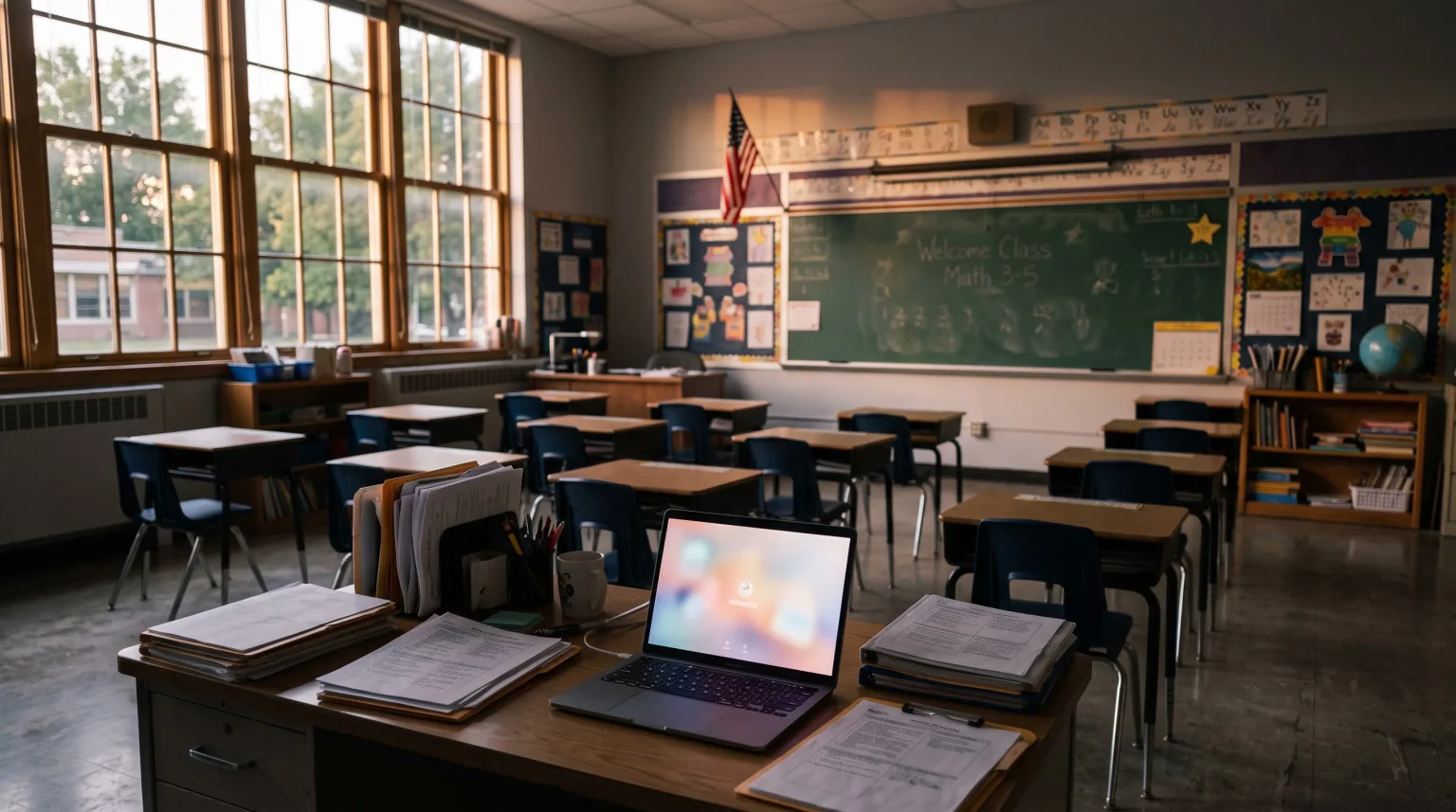
Anthropic just launched Claude for Teachers. Free, reserved for verified K-12 educators in the United States, it bundles premium Claude access, a library of teaching skills, and a connector tied to academic standards in all fifty states. OpenAI had already shipped ChatGPT for Teachers in November 2025. Google has been layering Gemini features into education since 2024. Microsoft followed with Teach inside Copilot, then Elevate for Educators in January 2026.
Three or four American giants are competing, at the same moment, for the attention of teachers and, by extension, for what an entire generation of students will absorb during their schooling. I train adults, not children. The responsibility is not the same, nor is the vulnerability of the audience. But the pattern I have watched play out for years in the companies I advise has an unmistakable familiarity: a tool promises to save time for the person using it, and ends up, without anyone quite deciding it should, doing the work in their place.
The race between the giants
Claude for Teachers was announced on July 14, 2026. The offering includes Claude Cowork and Claude Code, a connector called Learning Commons that surfaces academic standards across fifty states along with the prerequisite competencies beneath each one, and a set of Skills co-developed with the nonprofit Learning Commons and piloted with classroom teachers, including some at Prospect Schools in Brooklyn (Anthropic).
Anthropic also announced a partnership with the American Federation of Teachers around a “Gold Standard” of safety and privacy practices for K-12, along with an evaluation pilot in the Detroit Public Schools Community District focused on educator wellbeing and practice (Chalkbeat).
On paper, the intent reads as sound: close the gap between what learning science recommends (differentiation, mastery-based learning, small groups) and what an actual teacher’s week allows (EdWeek). On the ground, one question still has no clean answer: who corrects the AI when it gets a standard wrong, mismaps a prerequisite competency, or hands a struggling student an adaptation that misses the point entirely?
What technology never solves by itself
My book starts from something twenty-five years at Apple, at Sony, and as CTO of a group of more than a thousand engineers taught me the hard way: technology is not the invariant of innovation (My book, chapter 4). It keeps changing, it creates fads, it discards them just as fast. The real invariant is the human being: skills, reactions, emotions in the face of change.

Applied to schools, the principle plays out like this. The question is not which tool to pick among Claude, ChatGPT, or Gemini. It is whether the school system, the teaching staff, and the families had any say before the choice was made for them. A teacher handed a finished tool, with no part in designing or validating it, ends up in exactly the position I have watched executives fall into since ChatGPT arrived in 2022: fear of becoming obsolete, fear of being replaced, fear that the profession itself might not survive.
Who corrects the AI when it errs
A March 2026 review from Stanford’s SCALE Initiative, covering more than eight hundred academic papers, found that AI tools built with pedagogical guardrails, ones that guide a student’s reasoning instead of handing over a direct answer, show more promising outcomes than general-purpose chatbots (TechTimes). That same distinction between a tool built for the teacher and one placed directly in a student’s hands is the one Norway drew when it banned generative AI for students in grades one through seven starting in August 2026, after citing declining test scores (TechTimes).
Anthropic, for its part, points out that Claude remains off-limits to anyone under eighteen and that most of the offering targets teachers, not students (Chalkbeat). That is a sensible precaution. It does not fully answer the deeper question: when an AI-generated lesson plan contains an error, an oversimplification, or a poorly calibrated adaptation for a struggling student, who bears the responsibility for letting it through? The overloaded teacher who had no time to check everything? The publisher whose curriculum fed the model? The company that built it?
Daniel Buck, a research fellow at the American Enterprise Institute, warned in March 2026 that if teachers outsource their work to AI, classroom community and academic outcomes could deteriorate quickly (Chalkbeat). Other voices, including the OECD’s 2026 Digital Education Outlook, argue the opposite: co-designing tools with teachers can expand instructional capacity in ways improvisation never could (TechTimes). The two positions are not mutually exclusive. They simply describe two very different adoption paths for the same tool.
Assisting or replacing, a matter of one setting
In my book, I describe a five-step cycle for AI adoption inside an organization: define the vision, communicate it and measure the starting sentiment, explore with a pilot team, deploy while measuring outcomes, then measure sentiment again (My book, chapter 14). Nothing about that cycle is specific to private companies. It applies just as well to a school district office as it does to a staff room.
The trouble, given the pace at which Claude for Teachers, ChatGPT for Teachers, and Gemini’s education features have stacked up since November 2025, is that the first two steps, vision and communication, often get skipped in favor of direct rollout. The line between “AI assists the teacher” and “AI writes the lesson in the teacher’s place” sometimes comes down to a single checked box in a settings menu, or to a workload heavy enough that an exhausted teacher accepts whatever the machine suggests without a second read.
The La Poste case, a smaller-scale rerun
In 2024, La Poste, the French postal service, began using AI to set mail carriers’ delivery routes. The tool ignored some of the carriers’ personal constraints that the previous route system had accounted for (My book). Management had settled on this strategy back in July 2023 but only told employees once the system rolled out in January 2024. That communication failure triggered strike action among postal workers almost immediately.
A school is not a postal service, but the mechanism that produces distrust is identical: a decision made upstream, without the people directly affected, revealed only once it already governs their daily work. Swap “mail carrier” for “teacher” and “delivery route” for “lesson plan,” and the story repeats itself almost exactly.
What is actually at stake for children
Nobody elected Anthropic, OpenAI, or Google to decide how an entire generation of children will learn to read, count, or reason. The point is about governance, not a political judgment on these companies. Three or four private actors, based in a single country, are shaping tools right now that will influence instructional practice in tens of thousands of classrooms, carrying standards, biases, and design choices that most parents will never see.
This question sits above the divide between AI enthusiasts and skeptics in the classroom. It concerns how a society decides, or fails to decide, who gets to shape the content it passes on to its children. Voices from teachers’ unions, public administrations, and private foundations are part of today’s conversations around these tools, which at least shows the subject is not being ignored. Whether the pace of rollout leaves room for those conversations to actually shape the technical choices is a different question.
What a careful leader would do
If I sat across from a school board or a district leadership team, I would ask the same questions I put to my clients before any AI rollout: does your team have the intellectual humility to admit it does not yet have the skills to judge what these tools actually change in classroom practice? Did you measure teacher sentiment before imposing a tool, rather than after? Did you build a pilot team, multidisciplinary by design, to test the tool on real cases before scaling it up?
Assumptions are dangerous. They need to be killed with experimentation, not validated by a press release (My book, chapter 11). A free tool, generous in its features and backed by serious partnerships, is still a tool. What determines whether it serves children or mostly serves the commercial race between three American giants is how carefully responsible adults test it, oversee it, and correct it before it reaches the classroom.
The essentials
Remember three things:
- Technology is never the invariant: people, their fears, and their habits determine whether an AI tool assists or replaces a profession.
- The speed at which Claude for Teachers, ChatGPT for Teachers, and Gemini for Education rolled out does not excuse any school system from the steps of vision, communication, and experimentation before scaling up.
- The question of democratic governance over these tools remains open, and it deserves to be asked regardless of where one stands on AI’s pedagogical value.
No tool, however well intentioned, replaces the vigilance of adults willing to take the time to check what a machine hands to a child.


References
- (My book) https://philippeboulanger.com/book/
- (Anthropic) https://www.anthropic.com/news/claude-for-teachers
- (Chalkbeat) https://www.chalkbeat.org/2026/07/14/anthropic-launches-claude-for-teachers-as-ai-companies-battle-for-classrooms/
- (EdWeek) https://www.edweek.org/technology/anthropic-launches-claude-for-teachers-why-some-critics-are-concerned/2026/07
- (TechTimes) https://www.techtimes.com/articles/320533/20260715/anthropic-makes-claude-free-all-us-k-12-teachers-standards-aligned-agentic-ai.htm
- (EdSurge) https://www.edsurge.com/news/anthropic-introduces-claude-for-teachers