Apple confirmed it has acquired Q.ai, an Israeli startup of around 100 people. The exact price was not disclosed, but public estimates place the deal roughly between $1.5B and $2B (Reuters)(Financial Times)(Bloomberg)(The Verge).
At first glance, it looks like another AI acquisition. In reality, it may signal a major interface change: interacting with your iPhone (and Apple’s ecosystem) without making a sound.
The promise: understanding what you “say” without voice
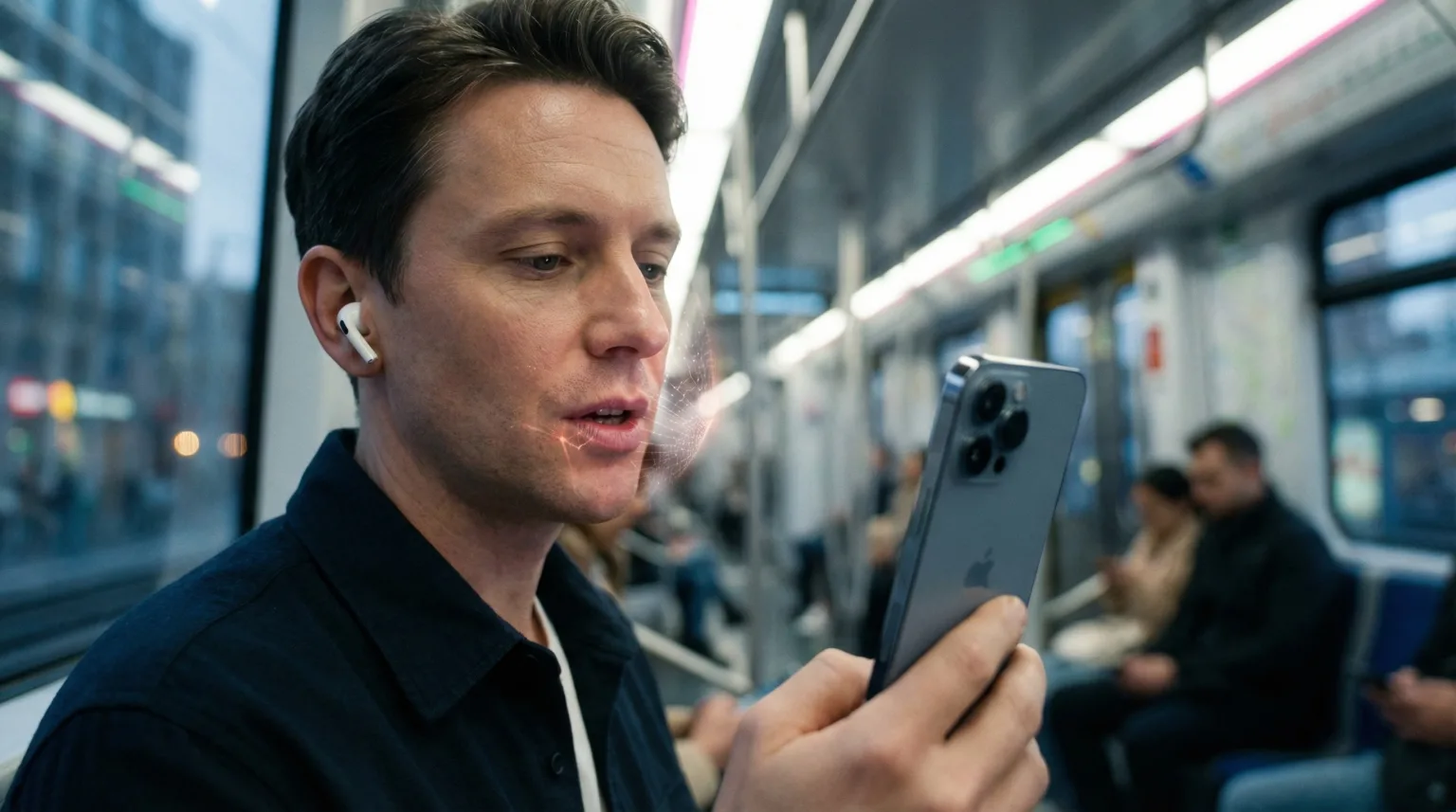
Q.ai works on approaches combining AI and sensors (notably optical sensing) to decode speech intent from facial micro-movements—lips, cheeks, jaw, skin—even when nothing is audible (Financial Times)(Reuters)(Bloomberg)(The Verge).
The goal is not merely “better voice recognition.” It is potentially bypassing voice altogether.
You can already picture the use cases:
- On the subway: replying to an assistant without broadcasting your private life to everyone nearby.
- In a meeting: dictating a message without performing the “I’m taking notes” character.
- In an open-plan office: triggering actions without the social awkwardness of saying “Hey Siri” out loud.
The real “revolution” is not a new gadget. It is a new interaction reflex.
Why Apple is paying that much
Because near-future consumer AI looks like a paradox:
- We want assistants everywhere (earbuds, glasses, phone, car).
- We don’t want to talk everywhere (privacy, fatigue, social context).
Voice interfaces hit a ceiling. You use them when it’s convenient. You avoid them when you’re observed, recorded, or simply surrounded.
With “silent speech,” Apple is trying a detour: keep hands-free immediacy while removing the social cost of voice (Financial Times)(The Verge). It aligns with the broader race toward AI wearables and new usage patterns (Financial Times).
The twist: Aviad Maizels, Apple gets him “version 2”
Q.ai is led by Aviad Maizels, previously linked to PrimeSense, acquired by Apple in 2013 (Reuters)(Forbes). PrimeSense is historically associated with perception/depth technologies and Apple’s path toward more “natural” interaction paradigms (Forbes).
In other words: Apple is not only buying a technology. It is buying a team and an interface bet, with a founder who has done this before.
The Kano model: when “talking to AI” becomes normal… you need the next step
In my book, chapter 12, I revisit the Kano model: excitement becomes expected, then essential.
Applied to AI:
- Yesterday, “talking to your phone” was futuristic.
- Today, it’s intermittent—sometimes useful, sometimes gimmicky.
- Tomorrow, if AI becomes ubiquitous, the challenge is no longer talking to AI… it’s interacting with minimal friction, without a social scene, without exposure.
Apple’s bet looks like this: shift from “I speak to a machine” to “I formulate silently, and it acts.”
Brilliant or scary? Both—depending on the rules
On the “brilliant” side: social privacy. You can interact without performing in public. You may also reduce the need to capture audio in sensitive environments.
On the “scary” side: if a system learns to read ultra-fine facial signals to infer intent, where does intent stop and inference begin?
Even with good intentions, such interfaces require guardrails:
- Is processing on-device or in the cloud? (This depends on future product implementations not detailed in the announcement.)
- What data is stored, for how long, and under what user control?
- Can we prevent drift from command decoding into broader state inference (fatigue, stress, emotion)? Reuters notes technical directions/patent angles that mention physiological signals alongside speech-related sensing (Reuters).
The key point: interfaces set norms. If “interacting without speaking” becomes normal, adoption will happen first—and only then will society debate what it accepted.
What to watch next
To track the signal without drowning in noise, watch five indicators in upcoming Apple products:
- Where it lands first: iPhone, AirPods, glasses/vision (Financial Times)(The Verge).
- Compute mode: on-device vs cloud (to be confirmed in product announcements).
- Consent design: explicit activation, visible indicator, usage logs.
- Portability: locked Apple-only feature or broader platform capability?
- Functional creep: silent command → silent dictation → more ambiguous “reading” of signals.
Apple didn’t invent silence. It may have bought the ability to make it mainstream.
So: brilliant… or scary?


References
(Reuters) = https://www.reuters.com/business/apple-acquires-audio-ai-startup-qai-2026-01-29/
(Financial Times) = https://www.ft.com/content/49f4e2e4-3a68-4842-be67-879409d06aa1
(Bloomberg) = https://www.bloomberg.com/news/articles/2026-01-29/apple-buys-israeli-ai-startup-that-interprets-facial-movements
(The Verge) = https://www.theverge.com/news/870353/apple-q-ai-acquisition-silent-speech
(Forbes) = https://www.forbes.com/sites/amitchowdhry/2013/11/25/apple-confirms-acquisition-of-3d-sensor-company-primesense/