Saturday of the absurd.
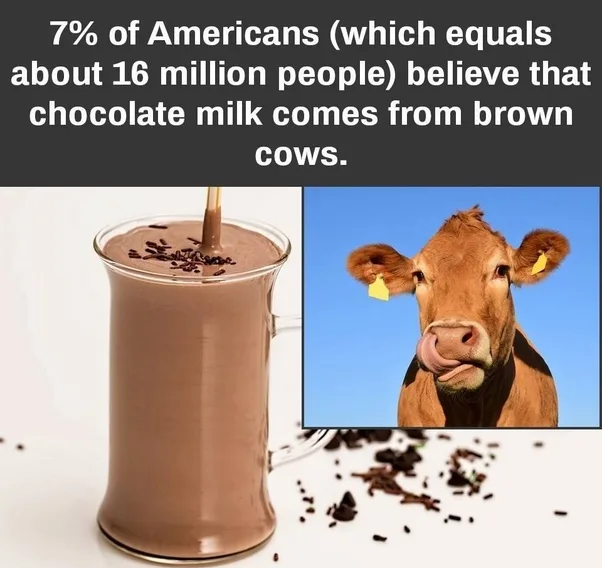
7% of American adults believe chocolate milk comes from brown cows.
Yes. Brown cows.
Before you laugh… ask yourself an uncomfortable question:
How many things do you treat as “obvious” without ever checking?
7% isn’t a “funny number.” It’s a signal.
In 2017, a nationally representative online survey commissioned by the Innovation Center of U.S. Dairy produced a headline-friendly result: 7% of adults linked chocolate milk… to the color of the cow. (The Washington Post)
The media cycle also amplified another figure: 48% said they didn’t know how chocolate milk is made. (Business Insider)
So yes, you can laugh.
But laugh precisely: this is not a milk story.
It’s a story about knowledge, certainty, and false obviousness.
The real danger: “I think I know” beats “I don’t know”
In my book, I draw a line that changes everything:
what we truly know vs. what we believe we know—and the risk of implicit assumptions (chapter 6: the first foundation level: the individual’s lived experience).
Why is it explosive?
Because “I think I know” doesn’t trigger investigation.
It triggers motion: we move forward.
We decide.
We comment.
Sometimes we vote.
We invest.
We hire.
We ship products.
And we fail… confidently.
Why 7% may not be the most interesting question
Several commentators raised a methodological point: without seeing the exact wording, it’s hard to interpret the result cleanly. Some phrasings can confuse respondents or inflate a “buzz” outcome. (Columbia Journalism Review) (University of Florida News) (SAGE Research Methods Community)
Translation:
the scandal isn’t only “people are wrong.”
The scandal is that anyone can be wrong—and the media ecosystem loves numbers that pop.
Even more when they confirm a comforting bias: “other people are ignorant.”
France / Europe: more or less than 7%?
I’m not aware of a widely cited French or European equivalent poll, in mainstream sources, on this exact question.
So I won’t invent a number.
But here’s a useful hypothesis:
the key variable isn’t the country.
It’s the distance between people and the systems that feed them, heal them, inform them… and govern them.
The larger the distance, the more “magical” beliefs thrive:
- “AI truly understands.”
- “Algorithms are neutral.”
- “A KPI equals reality.”
- “A strategy equals truth.”
- “A slide deck equals a decision.”
The brown cow is simply the comedic version of a serious phenomenon: the social production of obviousness.
The antidote: turn certainties into testable hypotheses
In my book, I explain why implicit assumptions are dangerous: they are neither spoken nor tested (chapter 6).
And that’s exactly what high-performing innovative organizations do:
- They detect toxic phrases:
“I think…”, “I’m sure…”, “Everyone knows…” - They turn them into hypotheses.
- They test fast, small, and clean: experimentation over opinion.
- They let reality contradict the meeting room.
Less sexy than certainty.
Infinitely more profitable.
Final twist: mockery is an escape
Mocking the 7% is easy.
But the story isn’t “them.”
It’s: where are your personal brown cows?
In your work. Your routines. Your industry. Your certainties.
Because if you think you have none… you probably haven’t looked.
Question for the comments
Do you think France/Europe would be higher or lower than 7%—and what’s your current professional “brown cow”?



References
(The Washington Post) = https://www.washingtonpost.com/news/wonk/wp/2017/06/15/seven-percent-of-americans-think-chocolate-milk-comes-from-brown-cows-and-thats-not-even-the-scary-part/
(Business Insider) = https://www.businessinsider.com/how-is-chocolate-milk-made-survey-brown-cows-2017-6
(Columbia Journalism Review) = https://www.cjr.org/analysis/brown-milk-study-cows.php
(University of Florida News) = https://archive.news.ufl.edu/articles/2017/07/take-that-chocolate-milk-survey-with-a-grain-of-salt-1.html
(SAGE Research Methods Community) = https://researchmethodscommunity.sagepub.com/blog/chocolate-milk-survey-tells-us-methods