Grenoble, Tuesday, November 24, 2026, 8:30 a.m. Arthur places his phone face down on the executive committee table. He read the news on the train: Nvidia has just brought back Jensen Huang, eleven days after his departure.
Arthur founded his optical sensor company twenty-two years ago. Three hundred and forty employees and customers in aerospace. And a question that kept him from reading anything else for the whole journey: if I disappeared tomorrow, would my teams sign a petition to bring me back? Or would they be relieved?
He hands a blank sheet and a pen to each of the eight committee members.
“You have sixty seconds. Write down the company’s vision.”
The pens hesitate. After a minute, Arthur collects the sheets. Eight answers, eight different visions. Two people wrote a revenue target. One wrote “be the best.” His CFO handed back a blank page.
Arthur smiles, a little sourly. “So the vision is me.”
I have been running this exercise in executive committees for years, and the result often looks like Arthur’s. Vision is a company’s North Star. When that star exists only in the founder’s head, the company flies blind the moment he steps away (My book, chapter 8).

The Nvidia affair raises this tension on a planetary scale. It deserves a close look, without a fan club and without a trial.
Eleven days that shook a giant
On November 12, 2026, Nvidia’s board announced Jensen Huang’s resignation as President, Chief Executive Officer and board member, effective immediately. Colette Kress, CFO since 2013, became interim CEO, and Harvey C. Jones was named the group’s first-ever Chair of the Board (SEC).
The context is heavy. Revelations about intimate relationships, one of them with a woman whom U.S. intelligence officials suspect was recruited by China’s spy agency (NPR). Questions from lawmakers about chip smuggling and the evasion of export controls, with a closed-door hearing scheduled for early December (NPR).
On November 17, during the quarterly earnings call, Harvey Jones shut the door: the board had unanimously accepted the resignation and did not intend to reinstate Jensen Huang (South China Morning Post). A few hours earlier, Jensen Huang had written on X that he would be honored to return if the board judged it to be in the company’s interest (Wccftech).
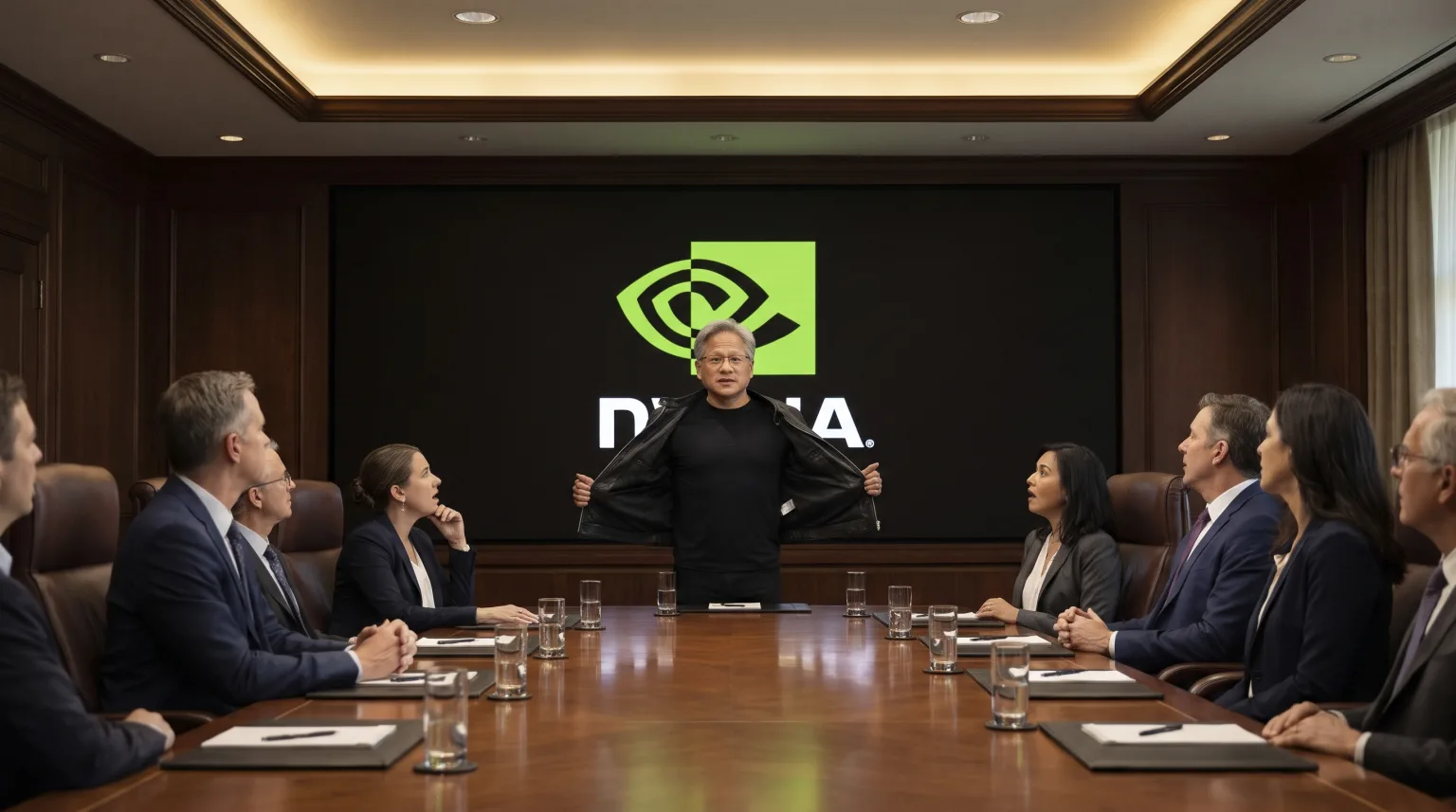
On November 23, a U-turn. The board voted unanimously to reinstate Jensen Huang as President, CEO and board member. It said it was satisfied with his candor and his ability to lead, and stated that, after input from senior levels of the U.S. government, his return poses no national security risk (NVIDIA).
Six days separate “we will not take him back” from “he is the right person.” Eleven days separate the resignation from the return.
What happened in between?
What a founder’s vision buys
Let’s start with the argument of those who wanted him back, because it is solid.
Jensen Huang co-founded Nvidia in 1993 and led it for more than thirty years. He bet on accelerated computing long before artificial intelligence became a boardroom topic. For years, that bet looked like an expensive engineer’s whim. Today, Nvidia chips power most of the data centers that train AI models.
This kind of vision creates a loyalty that org charts cannot manufacture. A petition for his return passed 180,200 signatures, including more than 8,800 people identifying themselves as Nvidia employees and more than 94,000 as shareholders (Finviz). Well-known investors weighed in publicly, and Bill Ackman argued that the board was not acting in shareholders’ interest (The Next Web).
Then there are the internal signals, the ones that don’t lie. To retain its teams, Nvidia brought forward pay rises and new stock grants to December, months ahead of the usual schedule. At an all-hands meeting, the general feeling in the room favored Jensen Huang’s return (The Next Web).
When a company has to pay early to keep its engineers from leaving after one man’s departure, it is measuring in dollars the value of that man’s vision.
I have lived a version of this film. I was at Apple when Steve Jobs returned. Pushed out in 1985, called back in 1997, he gave direction back to a company that had lost it. The teams followed an embodied conviction far more than a strategic plan.
Vision has real pulling power. A leader who sees further than others reduces uncertainty for everyone. Engineers know where the company is going, and customers know what to bet on.
So far, the “indispensable CEO” argument holds.
The price of being indispensable
Now let’s look at the other column of the balance sheet.
Since Jensen Huang admitted to an extramarital affair in early November, Nvidia stock had dropped more than 16% (NPR). At Nvidia’s size, a drop like that is counted in hundreds of billions of dollars of market value, because of one person. Financiers have a name for it: key-person risk. Engineers have another: the single point of failure.
A well-designed system survives the failure of one component. A system that depends on a single component stays fragile, however brilliant that component is.
Then there is governance. A board that states on November 17 that it will not take back its former boss, then takes him back on the 23rd, sends a mixed message. Axios put it bluntly: the campaign to reinstate Jensen Huang tests whether America’s most powerful CEOs can still be held accountable, or whether extraordinary success and political alliances have made them untouchable (Axios). The same article notes that a reinstatement might reflect investor pressure as much as political influence (Axios).
The board took precautions. The independent directors’ committee investigation will proceed to its conclusion, with Jensen Huang’s cooperation. A National Security and Export Control Committee, made up solely of independent directors, oversees these risks, and Nvidia is searching for a new Chief Compliance Officer (NVIDIA). These safeguards matter. They still leave the underlying problem untouched: what can a company that cannot do without one man still do without him?
There is one more bias I often describe in workshops: the halo effect. A spectacular success in one field colors our judgment on everything else. The genius of accelerated computing becomes, in our minds, infallible on everything. Authority bias, which Americans sum up with the acronym “HiPPO,” the highest paid person’s opinion, adds another layer: the more powerful a leader, the less their entourage dares to contradict them (My book, chapter 7).
A very strong vision and a very weak counterweight make a dangerous cocktail. Above all, the Nvidia story shows one thing: nobody had prepared the company to replace him.
A vision that lives in one head is a single point of failure
I am going to debug this case the way you debug a program. Root cause first, fix second.
The symptom: a company wobbles when its founder leaves, its teams threaten to walk, its board changes its mind in six days.
The root cause: the vision was never transferred. It was followed and executed. Nobody shared it to the point where they could carry it alone.
A transferred vision is one that every executive committee member can write down in sixty seconds, in similar words. It produces consistent decisions when the founder is on a plane or in front of a congressional committee. It is clear enough for a successor to defend it without imitating its author.
Arthur understood this as he collected his eight sheets. He can keep all of his vision. He has to move it from personal property to company asset.
The paradox is cruel for founders. The stronger your vision, the harder you must work to make it independent of you. An indispensable leader has left part of the job undone: building an organization able to think its vision without him.
Steve Jobs anticipated this in his own way. Before his death in 2011, he had prepared Tim Cook to succeed him and launched an internal university to pass on the way Apple makes decisions. You can debate the result. The intent was there.
Four questions to ask your committee on Monday morning
If you run a company, a business unit or a team, here is the exercise I suggest.
- The sixty-second test. Ask each member of your committee to write the company’s vision on a sheet, in one minute. Compare. If the answers diverge, your vision lives in your head and nowhere else (My book).
- The absence test. List the decisions made last month. How many would have been made the same way if you had been away? How many would have stalled?
- The challenger test. When did someone last contradict you in a meeting, and what did you change afterward? If you can’t remember, your halo may be silencing your team.
- The successor test. Who could carry your vision tomorrow without betraying it? If the answer is “nobody,” you have built your own key-person risk.
Rate yourself from 0 to 5 on each test. I’m not always at 5 myself.
The essentials
Remember three things:
- A strong vision creates real loyalty and value, and Jensen Huang’s return in eleven days shows it.
- A vision that lives only in the founder’s head turns him into a single point of failure, and the drop of more than 16% in Nvidia’s stock puts a price on it.
- The visionary leader’s job also includes making the vision transferable, so the company can carry it without him.
Being indispensable flatters the ego. Making your vision indispensable to the company, beyond your own person, protects the future. Innovate or agonize, the choice is yours!

References
- (My book) https://philippeboulanger.com/book/
- (NVIDIA) https://nvidianews.nvidia.com/news/nvidia-board-reinstates-jensen-huang-as-president-ceo-and-board-director
- (SEC) https://www.sec.gov/Archives/edgar/data/0001045810/000104581026000082/nvidiaannouncesceotransiti.htm
- (NPR) https://www.nhpr.org/2026-11-17/nvidia-board-says-it-does-not-intend-to-reinstate-jensen-huang-as-ceo
- (South China Morning Post) https://www.scmp.com/tech/article/3374812/nvidia-board-says-it-has-no-plans-reinstate-jensen-huang-ceo
- (Wccftech) https://wccftech.com/i-own-my-mistakes-completely-says-jensen-huang-offering-to-return-as-ceo-if-nvidias-board-deems-fit/
- (Finviz) https://finviz.com/news/423788/nvidia-board-reportedly-rules-out-jensen-huang-return-despite-growing-support-campaign
- (The Next Web) https://thenextweb.com/news/nvidia-pay-rises-december-all-hands-kress-ackman
- (Axios) https://www.axios.com/2026/11/17/jensen-huang-nvidia-ceo-accountability-power