When the Absurd Starts Looking Like an Early Prototype of the Future
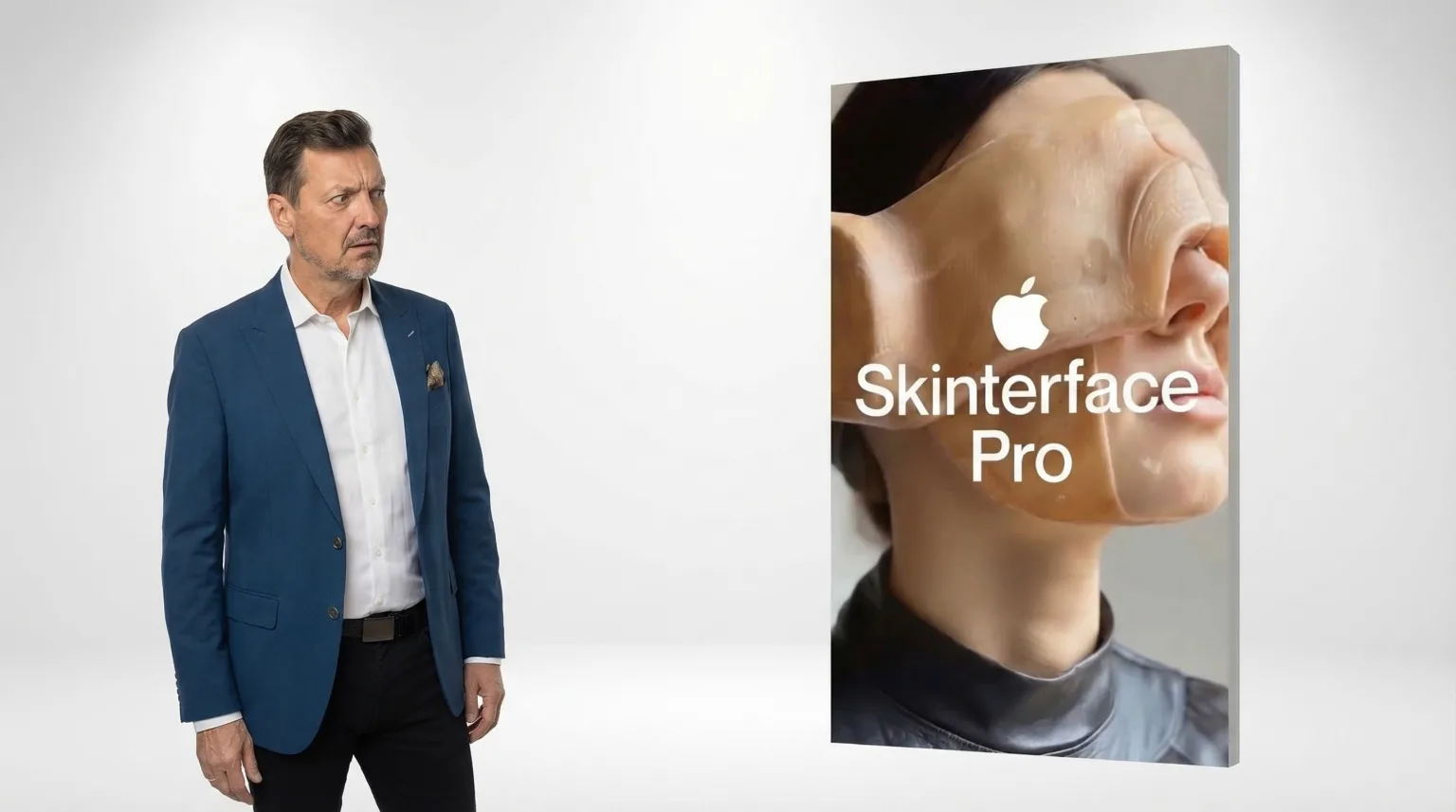
Saturday of the Absurd: “Skinterface Pro” absurd or futuristic in the world of augmentation and transhumanism? Your call.
At first glance, it sounds ridiculous.
An interface on the skin.
A world where we no longer just wear technology.
We stick it onto ourselves.
We almost merge it with our habits.
We slowly erase the line between tool and body.
Put that way, it feels like a joke.
And that is exactly why it matters.
Because “Skinterface Pro” sounds laughable right up to the moment you look at what research labs, engineers and human augmentation thinkers are already building. Then the laugh changes. It does not disappear. It becomes more uneasy.
The absurd is not always the opposite of reality.
Sometimes it is simply reality arriving earlier than our cultural comfort zone.
Skin is no longer just a boundary
For a long time, we treated skin as a limit.
It separated inside from outside.
Biology from technology.
Human from machine.
That boundary is starting to turn into an interaction surface.
Research on drawn-on-skin bioelectronics already shows that flexible devices can be fabricated directly on the skin to sense physiological signals, monitor the body, interact with the wearer and, in some cases, deliver therapeutic responses. Skin is no longer just a covering. It becomes a functional layer. (Nature)
At Stanford, Zhenan Bao’s work has long explored devices inspired by the softness, flexibility and sensing properties of human skin, with a future vision that includes health monitoring, healing support and even enhanced perception. That is not casual sci-fi anymore. That is a technological direction trying to integrate with life instead of sitting outside it. (Stanford)
So yes, “Skinterface Pro” is absurd as a marketing gag.
It is far less absurd as a technological trajectory.
Transhumanism rarely arrives in the form people imagine
When people hear “transhumanism,” many jump straight to blockbuster imagery.
Eyes that see through walls.
Brain chips.
Half-human, half-machine bodies.
That imagery is dramatic. It is also distracting.
In practice, human augmentation often advances through much smaller shifts: wearable sensors, smarter prosthetics, haptic feedback, skin-based interfaces, continuous physiological monitoring, cognitive assistance, performance optimization, functional repair and soft hybridization between bodies and digital systems. The UK government report on human augmentation describes precisely this continuum, from technologies that can already be integrated today to far more transformative possibilities over time. (GOV.UK)
The future does not always begin with a visible revolution.
It often begins with convenience.
Comfort.
Better measurement.
More control.
More personalization.
Less friction.
Then one day, what once looked excessive becomes normal.
That is usually how cultural thresholds move.
The most powerful interface may be the one that almost disappears
The most fascinating point is not the technical performance.
It is the gradual disappearance of the interface itself.
The best technologies often fade into the background.
They become natural.
Nearly invisible.
They reduce friction.
They merge with gestures.
They settle into habits.
Teams such as Cornell’s Hybrid Body Lab are already exploring customized epidermal electronics placed directly on the body to create always-available on-skin interaction. The idea is no longer just to wear a device. The idea is for the body itself to become a continuous access point for information and action. (Cornell)
Wearable haptic interfaces are moving in the same direction. A review published on PubMed Central shows how relevant these systems are becoming for immersive interaction, training, rehabilitation and virtual environments. In 2024, Northwestern also introduced a haptic patch capable of delivering more complex touch sensations through the skin. Once again, the pattern is clear: skin is no longer merely a passive receiver. It is becoming a communication channel between humans and machines. (PMC) (Northwestern)
At that point, “Skinterface Pro” stops being just a joke.
It becomes a believable caricature of a future that is already forming.
And the best caricatures are often the ones that exaggerate only slightly.
The real issue is not technical feasibility. It is cultural acceptance
The key question is not whether we can technically turn skin into an interface.
The key question is how quickly we will accept it once it feels useful.
Because once a technology promises:
more comfort,
better health,
more personalization,
more security,
higher performance,
greater fluidity,
cultural resistance melts fast.
This is where innovation becomes deeply human. Adoption is never just about technical capability. It is about perception, desire, trust, narrative and psychological friction. In my book, I explain that innovation only truly exists when it is implemented, and that biohacking itself follows a logic of vision, methods, experimentation and learning, with a strong individual dimension (my book, chapter 3 and chapter 17).
In other words, transhumanism will not spread first because it looks spectacular.
It will spread every time it feels practical.
Every time it removes pain.
Every time it simplifies effort.
Every time it offers an “improved” version of ourselves without demanding too dramatic an identity shift.
Today’s absurdity is often tomorrow’s cultural prototype
That is why “Skinterface Pro” is such a good Saturday of the Absurd topic.
Because yes, we can laugh at it.
But we can also read it differently:
as a cultural test,
as an imaginary mock-up,
as a revealing exaggeration,
as a way of preparing us for what is coming by first making it look ridiculous.
Yesterday, talking to your phone seemed odd.
Today, it is normal.
Yesterday, wearing your health on your wrist seemed like a gadget.
Today, it is a massive market.
Yesterday, sticking flexible electronics onto skin felt like a lab fantasy.
Today, research is moving quickly and already outlining credible uses in health, interaction and augmentation. (Nature) (Stanford) (Cornell)
So, “Skinterface Pro”?
Absurd, yes.
Futuristic, also.
And that combination is exactly why it deserves attention.
Because the future rarely enters our lives saying, “Hello, I am transhumanism.”
It usually enters with a simpler promise.
“You’ll see. It’s more convenient.”


References
(GOV.UK) = https://www.gov.uk/government/publications/human-augmentation-the-dawn-of-a-new-paradigm
(Nature) = https://www.nature.com/articles/s41528-023-00265-0
(Stanford) = https://baogroup.stanford.edu/news/electronic-skin-and-future-wearable-technology
(Cornell) = https://www.hybridbody.human.cornell.edu/skinlink
(PMC) = https://pmc.ncbi.nlm.nih.gov/articles/PMC9919508/
(Northwestern) = https://news.northwestern.edu/stories/2024/11/new-haptic-patch-transmits-complexity-of-touch-to-the-skin