Your brain may not be “old.” It may be inflamed.
For years, brain aging has been framed as a refined kind of decline. Slower recall. Less mental sharpness. More fog. And that tired verdict delivered as if it were wisdom: “that’s age.”
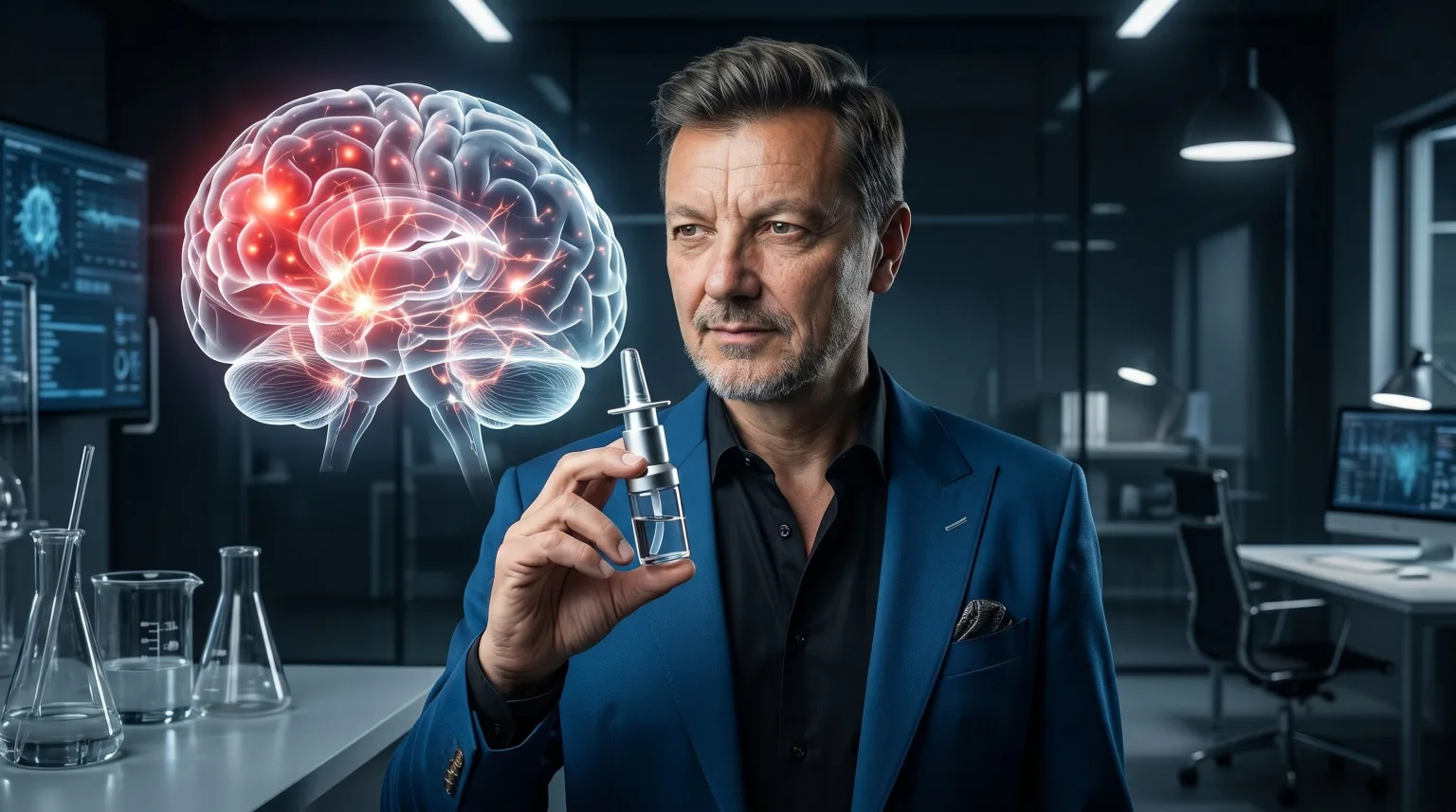
A study highlighted in April 2026 challenges that narrative. Researchers at Texas A&M reported, in preclinical models, that a nasal spray based on extracellular vesicles derived from human neural stem cells reduced brain inflammation, improved mitochondrial function, and restored memory performance. The crucial phrase is this one: in preclinical models. Nothing here proves the same effect in humans. What it does undermine is the lazy assumption that cognitive decline must be passive, linear, and untouchable (Phys.org, Texas A&M University, Journal of Extracellular Vesicles).
The old story of automatic decline is starting to crack
The most interesting signal is not only therapeutic. It is conceptual. If chronic inflammation actively contributes to brain fog, weaker plasticity, and memory fragility, then the aging brain no longer looks like a worn machine that must simply be accepted. It looks more like a dysregulated system loaded with bad signals, and some of those signals may be modifiable. The National Institute on Aging notes that inflammation may increase with age and affect mental function. That sentence looks modest. It is not. It changes the frame (NIA).
In the Texas A&M work, the intranasal route was designed to help the therapy reach the brain more directly and target the hippocampus, a central region for memory. The researchers also reported sustained benefits after only two doses in the tested models. Again, caution matters. Spectacular preclinical results are not clinical proof. Biomedical history is full of brilliant ideas that never translated well into humans. The value of this study is not that it sells a miracle. It forces a rethink of the diagnostic lens (Texas A&M University, EurekAlert!, Journal of Extracellular Vesicles).
The brain does not need a myth. It needs a strategy.
This matters far beyond neurology. It speaks to how we interpret every tired system. A slowing company. A rigid leader. A team convinced it has tried everything. An individual mistaking temporary decline for irreversible destiny.
This is where innovation becomes a mental discipline. The dominant reflex is to sanctify the current state. The system is struggling, so struggling must be normal. Yet many real breakthroughs begin with a simpler move: refusing to confuse habit with fate.
In my book, chapter 17, I explain that biohacking draws from innovational intelligence through vision, methods, experimentation, and learning. I also stress that exercise, nutrition, and sleep are among the variables we can actively influence, and that measurement is part of the process . That logic fits this new research remarkably well: cognitive longevity is becoming a serious experimental field, not a lifestyle slogan.
Aging better starts with measuring better
The big misunderstanding of our time is simple: many people want optimization before observation. They want the promise without the method. The supplement, the gadget, the protocol, without examining the basics: sleep, physical activity, metabolic inflammation, routine stability, mental load, and recovery.
The World Health Organization estimates that more than 55 million people live with dementia worldwide and that this number could reach 139 million by 2050. As the scale rises, it becomes absurd to treat cognitive health as a cosmetic side topic (WHO).
WHO has also issued guidelines on reducing the risk of cognitive decline and dementia. They are not built on magic. They are built on concrete health and behavior levers. In other words, long before any future therapy reaches clinics, there is already a serious field of action for people who want to protect their cognitive capital (WHO, NIA).
Useful innovation often starts with a better diagnosis
For too long, we have been asking the wrong questions. How do we accept decline? How do we compensate? How do we soften the damage?
A more useful question is this: what have we misdiagnosed?
When a brain appears to be aging, there may indeed be wear. There may also be inflammation, impaired cellular energy, poor sleep quality, metabolic dysregulation, under-stimulation, chronic overload, or some combination of them. That is why this study matters beyond biology. It reminds us that a massive symptom can sit on top of a lazy diagnosis.
Organizations make the same mistake. They label something “resistance to change” when it may be broken organizational design. They call it “lack of talent” when it may be low psychological safety. They talk about “fatigue” where they should be talking about structural inflammation. That is why this publication works as a high-level management metaphor too.
Cognitive longevity is becoming a strategic territory
The sharpest players will understand something early: performance will not depend only on raw skill. It will depend on the ability to preserve a clear, adaptive, energetic brain that can learn fast and recover well.
The future will not belong only to those who work more. It will belong more to those who protect their nervous system better, reduce inflammatory noise, reinforce plasticity, and manage cognitive hygiene with discipline.
There is a shift here similar to what happened with sleep. For years, sleep looked soft, secondary, optional. It is now discussed as a performance, health, and leadership issue. Cognitive longevity will likely follow the same path because it touches memory, judgment, creativity, and execution. This is an inference based on demographic aging, cognitive health trends, and current research, not a verified prediction.
Think, measure, adjust
What this breakthrough suggests is ultimately simple.
A tired system is not always a finished system.
A slower brain is not automatically a condemned brain.
A performance drop is not an identity.
A habit is not a law of nature.
In the tested models, a nasal spray reduced inflammatory disruption and restored functions associated with memory. In humans, enormous work still remains before any therapeutic conclusion can be made. Yet the strategic message is already visible: decline should no longer be treated as decorative fatalism. It should be treated as a problem worth exploring with method (Phys.org, Texas A&M University, Journal of Extracellular Vesicles).
And that is where things become truly interesting.
The brain does not need to be romanticized.
It needs to be understood, measured, protected, and finally treated as a true field of innovation.
References
- (Phys.org) = https://phys.org/news/2026-04-nasal-spray-rewinds-aging-brain.html
- (Texas A&M University) = https://stories.tamu.edu/news/2026/04/14/scientists-reverse-brain-aging-with-a-nasal-spray/
- (Journal of Extracellular Vesicles) = https://doi.org/10.1002/jev2.70232
- (National Institute on Aging) = https://www.nia.nih.gov/health/brain-health/how-aging-brain-affects-thinking
- (World Health Organization) = https://www.who.int/news/item/02-09-2021-world-failing-to-address-dementia-challenge
- (World Health Organization) = https://www.who.int/publications-detail-redirect/risk-reduction-of-cognitive-decline-and-dementia