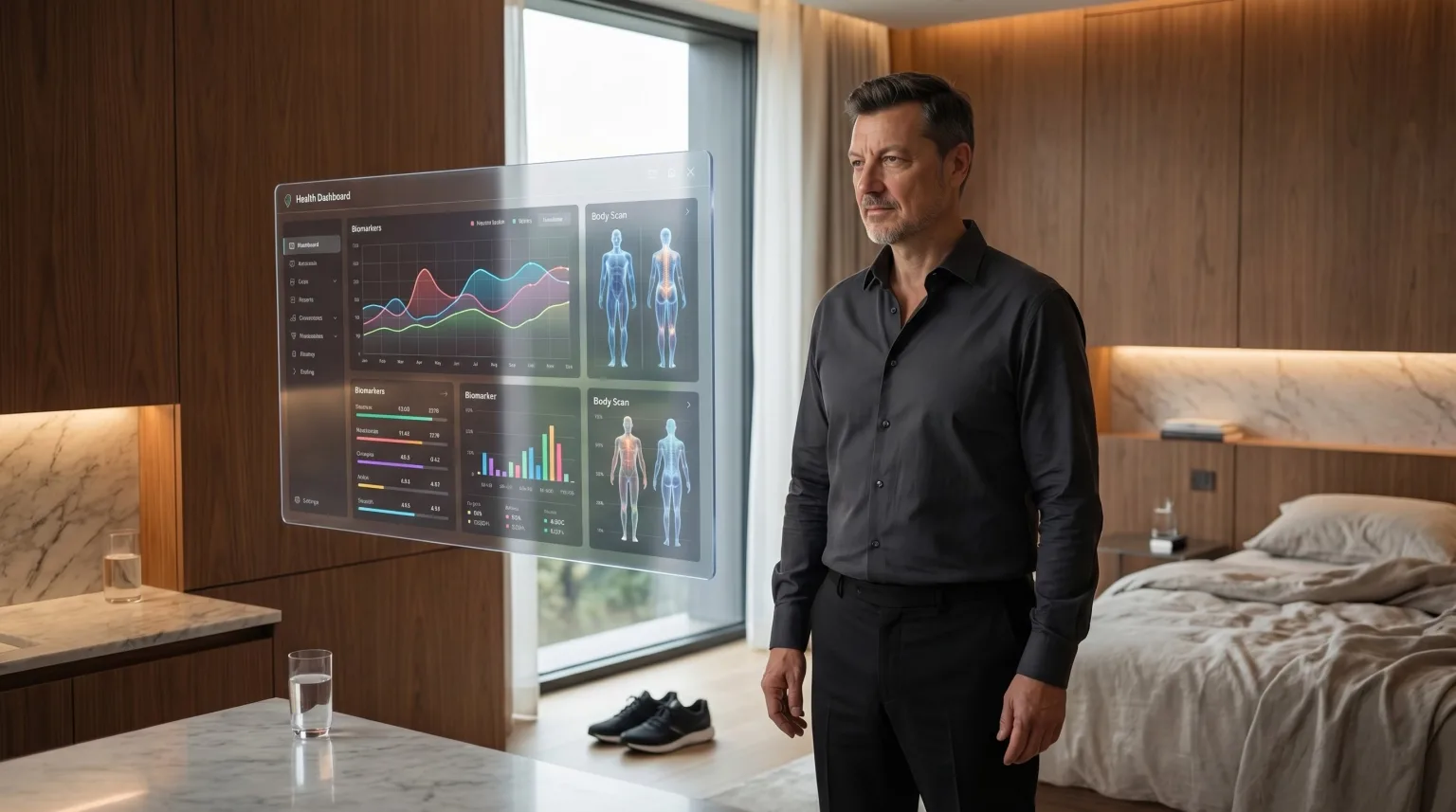
Premium longevity reveals something intimate about our era
The wealthy used to collect rare watches.
Now they collect whole-body MRIs, oversized blood panels, sensors, biomarkers, longevity clinic stays, optimisation protocols and promises of cellular rejuvenation.
That shift is fascinating.
It says far more than consumer preference.
It tells us that our era no longer wants only to treat disease. It wants to delay wear. It wants to monitor decline. It wants to manage the body like a strategic asset.
The market understood this perfectly.
Longevity clinics are multiplying, with offers built around imaging, advanced biomarkers, recurring memberships and premium experiences. An industry report published in early April 2026 describes a market structured around imaging-led offerings such as whole-body MRI, DEXA, VO2 max testing and advanced biomarker baselining, heavily concentrated in affluent urban centres (Future Market Insights).
The cultural signal is enormous.
When a society starts selling lifespan extension as a premium product, it reveals four obsessions at once: fear of decline, desire for control, status display and performance seeking.
The problem starts when the décor outruns the mechanism
The subject becomes slippery when sophistication is confused with lucidity.
Many people want the futuristic clinic before discipline.
The protocol before hygiene.
The supplement before sleep.
The machine before movement.
The promise before proof.
Yet the scientific literature remains cautious on several pillars of this booming market. A 2024 narrative review on whole-body MRI in average-risk populations highlighted both potential strengths and serious limitations, including insufficient robust evidence of net benefit, incidental findings, downstream testing and overdiagnosis (PubMed). Another review available through PubMed Central had already stated that, based on current evidence, whole-body MRI should not be offered for preventive screening to asymptomatic individuals outside a research setting (PMC).
Clinical voices echo the same caution. Michigan Medicine notes that most radiologists would not recommend whole-body MRI without symptoms, medical history or specific genetic risk, precisely because the benefit-risk balance remains uncertain for the general population (Michigan Medicine). Time captured the ambivalence well in 2025: such scans can occasionally catch something serious early, but they can also trigger cascades of anxiety, false positives and expensive follow-up procedures (Time).
In other words, premium longevity seduces because it creates the feeling of action.
But doing a lot is not the same as doing the right thing.
The body becomes a dashboard, and that changes our imagination
The deepest shift is not even medical.
It is symbolic.
The body leaves the realm of fate and enters the realm of management.
We want curves.
We want scores.
We want biological ages.
We want something visible that can be adjusted.
That desire for measurement is not absurd. It can even be valuable when it helps people understand sleep, recovery, glucose response, fitness or mental load. The trap appears when measurement becomes a religion and the metric replaces systemic intelligence.
In my book, chapter 17, I explain that biohacking is inspired by innovational intelligence: vision, methods, experimentation and learning. I also stress that the three parameters we can directly control are exercise, nutrition and sleep.
That may be the decisive distinction.
The most lucid people are not looking for a magic potion.
They build a system.
They observe.
They experiment.
They correct.
They begin again.
They know a sensor has value only if it produces a better decision.
They know a health panel matters only if it leads to sustainable action.
They know a clinic can accelerate awareness, but never replaces the foundation.
The real luxury may not be a longer life
The real luxury may be something else.
Remaining mobile.
Remaining energetic.
Remaining clear-minded.
Remaining capable of learning, loving, creating, deciding and acting intensely.
The kind of longevity that interests me is not a stockpile of abstract extra years. It is density of presence. Quality of function. A power of life that does not collapse too early under the weight of inertia, sedentariness, sugar, poor sleep, chronic stress and denial.
This also explains why longevity merchants thrive.
They understand one simple thing: almost everyone wants more years, but far fewer people are willing to change what is already stealing their energy today.
Booking a premium MRI is spectacular.
Sleeping properly is much less so.
Showing off advanced biomarkers looks impressive.
Walking twenty minutes after a meal looks ordinary.
Posting from a Swiss clinic sends a status signal.
Reducing excess, training regularly, protecting sleep and reducing sugar dependence mostly produce results, not prestige.
And yet your chapter 17 points exactly there: biohacking experiments matter only if they teach us what works for us individually, with direct effects on physical health, motivation, concentration and performance.
The longevity market also sells an emotion
It sells hope, of course.
It also sells an imaginary negotiation with the inevitable.
Buy more time.
More precisely, buy the feeling that you are no longer merely subjected to time.
Buy the sensation of taking control back.
This is where the topic becomes almost philosophical.
Traditional medicine promises diagnosis, treatment and repair.
The premium longevity industry promises something else: pushing back the moment when the body reminds you it has an end.
That promise fascinates because it touches a territory very few markets dare to address directly: death is not just a biological outcome, it is the deepest psychological blind spot of the modern consumer.
So the fear gets dressed in more elegant language.
Prevention.
Optimisation.
Regeneration.
Vitality.
Performance.
These words are not empty. They sometimes refer to useful realities. But they also help make an ancient anxiety look sophisticated.
A compelling industry, provided we ask the right questions
I am not caricaturing this market.
It contains serious work, real research, useful tools, demanding practitioners and concrete learning.
Le Figaro recently highlighted the growing business around lifespan extension through cellular reprogramming, full health workups and specialised clinics (Le Figaro). A few days earlier, Madame Figaro noted that cellular reprogramming inspired by Yamanaka factors opens real laboratory perspectives, but that in practice we are still mostly talking about slowing mechanisms and restoring function, not magically reversing human aging (Madame Figaro).
So the problem is not that the market exists.
The problem appears when the commercial story runs faster than the evidence, and when the prestige of the offer replaces the effort of discernment.
One simple question restores order: does this protocol truly improve my health, or does it mostly feed my need to feel exceptionally well managed?
The distance between those two outcomes is immense.
Aging better rarely begins in a white coat
Aging better usually begins long before the clinic.
In invisible consistency.
In repeated choices.
In the way one eats, sleeps, moves, recovers, limits excess and builds an environment that supports vitality instead of draining it.
Everything else can help.
Everything else can refine.
Everything else can alert.
Everything else can sometimes save.
But none of it replaces the foundation.
Longevity is therefore far more than a future market.
It is a mirror.
It reflects our relationship to time, the body, comfort, fear and discipline.
The smartest people do not buy tests alone.
They buy clarity.
Then they accept what that clarity requires.
That is less glamorous.
It is also much more serious.


References
(Le Figaro) = https://www.lefigaro.fr/conjoncture/reprogrammation-cellulaire-bilan-de-sante-complet-cliniques-specialisees-le-juteux-business-de-l-allongement-de-la-duree-de-vie-20260412
(Madame Figaro) = https://madame.lefigaro.fr/beaute/peut-on-inverser-le-vieillissement-des-cellules-20260406
(PubMed) = https://pubmed.ncbi.nlm.nih.gov/41792025/
(PMC) = https://pmc.ncbi.nlm.nih.gov/articles/PMC6850647/
(Michigan Medicine) = https://www.michiganmedicine.org/health-lab/whole-body-mris-arent-beneficial-they-seem
(Time) = https://time.com/7275819/should-you-get-full-body-mri-scan/
(Future Market Insights) = https://www.futuremarketinsights.com/reports/longevity-clinic-chain-infrastructure-market