Your car isn’t the target. Your key is.
That’s the uncomfortable twist of modern innovation: the more a technology removes friction from your life, the more it can become an entry point for people who monetize the opposite.
The most ordinary scenario (and that’s exactly the problem)
You park on the street.
You go to a restaurant.
The car locks when you walk away. It unlocks when you come back. You don’t even take the key out anymore.
It feels like magic. It’s called Keyless.
But the “relay attack” is designed to exploit that convenience (PassionAndCar).
In simple terms:
- One device gets close to the key (close to you: street, restaurant, lobby, terrace).
- Another device stays close to the car.
- The devices extend the signal: the car “believes” the key is nearby even when it’s tens of meters away (RAC).
The result: 35 cars tested, 18 unlocked/started, i.e., 51% (PassionAndCar).
However, the relay-attack mechanism is widely documented by recognized organizations and media: it’s a known risk for keyless systems (Thatcham Research) (AP News) (ADAC) (RAC).
The blind spot: friction was removed… and so was a barrier
In my book, Chapter 7 — “The second foundation level: the team’s lived experience”, I use a simple equation: success = desire – friction P001-304-9782100876556_ep05 – f….
Keyless is a perfect illustration:
- Desire: it’s smooth, premium, effortless.
- Friction: you stop thinking about locking/unlocking.
But sometimes, removing friction also removes a behavioral security barrier.
The “restaurant” case: how to protect the key when it’s on you
The best on-the-ground defense is to stop your key from emitting/responding.
Common recommendations from credible sources:
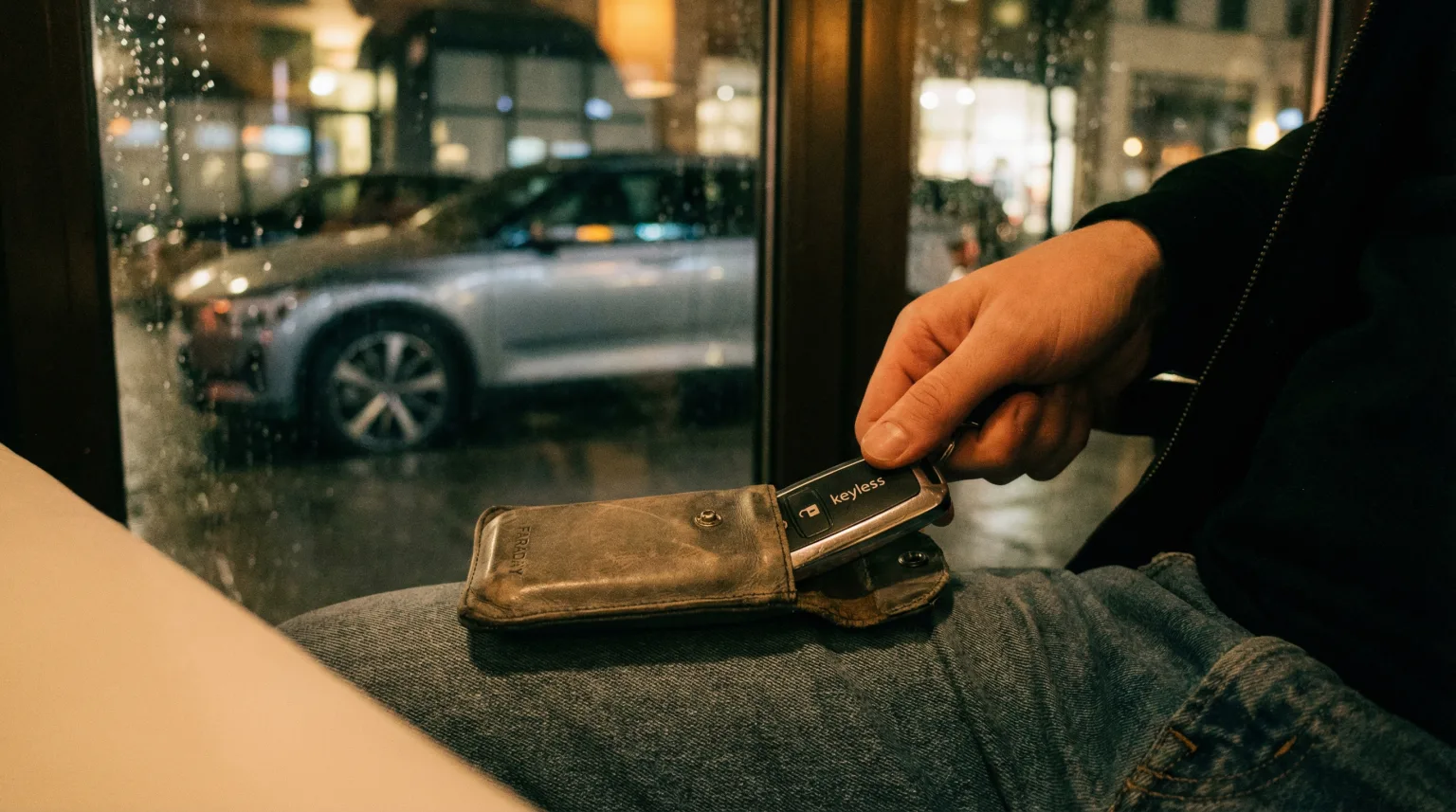
- Use a Faraday pouch/box
A Faraday pouch blocks the key fob’s radio signals, reducing the value of a relay attack (Thatcham Research) (RACV) (AP News).
Restaurant-friendly routine:
- Keep the key on you, inside the Faraday pouch, throughout the meal.
- Avoid leaving it on the table, window ledge, or in a bag that’s easy to approach.
- Avoid easy-to-approach placements
- Key on a table near a window.
- Bag on a chair facing the street.
- Coat behind you with the key in an accessible pocket.
The goal is to make any approach to your key socially visible and therefore risky for an attacker.
- Disable passive features if your vehicle allows it
Some vehicles allow disabling passive entry, enabling “sleep mode,” or turning keyless off temporarily (Thatcham Research) (AP News).
The “at home” case: the routine that can cost you
Common relay scenarios happen at home: the key is near the front door, the car is close to the house.
Frequent advice:
- Keep keys away from doors/windows (Thatcham Research) (RAC).
- Store keys (including spares) in a Faraday pouch/box (Thatcham Research) (RACV).
- Add visible physical deterrents (steering wheel lock, etc.) (AP News).
“No forced entry”: why insurance can become complicated (contract-dependent)
Many electronic thefts leave few visible signs (no broken windows, no forced lock).
That can sometimes trigger disputes if insurers suspect negligence, exclusions, or “key left nearby” scenarios. The Financial Ombudsman Service outlines typical reasons for claim rejections or disputes in vehicle theft cases (Financial Ombudsman Service).
The real question: what security micro-frictions did you remove without noticing?
Keyless isn’t “evil.” It’s a symptom of a bigger pattern:
We turn safety gestures into “unnecessary details”… until those details were the last lock.
So here’s the question:
Which “security micro-frictions” have you removed—personally or in your products—before paying the price?



References
(PassionAndCar) = https://www.passionandcar.fr/2026/02/11/keyless-la-porte-ouverte-aux-voleurs-1-voiture-sur-2-laisse-demarrer-un-inconnu-avec-un-simple-relais/
(Thatcham Research) = https://www.thatcham.org/how-can-you-increase-your-car-security/
(ADAC) = https://www.adac.de/rund-ums-fahrzeug/ausstattung-technik-zubehoer/assistenzsysteme/keyless/
(RAC) = https://www.rac.co.uk/drive/advice/road-safety/car-security/
(RACV) = https://www.racv.com.au/royalauto/transport/car-safety-security/what-is-a-faraday-bag-used-for.html
(AP News) = https://apnews.com/article/4c015a9f16b1ff01de6250332a34226e
(Financial Ombudsman Service) = https://www.financial-ombudsman.org.uk/consumers/complaints-can-help/insurance/motor-insurance/vehicle-theft