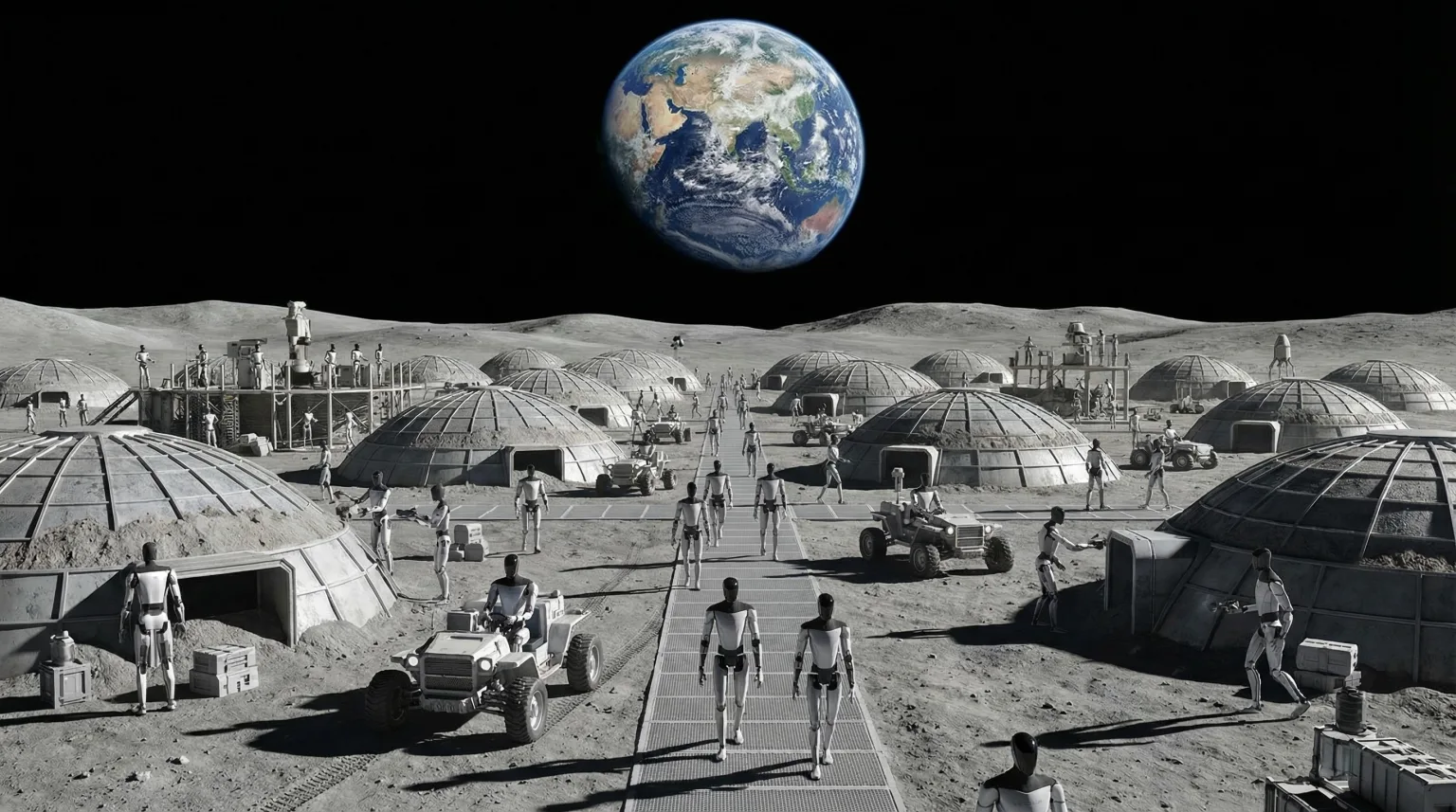
He changed planets the way he changes T-shirts. Or the mother of his children. Yes, I’m talking about Elon Musk.
Some leaders pivot because they learn.
Others pivot because the previous story is starting to get expensive.
This piece isn’t judging ambition. It’s dissecting the mechanism.
Because Musk has become the most visible symbol of something bigger than Musk: the show-pivot.
A pivot that looks like an announcement.
An announcement that looks like a promise.
A promise that sometimes helps people forget the previous one.
Pivot #1: yesterday Mars, today the Moon
For years, the trajectory sounded simple: Mars.
A perfect destination: distant, mythical, total. It pulls everything in—talent, capital, attention.
Then the poster changed: the Moon.
The interesting question isn’t “Moon vs Mars.”
It’s how quickly a public “vision” can be reconfigured—without demanding proof—when the packaging is compelling enough.
According to (Reuters), Musk now says SpaceX is prioritizing a “self-growing city” on the Moon before Mars.
And (Space.com) highlights how this contrasts with his earlier statements, when he described the Moon as a “distraction.”
That shift exposes a simple rule: the farther the promise, the more flexible it becomes.
Mars is so distant that almost any timeline can be projected onto it.
The Moon, being closer, enables a different argument: iterate faster, run more attempts, “industrialize exploration.”
All of this can be rational.
But it can also serve to reset the conversation.
Pivot #2: Tesla was supposed to “reinvent the car”… but robots take center stage
Tesla was meant to remain a measurable story: production, deliveries, margins, quality, industrial cadence.
Cars are unforgiving: you must ship, maintain, repair, recall, and compete.
A humanoid robot, by contrast, is a perfect promise.
It’s cinematic.
It’s visual.
It’s always “soon.”
And—crucially—it lives in a space where “delays” can be framed as normal, because the claim isn’t incremental—it’s foundational.
Tesla itself describes Optimus as a general-purpose, bipedal, autonomous humanoid robot meant to do “unsafe, repetitive, or boring” tasks (Tesla).
And Tesla explicitly frames a future built on autonomous vehicles and robots (Tesla).
Again: the issue isn’t whether the robot is a good idea.
The issue is whether it’s being positioned as a product—or as a narrative.
Products demand brutal questions:
- What capabilities, exactly?
- In which real environments?
- What total cost?
- What credible timeline?
- Who is liable in case of accidents?
- When does it become industrial?
Narratives invite emotional reactions:
- “That’s the future.”
- “It’s inevitable.”
- “They’ll figure it out.”
In the attention economy, narratives often beat products.
The real problem: pivoting like a magician
The problem isn’t pivoting.
The problem is pivoting like a magician: redirecting attention precisely when technical reality catches up with past promises.
🎩 “Look at the new planet.”
✨ “Look at the new promise.”
🔦 “Look at the future.”
Meanwhile, the present becomes blurry.
A grown-up pivot: stable vision, tested strategy, experiments that decide
A healthy pivot looks like a learning organization:
- a vision that barely moves (the compass),
- a strategy tested against reality (the method),
- experiments that decide (the proof), not slogans.
In my book, Chapter 8 — “The vision, mission and strategy pillar” (section “Strategy”), I write:
“Vision rarely changes, but strategy can be tested through various experiments to adapt to increasingly rapid market evolution.”
That sentence imposes discipline: strategy isn’t a declaration.
It’s a testable hypothesis.
What this says about our era: proof retreats, mythology advances
We’re living in a time when:
- proof is valued less,
- storytelling is valued more.
Roadmaps get funded less,
mythologies get funded more.
Because mythologies:
- attract talent that wants to “join the story,”
- tolerate uncertainty without immediate metrics,
- manufacture patience,
- turn delays into “normal stages.”
This isn’t always cynical. Sometimes it’s structural.
But it’s risky:
- for teams (priority whiplash),
- for markets (trust shifts from delivery to narration),
- for innovation culture (audacity becomes confused with announcements).
The anti-smoke method: pivot in 5 steps
Hypothesis → experiment → learning → pivot decision → communication
- Hypothesis (testable)
- Experiment (designed to contradict you)
- Learning (what was decided, not what was attempted)
- Pivot decision (what you stop)
- Communication (belief → test → learning → change)
Three questions to detect a “smoke” pivot
- What are you stopping?
- What do you know now that you didn’t know before?
- Which experiment made the old plan obsolete?
Conclusion
Musk isn’t just a case study. He’s a mirror.
The question isn’t “who is right?”
It’s: how do you pivot—with data, or with smoke?
And in your company, do you mostly see “data pivots” or “smoke pivots”?


References
(Reuters) = https://www.reuters.com/science/musk-says-spacex-prioritise-building-self-growing-city-moon-2026-02-08/
(NASA) = https://www.nasa.gov/humans-in-space/artemis/
(NASA) = https://www.nasa.gov/news-release/as-artemis-moves-forward-nasa-picks-spacex-to-land-next-americans-on-moon/
(Tesla) = https://www.tesla.com/AI
(Tesla) = https://www.tesla.com/en_in/we-robot
(Space.com) = https://www.space.com/astronomy/moon/a-city-on-the-moon-why-spacex-shifted-its-focus-away-from-mars
(X) = https://x.com/elonmusk/status/1875023335891026324