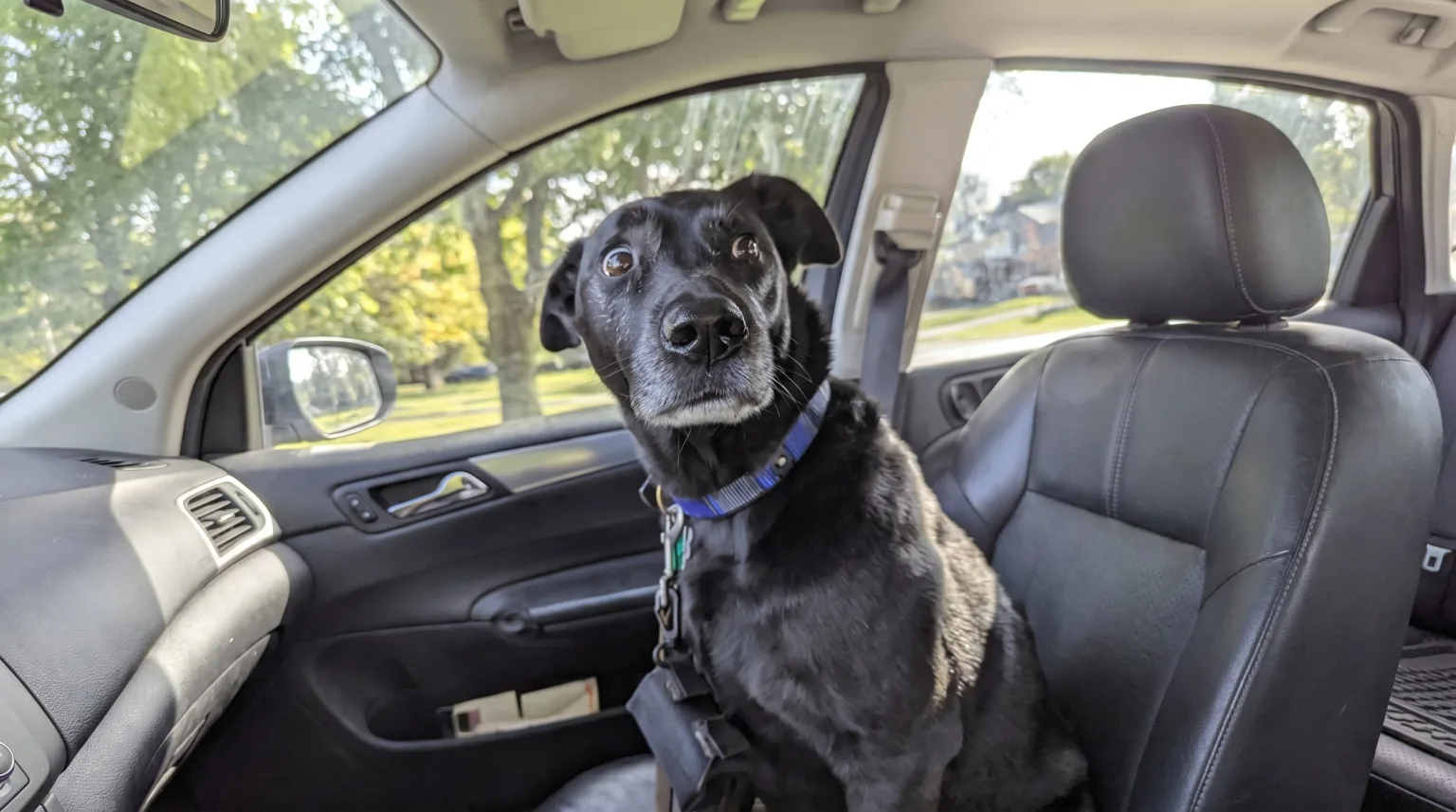
The collar selling a comfortable impossibility
A connected collar claims it can turn barks and meows into human sentences.
“I’m hungry.”
“I’m stressed.”
“I want to play with you.”
Admit it: it is irresistible.
Because deep down, we do not only want to understand our animals. We want reassurance.
We want to know whether our dog truly loves us. Whether our cat ignores us out of contempt or strategic genius. Whether that look fixed on us means tenderness, fatigue, or silent judgment of our career choices.
PettiChat presents itself as the “world’s first real-time pet translator.” Its website promises to help us understand what our furry companions are trying to tell us. The official announcement describes a 27-gram device, a 1.2-second response time, a model trained on over one million vocal and behavioral samples, and a claimed accuracy rate of 94.6%. (PettiChat) (PR Newswire)
Very impressive.
Except the public promise looks less like translation and more like algorithmic interpretation.
And that difference is huge.
Translation or interpretation?
Translation implies a structured language.
It requires stable units, rules, grammar, a shared system. When I translate a French sentence into English, I can debate nuance, tone, and context, but I am working with two human languages.
A dog does not bark in French.
A cat does not meow in English.
An animal expresses states, probable intentions, reactions, tensions, comfort or discomfort signals. Its communication is vocal, bodily, olfactory, contextual, relational.
This is exactly what researchers interviewed by TF1 Info emphasize: animal communication is multimodal, and micro-behaviors, gaze, ear movements, motion, and context matter as much as sound. The article also reports that the company does not publicly provide the scientific work that is supposed to validate its translation accuracy. (TF1 Info)
Science is moving forward, of course.
Recent research shows that automatic analysis of dog barks can help classify identity, breed, age, sex, and the context associated with a bark. But the authors also state that their method is not ready for operational ethological use. In other words: we are making progress in signal classification. We do not have a universal dog-to-human dictionary. (PubMed)
With cats, the situation is just as fascinating. A study published in Applied Animal Behaviour Science shows that human-directed meows vary depending on physical context, with differences in duration, fundamental frequency, and intonation. The authors suggest this variation may reflect emotional or mental states, while calling for further research to confirm it. (ScienceDirect)
Another exploratory study indicates that humans are generally poor at classifying meows by context, although some owners perform better with their own cat than with an unfamiliar one. (AGRIS / FAO)
That is the core point: it is plausible for AI to detect some probable states. It is much more fragile to claim it translates a sentence.
“Your dog seems alert” has nothing to do with “the mailman is coming, I shall defend the family territory with courage.”
The first formulation is a useful hypothesis.
The second is a human script projected onto an animal.
Marketing loves certainty
PettiChat is interesting because it combines several elements that create an impression of seriousness: AI, specialized model, massive data, adaptive learning, real time, precise percentage, mobile interface, emotional promise.
A nearly perfect marketing cocktail.
A number like 94.6% has hypnotic power. 95% looks rounded. 94.6% looks scientific. It creates the impression that a solid protocol sits behind the decimal point.
Maybe that protocol exists.
I cannot verify it from the public materials reviewed.
And as long as the independent methodology is not available, the number should be treated as a commercial claim, not scientific proof.
Frandroid makes the reservation very clear: PettiChat announces 94.6% precision, but without an independent study, published methodology, or accessible peer-review process to validate the number. (Frandroid)
The issue goes far beyond PettiChat.
We are entering a phase where many AI products will sell a form of psychological certainty. They will not only say: “Here is a probability.” They will say: “Here is what you should believe.”
AI then becomes less a tool for understanding and more a dispenser of mental comfort.
The real market: anxious humans
PettiChat is fascinating because it officially targets animals, but speaks deeply to humans.
The apparent market is dogs and cats.
The real market is anxious owners.
The person who worries about leaving their dog alone for too long.
The person wondering whether their cat is suffering, bored, or judging them.
The person dreaming of proof that the love they give is truly received.
The person who wants to turn a living, ambiguous, unpredictable relationship into a readable dashboard.
This is where the object reveals our age.
We already have watches translating our sleep into scores.
Apps translating our emotions into curves.
Platforms translating our popularity into engagement.
AI systems translating our uncertainty into polished answers.
It was only logical that we would eventually want to translate our animals’ silence into reassuring sentences.
The most profitable innovation is not always the one that solves an objective problem. Sometimes it dresses an ancient anxiety in a shiny interface.
Here, the anxiety is simple: “I live with a being I love, but I do not really know what it feels.”
The collar answers that anxiety with a powerful message: “Do not worry anymore, AI will tell you.”
Understanding is not controlling
In my system of innovational intelligence®, innovation always begins with the lived experience of the individual: emotions, biases, fears, beliefs. PettiChat is fascinating because it presses exactly there. On our need for certainty. On our fear of loving badly. On our desire to transform the living into a dashboard. (my book, chapter 6)
The danger is not the collar.
The danger is confusing understanding with control.
Observing an animal requires patience. You need to know its habits, rhythms, signals, environment, history, and relationship with each member of the household.
AI can become a tool for attention if it helps detect weak signals: unusual stress, behavioral variation, abnormal vocalization, reduced activity, routine disruption.
In that case, it increases our vigilance.
But if it turns a meow into a definitive sentence, it may put our attention to sleep.
We no longer look at the animal.
We look at the app.
We no longer learn to observe.
We wait for a sentence.
That shift is subtle, but major.
The animal as a mirror of our loneliness
The relationship with companion animals is deeply connected to social connection. A research brief on pets and loneliness indicates that many individuals form high-quality attachments with their pets, and that these relationships may act as a source of attachment or as a social catalyst, while emphasizing that effects depend on context, relationship quality, and pet type. (Social Connection Guidelines)
This is exactly where PettiChat’s promise becomes culturally interesting.
It does not only sell translation.
It sells a presence that answers.
It sells the fantasy of a clarified bond.
It sells the idea that love could finally be measured, confirmed, textual, stored in an app.
In its official communication, PettiChat even mentions conversation history, so owners do not miss any “precious moment.” (PR Newswire)
What a fascinating time.
We no longer only want to live a moment with our animal.
We want to store it.
Read it again.
Verify it.
Turn it into evidence.
Two angles to understand this innovation
There are two ways to look at PettiChat.
The first is technological: can AI truly translate a dog or a cat?
At this stage, based on the public information available, the answer must remain cautious. AI can probably help classify certain signals. It may detect probable states. It may become a useful behavioral monitoring tool, especially if validated seriously.
But reliable translation into human sentences remains a very fragile promise.
The second angle is human: why do we want it to be true so badly?
This is where the product becomes compelling.
Because it reveals less about the future of animal communication than about our contemporary relationship with uncertainty.
We tolerate ambiguity less and less.
We want to measure everything.
Interpret everything.
Optimize everything.
Even the love of a dog.
Even the supposed contempt of a cat.
Even the mystery of a silent look from the end of the sofa.
Good innovation increases attention
Good innovation does not replace relational intelligence. It increases it.
It does not say: “Stop observing.”
It says: “Observe better.”
It does not say: “Here is the truth.”
It says: “Here is a signal to interpret carefully.”
It does not say: “Your dog thinks exactly this.”
It says: “Something has changed, look.”
That is probably the most relevant use for this kind of technology: not translating, but alerting. Not speaking on behalf of the animal, but inviting the human to listen better.
The difference seems small.
It changes everything.
Because healthy innovation makes us more present to the world.
Lazy innovation sells us comfortable certainty instead of patient learning.
Illusion will always be easier to sell than attention
PettiChat’s promise works because it is emotionally perfect.
It activates tenderness.
It flatters curiosity.
It relieves guilt.
It turns the animal into a readable interlocutor.
It revives an ancient idea: what if the living could finally answer us in our language?
But the living does not necessarily owe us sentences.
Sometimes, it only asks us to look.
To listen.
To wait.
To understand over time.
Innovation becomes interesting when it respects that slowness.
It becomes worrying when it claims to abolish it.
👉 Would you pay for AI to give you the illusion of understanding your animal instead of learning to truly observe it?
Of course, I address this type of overpackaged technological promise in my keynotes, workshops, and advisory work.


References
- (PettiChat) = https://pettichat.com
- (PR Newswire) = https://www.prnewswire.com/news-releases/pettichat-launches-worlds-first-real-time-pet-translator-on-kickstarter-start-a-real-conversation-with-your-pet-302741920.html
- (TF1 Info) = https://www.tf1info.fr/high-tech/verif-un-collier-connecte-a-une-ia-promet-de-traduire-ce-que-dit-votre-chien-ou-votre-chat-innovation-majeure-ou-duperie-2444253.html
- (Frandroid) = https://www.frandroid.com/produits-android/3110697_un-collier-ia-pour-traduire-votre-chien-a-946-ce-quen-dit-la-science
- (PubMed) = https://pubmed.ncbi.nlm.nih.gov/38648990/
- (ScienceDirect) = https://www.sciencedirect.com/science/article/pii/S0168159123003180
- (AGRIS / FAO) = https://agris.fao.org/search/en/providers/122535/records/65de2c880f3e94b9e5cb73a3
- (Social Connection Guidelines) = https://www.socialconnectionguidelines.org/en/evidence-briefs/do-pets-help-with-loneliness